There's a new poll out today that has a bit of something for everyone - republican-minded Yessers are delighted that it shows only a minority of the Scottish public are in favour of retaining the monarchy, whereas the unionist side are claiming it shows opposition to independence. You won't be surprised to hear, though, that not everything is quite as it seems.
First things first: this is not an independence poll. If you want to know whether people think Scotland should be an independent country, you ask "Should Scotland be an independent country?", or use very similar wording. If you turn the question on its head and ask whether Scotland should remain part of the United Kingdom, you tend to get a slightly different result. That may seem inexplicable, but there are lots of people in the middle who aren't really that bothered one way or the other, and who have a different instinctive reaction depending on how the question is framed. What makes this poll even less meaningful is that it isn't even about Scotland specifically - it asks about whether the union of four nations should continue in roughly its current form. If you're a voter with no particularly strong view about Scottish independence, it's highly unlikely that you would give a negative answer to that question. You would feel like you were tearing someone else's house down because of your uncertainty about where the best interests of your own country lie - ie. just one country out of the four. You'd have to be a very committed Yesser to reply in that way - and as it happens a healthy enough 30% did so. A further 18% declined to give a view.
Apologies to any disappointed unionists, then, but this poll does not show an increase in opposition to independence. It's just a practical demonstration of the obvious point that if you ask a different question you get a different answer. I have no idea what the poll would have shown if it had asked the standard independence question, but it's safe to assume that the Yes vote would have been significantly higher than 30%. And as has already been pointed out on Wings Over Scotland, another question in the same poll found that 34% of the Scottish public have become less supportive of the union in recent years, and only 20% have become more supportive. That's the only genuine indication offered by the poll of the direction of travel.
You might be wondering about the credibility of the poll's methodology. It was conducted by Deltapoll, which is an entirely new outfit and as far as I can see is not yet a member of the British Polling Council. However, it was set up by two extremely well-known people from the polling industry (Martin Boon and Joe Twyman), so it's unlikely to be a Mickey Mouse operation. Apparently the sample size in Scotland was around 500, which is large enough to be taken seriously - albeit only just. The margin of error is therefore a little higher than it would be for a poll of 1000 or 2000 people.
The poll has Westminster voting intention numbers, which annoyingly are only presented with the Don't Knows left in, but a rough recalculation gives the following -
SNP 36%
Labour 29%
Conservatives 24%
Liberal Democrats 7%
Greens 3%
UKIP 1%
Just to reiterate - those figures are only approximate, because they're my own calculation with Don't Knows removed. Not quite as good for the SNP as some recent full-scale Scottish polls from other firms, but bearing in mind the unusually small sample size, there's certainly no cause for alarm. Even on these numbers, the SNP would be regaining seats from the Tories.
On the monarchy results, the fact that only 41% of the Scottish public support the monarchy doesn't tell anything like the whole story, because only 28% are actively opposed. Nevertheless, it would have been unthinkable a few decades ago for the hostile and the uncommitted to have a majority between them, so perhaps the establishment should be a tad concerned. In view of the other results, no-one can really say that the poll was distorted by having too many Nats in the sample!
Last but not least, the poll found that 54% of respondents regard themselves as primarily or wholly Scottish. Only 14% regard themselves as primarily or wholly British. 31% feel that they are equally Scottish and British. That's pretty much in line with what the Scottish Social Attitudes Survey has been showing of late. It remains the case that the independence campaign could win a majority if they persuade people to remove the word "but" from the sentence "I feel Scottish, but..."
Showing posts with label Royal family. Show all posts
Showing posts with label Royal family. Show all posts
Monday, May 21, 2018


Thursday, December 25, 2014
A Queen-sized error of judgement
I didn't watch the Queen's speech today (I haven't bothered with it for years - paint dries in a more entertaining manner), but if it's true that she called for reconciliation between Yes voters and No voters, it was a spectacularly ill-judged comment. For starters, as a Yes voter I'm getting a bit bloody sick of being treated by the London establishment as a belligerent in an unfortunate war that should be forgotten as soon as possible, rather than as a participant in the greatest exercise in democracy in British (let alone Scottish) history. But more to the point, after the shocking revelation that the Queen breached her duty of impartiality to intervene on behalf of the No campaign just days before the referendum, what we needed to hear from her today was an apology, or more realistically an embarrassed silence on the topic.
I'm not a monarchist. I don't necessarily think that getting rid of the monarchy should be the number one priority after independence, but it's high time for it to be slimmed down and totally stripped of its remaining political powers. We've learned over the last couple of years that those powers are far more extensive than we realised, and include the right to secretly veto legislation affecting the Royal Family. That's just not on in a supposedly democratic country.
Hope you're all having a splendid Christmas. I should have pre-scheduled a quiz or a word-search or something, but I didn't think of it in time!
Wednesday, December 17, 2014
More damning evidence that the independence referendum was not fairly conducted : The Guardian reports that the "politically neutral" Queen was asked by the No campaign to interfere, and freely agreed to do so
One of the favourite tactics of the No campaign as the referendum approached was to portray their opponents as utterly paranoid - there was much mirth, for example, about the plans of some Yes voters to take their own pens with them to the polling station in case their votes were erased. But as the saying goes, "just because you're paranoid it doesn't mean they're not out to get you", and the evidence just continues to mount that the London establishment (political, media, business, you name it) flagrantly bent and breached the rules of the democratic process at their leisure to get the result they required in September.
With the benefit of hindsight, I may even have been a bit naive about just how far they were prepared to go. When the media made a huge song and dance about a supposed "intervention" from the Queen that seemed to consist of nothing more than her being casually overheard to say to a member of the public that she hoped voters would think carefully about the big decision ahead of them, my reaction was this : Oh, come off it. The Queen is probably anti-independence in private, and that has perhaps unwittingly shone through in the tone of her remark. But she wasn't consciously saying anything at all, and she didn't expect to be overheard anyway.
If the Guardian is to be believed, and it probably should be because its sources seem plentiful and credible, the polar opposite is true. It seems our unelected Head of State breached her clear and solemn duty to remain politically neutral, and consciously colluded with the UK government to set up a little scene that was intended to be helpful for the No campaign. In retrospect, it should have been obvious that was what had happened, because the media's breathless reaction was an integral part of the whole pre-scripted drama (in a similar way to an earlier incident when Nick Robinson dutifully asked Barack Obama the question he had been told by Cameron's minions to ask). If News at Ten is telling you that the Queen has "intervened" and that the London government is "delighted" about it, it's because journalists have been tipped the wink that these things don't happen by accident. Of course, what those journalists should then do is react with moral outrage, offer full disclosure to their viewers and listeners, and use their investigative skills to work out what the hell is going on and whose heads will roll as a result. But they don't do that, because the London-based broadcast media, just like the London-based civil service, see themselves as being "on holiday" from their duty of impartiality, and are enjoying being part of a collective establishment effort to "save the union". (Don't be surprised if, just like their civil service counterparts, they eventually receive a trophy for their sterling efforts at a glittering awards ceremony.) So they instead credulously report on how the Queen has intervened on behalf of the No campaign, and somehow done so in a completely impartial way that is entirely befitting of her office.
Even the Guardian's report today maintains that ludicrous doublethink, insisting there was a "determination to ensure [the Queen] did not cross a line". Look, guys, if you've established that there was a clear and conscious intent to intervene and to have a direct impact on the referendum result, then it doesn't matter a damn what the nature of that intervention was and what exact words were used. The line has been crossed, the constitutional duty has been breached. And, needless to say, this is a two-way street - it was just as outrageous for the London government to ask the Queen to breach her duty of impartiality as it was for the Queen to agree.
It looks very much like the Queen's 'off-the-cuff' comment was scripted for her by the No campaign, and that she was fully aware that she was being overheard and would be interpreted in the 'correct' way. What we don't seem to know yet is whether the well-wisher who asked her the question in the first place was a Better Together plant, but logically we must conclude that was probably the case. That would have seemed paranoid beyond belief if anyone had suggested it at the time, even as a vague possibility. But every day is an education in post-referendum North Britain.
The SNP leadership will of course defend the Queen to the hilt over this. They'll either try to shut down the story completely, or will place the blame for any wrongdoing squarely with the London government. That's an astute thing to do, because any Scottish government has to be on the same page as the majority of the Scottish population (albeit perhaps not an overwhelming majority) in assuming the Royal Family's good intentions. But that shouldn't stop the rest of us speaking truth about an appalling abuse of privilege.
Alistair Davidson penned a thoughtful piece on Bella Caledonia yesterday in which he suggested that the No campaign under Blair McDougall had been tactically brilliant in identifying courses of action that would help them to narrowly win in the short-term, but had been strategically hopeless in failing to spot that what they were doing would destroy their cause in the longer-term. That same verdict could easily apply to the whole London establishment, who couldn't seem to see past September 18th, and still can't. How else do we explain the bizarre spectacle of the civil service patting themselves on the back in public about conduct during the referendum that they freely admit was "very close" to being inappropriate? Haven't they seen the opinion polls recently?
The monarchy's short-sightedness is even more inexplicable, because unlike other London institutions it would have survived in Scotland, and quite possibly thrived, after independence. But it seems that wasn't enough for them, and that the Queen simply had to be this country's Head of State in the way that she is accustomed to. That irrational conservatism has led her to take a step that may have poisoned the goodwill that some Yes voters felt towards her, and may as a result make it somewhat less likely that Scotland will retain the monarchy for very long if it becomes independent in future. Hey-ho.
Saturday, December 14, 2013
I am a traitor
And I mean that quite literally. From the Guardian -
"A 165-year-old law that threatens anyone calling for the abolition of the monarchy with life imprisonment is technically still in force – after the Ministry of Justice admitted wrongly announcing that it had been repealed...
The Ministry of Justice said: "Section 3 of the Treason Felony Act 1848 has not been repealed."...
That means in theory that to "imagine" overthrowing the Crown or waging war against the Queen, as the wording of the act describes, could still result in a life sentence."
Merely 'imagining' it is enough? Having been brought up a Catholic, that reminds me a bit of the doctrine that having 'impure thoughts' is just as sinful as actually doing the deed. Now, I don't know about you, but I find that while I may be able to control my actions, my thoughts are rather resistant to that form of discipline. Which begs the obvious question - if you're going to be deemed as bad a criminal/sinner anyway, why not just go the whole hog? Let's do it now - let's overthrow the Queen!
Tuesday, July 23, 2013
This is something that happens nowhere else in the world
Spotted at the BBC's "live blog of the royal baby celebrations" (give me strength) -
"As a British expat living in East Germany and married to a Ukrainian I couldn't feel more proud and happy to be British right now!"
Yeah, 'cos we Brits can actually deliver a baby. Take that, East Germany and Ukraine!
"As a British expat living in East Germany and married to a Ukrainian I couldn't feel more proud and happy to be British right now!"
Yeah, 'cos we Brits can actually deliver a baby. Take that, East Germany and Ukraine!
Congratulations, Mrs Windsor, it's a head of state!
By a rough extrapolation, Kate Middleton's son was just one of the 5000 or so babies born yesterday in the sixteen Commonwealth Realms that share the same monarchy. For all our sakes, we'd better hope that, by some extraordinary coincidence, he just happens to be better suited to the role of Head of State than all of the rest of those 5000 (not to mention the countless millions that will be born on all the other days between now and his accession to the throne). But it does seem somewhat unlikely.
On the plus side, Gordon Brown can sleep a tad more easily tonight. Apparently one of the twenty-odd things that's been troubling him most about the prospect of independence is that the Scottish Parliament might "take a different view on the line of succession for the monarchy" (although why the Scottish Parliament would be any more likely to do that than the Australian, Jamaican or Barbadian parliaments is something of a mystery). Well, now that males are clearly first in line to the throne for the next three generations regardless of whether they are given constitutional precedence over females, that seems to be yet another of the No campaign's "terrifying" imagined futures that we can safely stop fretting about.
On the plus side, Gordon Brown can sleep a tad more easily tonight. Apparently one of the twenty-odd things that's been troubling him most about the prospect of independence is that the Scottish Parliament might "take a different view on the line of succession for the monarchy" (although why the Scottish Parliament would be any more likely to do that than the Australian, Jamaican or Barbadian parliaments is something of a mystery). Well, now that males are clearly first in line to the throne for the next three generations regardless of whether they are given constitutional precedence over females, that seems to be yet another of the No campaign's "terrifying" imagined futures that we can safely stop fretting about.
Monday, December 24, 2012
The imperial delusion lives on
The SNP's Angus MacNeil and Labour's George Foulkes found some rare common ground a few days ago in condemning the Queen's 'silent' participation in a cabinet meeting, on the grounds that it breached a "vital separation of powers". Personally, I'm all for stunts like this - anything that undermines the ludicrous mythology of a monarchy that is "above politics" can only be a good thing, and means that the debate about the sort of Head of State we want in future will at least be marginally more clear-sighted. In a democracy, people who wield power are held accountable for their actions - or at least that's the theory. I look forward to Prince Charles being subjected to a long-overdue Paxman sneerfest one of these days.
No, what took my breath away was not the Queen's cabinet appearance, but the naming of a part of Antarctica in her honour. We know all about the extent to which individual Tory politicians lack self-awareness, but this is the clearest example yet of an institutional self-awareness problem on the part of the entire Tory/Lib Dem government. This is an administration that wants the world to believe that its upholding of British sovereignty in the Falkland Islands is not about imperialism, but self-determination. As I've said many times, that's a perfectly defensible position, because the Falklands are not an empty land - they contain thousands of people who want to retain the constitutional link with the UK, and who are the only stable population the islands have ever had.
But to ride roughshod over Argentina's Antarctic claim - which is no more or less legitimate than Britain's, because Antarctica really is an empty land - will send a powerful signal to the whole world that Britain's actions in the South Atlantic are in reality driven by the old, unreconstructed imperial impulse. Just how moronically insensitive can they get? Why not rename somewhere in the UK after the Queen? Or why not give her a beach in Pitcairn, if for some reason it really had to be an overseas "possession"? Oh no, that's not good enough for imperialist Tory governments - nothing but a continent will do for their monarch.
Yup, it's true - Cameron thinks he's Benjamin Disraeli. With a bit of luck, that delusion might just be taking a slight knock in 2014.
* * *
I feel slightly queasy. I can't stand Piers Morgan - but he's currently running rings round the American gun lobby quite brilliantly, and speaking vital truths to his adopted country in the unapologetic way they need to be spoken.
All the same, though - Piers Morgan. It's a bit like discovering that Political Betting's Plato is my local SNP candidate.
And on that downright disturbing note, I'll wish you all a very happy Christmas!
Monday, December 3, 2012
Our Head of State for 2060 has just been selected...
We don't have a clue about his or her personality, talents or intelligence, but we're absolutely certain that he/she will be just the chap/chapess for the job.
Democracy and rationality at its finest.
Democracy and rationality at its finest.
Friday, September 21, 2012
Why my sympathy for Kate over the topless photos is limited
I suppose I can see as a matter of principle that it's objectionable to furtively photograph a woman with a telephoto lens while she is sunbathing topless on secluded private property, and then to publish those photos. But somehow I'm totally unmoved by the revelation that Prince William is "incandescent with rage" on his wife's behalf. Nor am I inclined to fall dutifully into line with Nicholas Witchell's demand for us to see the Royal couple as uniquely put-upon victims who are showing extraordinary dignity in impossible circumstances. And I'm not sure my reaction is entirely irrational.
The Royal Family claims to be (and is claimed by others to be) "above politics", but in truth it's a thoroughly political institution. As Gerry Hassan recently reminded us, their position at the apex of the constitution even affords them power to veto or influence legislation in secret. The frighteningly effective propaganda operation to justify the continuation of such unjustifiable privilege is not in place for us, or for the British tourist industry as we're sometimes risibly told - it's entirely there for them, and for other members of the establishment who benefit from the constitutional status quo. The choice of Kate for William's spouse was part of that propaganda operation, and was thus a political act. Yes, I'm sure it was a love match, but it was a highly convenient one, and if William had chosen "unwisely" we can safely assume he would have been quietly asked to think again, just as his father was more than three decades ago. The projection of Kate's beauty and charm is entirely political, and when it goes awry as it did in France it's a political mishap. We don't generally feel particularly sorry for politicians who suffer mishaps in their propaganda operations, so why should we react any differently in this case? The royals scarcely need any sympathy from the likes of us, anyway - they're already guaranteed the type of unquestioning sympathy from even "neutral" segments of the media that would make any self-respecting politician blush. Instead of sceptically scrutinising the exercise of political power on the part of the royals, the media are happy to uphold the embroidered fantasy of Kate as a storybook princess, a uniquely special and virtuous person, above the rest of us, whom the normal rules do not apply to, and who is therefore degraded by being seen minus a few of her clothes in a way that would only otherwise apply to the Pope's wife.
By the way, it's political on Kate's own part as well - she chose this life for herself in order to accrue power, which can be reasonably characterised as political power. I can hear the romantics out there saying "she can't help who she fell in love with", but that doesn't wash. Her fateful choice was not to marry William, it was to accept the role of future queen. If the right to live in peace and quiet with the person you love is all that matters to Kate and William, they had the option of marrying, renouncing all claim to the crown and living as private citizens. And if unauthorised topless photos of Kate had been published in that scenario, she'd have deserved all the sympathy and legal protection she got (even though it was more than any other female celebrity could have expected in identical circumstances). As it is...not so much.
Friday, July 6, 2012
Photos on Friday : Rubbish photo of the Queen edition
Long-term readers of this blog will of course recall the irregular 'Photos on Friday' feature (irregular in the sense that it appeared once). I thought I'd give it another outing to mark the occasion of me successfully managing to take the world's most rubbish photo of the Queen.
I had to be in Edinburgh anyway, so I decided to wander down to Holyrood to see the festivities, which basically consisted of a band called Whisky Kiss, a group of Highland dancers, a Robert Burns impersonator doing a reading of To a Louse, and umpteen pipe bands. I must say the whole thing seemed strangely under-rehearsed, as if it had been hastily thrown together at the last minute. But it was good fun all the same.


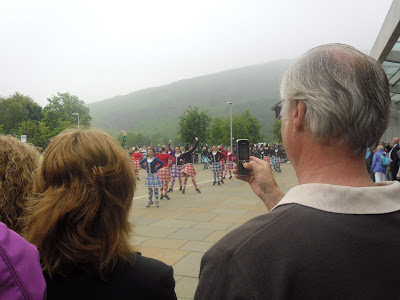


You'll be encouraged to hear that it was saltires and Lion Rampants all the way - I did spot a couple of Union Jacks, but they looked very lonely among a sea of sky-blue and white.
Afterwards, I started making my way up the Royal Mile, but I noticed that people were still lining the street. I overheard a policeman say to someone : "I don't have a time, but soon. Stick around." From which I inferred that the Queen was coming, so I waited a few minutes to see what I could see.
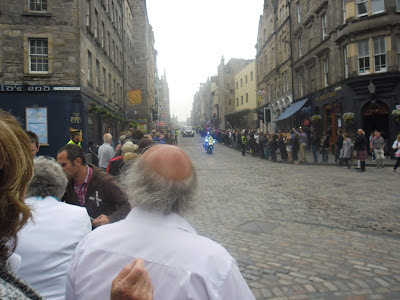

In case you're wondering why everyone was looking at the car behind the Queen, it's because Kate Middleton (or the Cambress of Dutchton, or whatever her name is supposed to be these days) was in that one. I didn't get a photo of her, but I dare say the world can survive without one more of those. Nor did I get a snap of Princess Anne in the third car, although I imagine all I'd have to do to put that right is pop round to Murrayfield in November with a long-lens camera.
I'm slightly embarrassed to confess that I waved to the Queen as she went past. Having said that, if waving at someone is to be taken as an indication of political support, it should be remembered that the Queen also waved in the general direction of little old republican me. So it's swings and roundabouts, really.
I had to be in Edinburgh anyway, so I decided to wander down to Holyrood to see the festivities, which basically consisted of a band called Whisky Kiss, a group of Highland dancers, a Robert Burns impersonator doing a reading of To a Louse, and umpteen pipe bands. I must say the whole thing seemed strangely under-rehearsed, as if it had been hastily thrown together at the last minute. But it was good fun all the same.


(Click the photos to enlarge)
You'll be encouraged to hear that it was saltires and Lion Rampants all the way - I did spot a couple of Union Jacks, but they looked very lonely among a sea of sky-blue and white.
Afterwards, I started making my way up the Royal Mile, but I noticed that people were still lining the street. I overheard a policeman say to someone : "I don't have a time, but soon. Stick around." From which I inferred that the Queen was coming, so I waited a few minutes to see what I could see.


In case you're wondering why everyone was looking at the car behind the Queen, it's because Kate Middleton (or the Cambress of Dutchton, or whatever her name is supposed to be these days) was in that one. I didn't get a photo of her, but I dare say the world can survive without one more of those. Nor did I get a snap of Princess Anne in the third car, although I imagine all I'd have to do to put that right is pop round to Murrayfield in November with a long-lens camera.
I'm slightly embarrassed to confess that I waved to the Queen as she went past. Having said that, if waving at someone is to be taken as an indication of political support, it should be remembered that the Queen also waved in the general direction of little old republican me. So it's swings and roundabouts, really.
Sunday, June 10, 2012
The intrinsic value of constitutional referenda
After all the Jubilee 'excitement' last week, I speculated that it would be a deeply traumatic experience for some royalists if they ever had to go through a referendum on retaining the monarchy, in spite of the likelihood that they would win handsomely. But I've been thinking about that some more, and it occurs to me that the mere fact of a referendum itself would mean - in a sense - that the monarchists had already lost. After all, the principle they hold most dear is that the monarchy is a fact of life, something that everyone accepts is 'out of bounds' for political discussion. The minority of dissenters who do exist can be rationalised away by pretending that they are much smaller in number than they truly are (the media help enormously in that respect), and are killjoys with perhaps just a hint of mental instability about them. As a royalist put it to me after I condemned the shouting down of a republican protest : "Of course these people have a right to protest, but the rest of us have a right to point out they are plonkers." Really? Wanting a say over who is your Head of State in the 21st Century makes you a plonker?
A referendum would change that narrative forever, despite the likely result. Elizabeth Windsor would be our Head of State not because forces that mere humans dare not interfere with had willed it so, but because we as a people had decided by democratic means that she is preferable to the alternatives. OK, that process would be ad hoc and less than satisfactory, but it's in the nature of any democratic decision that it can be revisited in the future, and everyone would know that. Just think how different the coverage of the Jubilee would have been had such a referendum taken place over the last few years. It would have been unthinkable for 'historians' to go on TV and treat the people as passive (albeit uniformly appreciative) spectators of a grand, ongoing, centuries-old story that the royals are free to shape for themselves. It would have been unthinkable to exclude all anti-monarchist views on the grounds that the crown is an 'apolitical' institution which everyone must unite around. There would have had to be time devoted to the views of the minority of people who voted against the political choice of monarchy, and there would have had to be sober analysis of how the propaganda value of the Jubilee spectacle was being used by the monarchy to win favour with a people who were now demonstrably its democratic masters.
To some extent, the independence referendum will have a similar intrinsic value, regardless of the outcome. Although independence is plainly not regarded as "out of bounds" for the democratic process, that is a relatively recent development, and even now the principle of self-determination is not universally accepted - there are still neanderthals like Alastair Campbell who believe that Scotland can quite legitimately be held captive within the UK if the English don't want us to go. So even if the worst happens and there is a No vote, the referendum will be a confirmational moment, one that will represent a defeat for those who would much rather file the 1707 treaty away as some kind of 'eternal union' that the Scots as a people cannot reconsider at a time of their own choosing.
One parallel with the monarchy debate is that there are still some people out there (mostly but not exclusively south of the border) who interpret opposition to the British union as a form of 'immaturity'. A few years ago, there was an item on Alan Titchmarsh's ITV show about independence. Titchmarsh reacted to Angus MacNeil's arguments with an impressively varied repertoire of incredulous facial expressions, and then wrapped up by saying with an exasperated air "let's see if we can all get along for the rest of the programme, shall we?". 'We', of course, referred to the happy British family - or rather a family that would be happy if it wasn't for the children throwing temper tantrums and electing SNP governments. That mindset will certainly be challenged by a referendum campaign that accords independence parity of esteem with the 'happy family' fantasy.
Another parallel is that there are many institutions which treat the goodness of British national unity as a 'given', and don't believe that this in any way detracts from their political neutrality. Regardless of the outcome, the referendum process will force those institutions to make a long-overdue choice - they can be pro-union, or they can be politically neutral, but they can't be both.
Saturday, June 2, 2012
Is Tom Farmer the independence referendum's 'Alec Douglas-Home in reverse'?
To return briefly to the subject I discussed the other day, it's gloriously ironic that Mike Smithson suggested that Tom Farmer's intervention this week was somehow a 'blow for the SNP', because in truth it's an early illustration of the massive dilemma that the No side will face as the campaign progresses. In a small way, Farmer can be seen as this referendum's "Alec Douglas-Home in reverse". Douglas-Home was someone with impeccable credentials as a devolutionist who voted No to devolution because it was "the wrong sort of devolution". By the same token, Farmer has impeccable credentials as someone who has always supported the union, but he is nevertheless minded to vote Yes to independence because the wrong type of union will be on offer (ie. the status quo). Now, he might not be enough on his own to make the kind of impact that Douglas-Home did in 1979, but if he and Jim McColl are joined by other well-known public figures over the next two years, and if the polls begin to show that a significant number of people who are essentially anti-independence are minded to vote Yes to independence as the only alternative to the status quo, then London's insistence on a single question is going to start looking like a monumental tactical blunder. So can the No side (to coin a phrase) get themselves off the hook? Other than backing down and accepting a second question on Devo Max, which would be both the most sensible and the most democratic option, the only other alternative would be for Cameron to put some flesh on the bones of this Top Secret Devo Plus Plan of his that supposedly has a chance of being implemented if there is a No vote (but only if we're very nice to him and if he's in a good mood, of course).
A list of specific powers to be transferred and a proposed date of implementation would probably do to be getting on with.
* * *
As I mentioned at the time, by completely freakish chance I managed to miss the whole of the Royal Wedding last year because I was stranded on Arran. No such luck for the Jubilee Weekend, though. I have a couple of royalists in the family, and when I walked past the TV set last night, I kept hearing snatches of Prince Charles saying things like "what the Queen means to us as a nation, or even as one of her children", and Alan Titchmarsh (!) saying things like "the Queen was determined that ceremony should not detract from Kate and William's special day", and I just thought, for the love of God, this is supposed to be a modern 21st Century democracy, not North Korea or Iran. Shouldn't it be possible to make a clear-sighted documentary about our Head of State? It doesn't even have to be particularly critical - just anything shy of hagiography would be great.
When I was at university, I winced when an American politics tutor informed us that the UK media's reporting of the Royal Family is "deferential". All I could think at the time was "what about the American media's fawning deference towards politicians?" But in retrospect I realise that it's utterly impossible to dispute her point.
Monday, May 16, 2011
'There will always be a United Kingdom'
In this whole debate about "independence-lite" that has suddenly sprung up, one catchphrase that is really beginning to get on my nerves (purely on the grounds of a lack of accuracy and linguistic precision) is Professor James Mitchell's "there will always be a United Kingdom in some form", which he repeated again tonight on Michael Portillo's documentary about Alex Salmond. Portillo was evidently so taken by it that he used it himself on This Week last Thursday.
Stripping away all the speculation about how a new confederal arrangement with the rest of Britain might work, I presume what Mitchell is really getting at is simply that the SNP support the retention of the monarchy. But that doesn't in itself assure the United Kingdom of a future. After all, we currently have the same Queen as Canada, New Zealand and Jamaica - does that mean these countries are all part of the "United Kingdom"? Of course not. The constitutional relationship between the different Commonwealth realms is, to all intents and purposes, what used to be described as a 'personal union' - different kingdoms ruled by the same monarch. (And of course the concept of being 'ruled' is a purely nominal one in the age of constitutional monarchy.) That's almost certainly the model an independent Scotland - whether of the 'lite' or 'full fat' variety - would follow.
Stripping away all the speculation about how a new confederal arrangement with the rest of Britain might work, I presume what Mitchell is really getting at is simply that the SNP support the retention of the monarchy. But that doesn't in itself assure the United Kingdom of a future. After all, we currently have the same Queen as Canada, New Zealand and Jamaica - does that mean these countries are all part of the "United Kingdom"? Of course not. The constitutional relationship between the different Commonwealth realms is, to all intents and purposes, what used to be described as a 'personal union' - different kingdoms ruled by the same monarch. (And of course the concept of being 'ruled' is a purely nominal one in the age of constitutional monarchy.) That's almost certainly the model an independent Scotland - whether of the 'lite' or 'full fat' variety - would follow.
Wednesday, December 8, 2010
Americans even spun themselves on Lockerbie
One thing I've found slightly amusing about the WikiLeaks cables so far is the entirely superfluous efforts of the authors to paint the US in a saintly light, despite the (intended) highly restricted audience. For instance, in the now-notorious write-up of Prince Andrew's boorish behaviour, we have the American ambassador "gently reminding" the prince that her country's presence in Central Asia is not in any way a continuation of the "Great Game", ie. competition with Russia for spheres of influence. Well, if you believe that you'll believe anything, but it appears the US has a self-image to maintain at all costs.
In the light of which, we shouldn't be surprised that the newly-published documents relating to the Megrahi release generate more spin than light, and seek to bolster the favoured US narrative despite the - quite literally - total absense of supporting evidence. One cable is dramatically titled "Qatar's Involvement in Al-Megrahi's Release" - but that 'involvement' seems to consist solely of the Qataris speaking to the Scottish government. It's fairly plain that there's an intense longing on behalf of the author for something far juicier, but instead all he/she can do is faithfully record the Qataris' entirely plausible denials of wild (and seemingly rather vague) US allegations of "any financial or trade incentives to induce Al-Megrahi's release".
Another cable purports to relate the Scottish government's "underestimation" of, and Alex Salmond's private "shock" at, the US reaction to Megrahi's release. But once this light dusting of spin is brushed away, what we actually learn is that Salmond's private statements were near-identical to what he was saying in public. It seems his "shock" related primarily to FBI director Robert Mueller's public letter of protest, and given that the widespread view in these parts was that Mueller's intervention was astonishingly thuggish, ill-conceived, self-indulgent and unprofessional, it's hard to see what reaction other than "shock" would have been appropriate in the circumstances. It's gratifying to learn that the Scottish government's representative made abundantly clear to the US that the shock was of the "offended" rather than "humbled" variety, although you'd be forgiven for thinking otherwise from the cable's billing (not to mention the Guardian's credulous summary).
Of course, it's the little details that give the authoritativeness (or otherwise) of these documents away, so it's also somewhat amusing to learn that the Americans were clearly basing their understanding of the Scottish Parliament's procedures not, as you might expect, on a close reading of the Scotland Act, but instead on the media's entirely erroneous belief that a two-thirds majority was required to pass a motion of no-confidence in the government. And this is supposed to be the world's most sophisticated intelligence-gathering outfit?
Wednesday, November 24, 2010
Just one day out of life, it would be, it would be so nice
Casting my eye over political message boards yesterday lunchtime, I was heartily amused at the reaction from many right-wing posters to the shock revelation that the Scottish government could actually decide for itself (!!!!!) whether to mark the Royal Wedding with a bank holiday. Never mind the fact that there wasn't the slightest indication that the extra day off wouldn't in fact get the nod - the indignation went straight into overdrive without passing go. "They'd better, or they'll have a riot on their hands!" declared someone smugly, apparently oblivious to the fact that not everyone in the UK regards deprivation of their Royal conjugal fix as an obvious trigger-point for mindless violence.
But hang on a minute - can you think of a single other circumstance in which the Right has ever regarded an extra holiday as acceptable, let alone desirable? I must have imagined CBI Scotland's apoplexy every time the possibility of a St Andrew's Day holiday is mentioned, let alone the attitute towards more generous maternity or paternity leave. Yet put an ostentatious ring on a posh woman's finger, and suddenly it's a moral outrage that there's even a theoretical possibility that we won't be getting a random lie-in one day next April.
I even saw a newsreader who felt bold enough to decorate her dutiful explanation that Scotland would make its own decision by adding "let's hope we all get a holiday, though". Has the world gone mad? Since when did such blatant breaches of BBC impartiality in support of the workshy provoke nothing more than a cry of "ooh, isn't that sweet" from the decent, hard-working, law-abiding, fox-hunting people of this country? I demand that they come to their senses immediately and jam the BBC switchboards in protest at this brazen show of leftyism - if it isn't nipped in the bud pronto, we'll be turning into FRANCE.
Saturday, November 20, 2010
Want to choose the Queen? You may be missing the point here...
So the tedious issue of whether Camilla could one day be Queen has been reignited by Prince Charles' slip in an American TV interview. I tend to think the people questioning whether a woman they don't happen to like very much "should" become Queen are a bit like the outraged TV talent show viewers who think that Wagner "shouldn't" win The X Factor just because he can't sing very well, or that Ann Widdecombe "shouldn't" win Strictly Come Dancing just because she can't dance very well. What, you mean that in a public phone vote, the person with the most votes wins? What, you mean that in a hereditary monarchy, the wife of the heir to the throne gets to become Queen? Who'd have thunk it?
If Camilla does become Queen (or indeed if Wagner wins The X Factor) it's the sign of a system working exactly as it's supposed to. If you don't like that system, let me suggest the remedy has been staring you in the face all along...
If Camilla does become Queen (or indeed if Wagner wins The X Factor) it's the sign of a system working exactly as it's supposed to. If you don't like that system, let me suggest the remedy has been staring you in the face all along...
Wednesday, November 17, 2010
Here we go again
I wonder if I was the only person today who saw the headline "Prince William announces engagement" and then spent the remainder of the day avoiding newspapers and the TV news at all costs. (It's a coping strategy I perfected when England won the Rugby World Cup.) I think I'll probably just about be able to cope with the horrors of the day itself - with plenty of notice and medicinal assistance. But when it's a bolt from the blue, 24 solid hours of Royal Syrup is more than I can take.
The only breach in my defences was that I saw about ten seconds of David Cameron doing his "I know I speak for the whole country" bit (no-you-don't) with the sound down, and even that was enough to make me feel distinctly nauseous.
The only breach in my defences was that I saw about ten seconds of David Cameron doing his "I know I speak for the whole country" bit (no-you-don't) with the sound down, and even that was enough to make me feel distinctly nauseous.
Subscribe to:
Posts (Atom)