So the STV by-election gods giveth, and the STV by-election gods taketh away. A couple of weeks ago we were enjoying a technical SNP 'gain' from Labour in Penicuik, even though the SNP's vote had gone down slightly and they had remained in first place in the ward. Today we're getting the flip-side of the equation: the SNP have technically 'lost' a seat in Caol and Mallaig, even though they have remained in second place in the ward and their vote has gone up appreciably. On the plus side, because the Liberal Democrats have gained the seat, it's always quite a fun pastime trying to work out which triumphalist Lib Dem supporters are just pretending not to understand how the voting system works, and which ones are genuinely clueless enough to think that this is some sort of terrible setback for the SNP. For a party that is supposed to regard STV as the holy grail of voting systems, the Lib Dems don't always give the impression of being terribly well versed in it.
Caol and Maillaig by-election result (first preferences):
Liberal Democrats 31.1% (+21.7)
SNP 27.2% (+3.2)
Independent - Wood 21.5% (n/a)
Conservatives 8.7% (+0.5)
Independent - MacKinnon 6.9% (n/a)
Independent - Campbell 4.6% (n/a)
There's probably not a lot of point in trying to make sense of the big increase in the Lib Dem vote - this is a part of the world where the candidate often counts for more than the party label, which is why a lot of people were betting on victory for one of the three independent candidates. A Lib Dem win is a surprise, but isn't a sign that Rennie-mania is sweeping the nation. For the same reason we shouldn't get too excited about the fact that there has been a small net swing from Tory to SNP.
Friday, April 6, 2018


Wednesday, April 4, 2018
Some recommended reading...
It's the blogpost that's caught the imagination of a nation. If you haven't seen it yet, take a few moments to read the legendary Ruth Wishart's reply to her namesake Pete Wishart, explaining her reasons for concluding that the independence referendum must be held by March 2019. You can read it HERE.
Tuesday, April 3, 2018
A right of reply to Pete Wishart: why "losing is not an option" is an immature belief that would lead to the quiet death of the independence cause
As you may have seen doing the rounds on Twitter, the letters page of this month's iScot magazine contains a contribution from Pete Wishart MP, billed as a "right of reply response to James Kelly's article Why the SNP must use its mandate to call an Indyref". I have to say I'm rather bemused by it, because with one possible minor exception it doesn't actually engage with the points I made in the article at all. Quite the contrary, in fact - it implies that I said things I didn't say, or that I said the opposite of, which suggests to me that if Pete is replying to anyone, it's to an imaginary person who is not me. My article was in itself a reply to Pete's 'Braveheart' piece in The National, and to a large extent all that Pete's "reply" does is reiterate the points he already made in his original article about why the SNP's hard-won mandate for a second independence referendum should be allowed to expire (albeit he fleshes some of them out a bit). Well, this is my own right of reply to his "reply", and I'm actually going to try to take things forward by tackling some of his arguments and claims directly.
First things first: Pete says that the only thing that dictates his attitude to the timing of an independence referendum is winning it. He obviously thinks that point is a no-brainer, but is it? Isn't there also the small matter of honour in politics, and carrying through a solemn commitment made to people who voted for you in good faith? We must never forget that before the June 2017 general election, the Scottish Parliament voted to hold an independence referendum in this current Holyrood term, meaning before May 2021. People were then urged to vote SNP on the basis that if the party won a majority of Scottish seats at Westminster, that would constitute a "triple lock" mandate for the referendum. A comfortable majority of seats was duly secured. If Pete thinks that no SNP supporters took the 'triple lock' commitment seriously or cared about it, I would suggest he urgently catches up with the writings of Thomas Widmann, a pro-indy blogger with Danish citizenship, who listened to the SNP leadership's promise about an independence referendum before Brexit, and made hugely important personal decisions about whether to remain in Scotland on that specific basis. He now doesn't know what to do, because it's so difficult to read whether that promise is actually going to be honoured, at least in part (ie. we already know the originally planned timing is likely to slip at least a bit).
Pete writes at length about the canvass results the SNP received in his own constituency. It's a statement of the obvious that the Tories were gaining traction with their ultra-simplistic 'No to Indyref2' message among people who didn't want Indyref2, but Pete also claims that he never met a single person who was refusing to vote SNP because the party wasn't being strong enough in its support for a new referendum. I'd suggest we'd all be well advised to take the implication of that claim with a heavy dose of salt, because there is ample polling evidence that large numbers of SNP voters from 2015 abstained in 2017 rather than switching to another party. By far the most plausible explanation for that phenomenon is the failure of the SNP leadership to find a suitably inspiring pitch on independence. But even if we accept Pete's contention that pro-referendum voters were broadly happy with what the SNP were saying during the election, isn't it rather problematical (or fatal) for Pete's argument that what the SNP were saying during the election is the opposite of what Pete is saying now? There was no talk during the campaign of "we want a mandate from you, but we probably won't use it unless everything seems perfect". The call was for a mandate which was actually going to be used. It's a bit meaningless to pray in aid your belief that pro-referendum folk were satisfied with what you were offering at the election if you're also arguing that what you offered should not be delivered now that the votes are safely in the bag.
It seems to me there is a very obvious subtext in Pete's letter that the holding of an independence referendum should be subordinate to considerations of what is going to win or lose the SNP votes and seats in a Westminster election. That sort of thinking really ought to be alien to a party that is serious about achieving independence, but it actually doesn't even make sense on its own terms, because in all probability a pre-2021 referendum would precede the next Westminster election, and indeed every other election apart from by-elections. Yes, a snap general election is still possible, but the strengthening of Theresa May's personal position means it's considerably less likely than it was.
To turn now to the central thrust of Pete's letter, he repeatedly uses language like "Losing again is simply unthinkable" and "losing again should simply not be an option". That's an argument that has great emotional resonance for some people, who think back to how they felt on September 19th, 2014, and want to avoid feeling that way ever again. It's also, I'm afraid, an extremely immature argument, because the nature of holding any democratic vote at any time is that defeat is always an option. Absolutely always. I can give you chapter and verse on referendums from around the world in which one side or the other has lost a commanding lead in the blink of an eye. It is simply a statement of fact that if we hold a referendum, we might win it and we might lose it. But here's the the thing - if we want independence, we can only get it by holding a referendum, which means we have to risk losing again sooner or later. Pete is arguing that we must wait until we have "optimum conditions" that will "ensure" and "guarantee" victory, but those conditions will simply never exist in the real world. His prospectus is a recipe for what you might call the 'heat death' of the independence cause - the SNP would continue nominally arguing for independence into infinity, but the rallying cry would be the hollow shell of "let's keep preparing for those optimum conditions!", which will always be supposedly around the corner, but will never actually arrive.
In my article that Pete is nominally "replying" to, I turned his call for "pragmatism" on its head by pointing out that pragmatism actually demands that we hold a referendum when we can, and not when we can't. In other words, even if his "optimum conditions" were theoretically achievable, they wouldn't be much use to us if they happened to coincide with a time when there was no pro-independence majority at Holyrood, and therefore a referendum couldn't be held. To the limited extent that Pete indirectly addresses that point, his answer is totally unsatisfactory. He claims that if the pro-indy camp can't win a majority at Holyrood, there would be very little chance of winning a referendum anyway. Frankly, that's an absolute nonsense, and I can't believe he really thinks that. There are any number of reasons why pro-independence voters might vote for an anti-independence party (especially Labour) at a parliamentary election but then still vote for independence in a referendum. We saw plenty of evidence in opinion polls last year that a minority of people were moving from SNP back to Labour but were still backing independence. The idea that if pro-indy parties "only" win 48% of the seats at a Holyrood election, it would then be virtually impossible to achieve a pro-independence majority vote at any point over the subsequent five years, which is essentially what Pete is arguing, is risible and not worthy of serious discussion. The only thing that would make a Yes vote impossible in those circumstances is that we wouldn't be able to hold a referendum in the first place without a pro-indy parliamentary majority - and that's the trap Pete is leading us into. He tells us what a tragedy it would be if we were to hold a referendum prematurely and lose it when it could have been won later - but how would that be any more of a tragedy than spurning the chance of holding a referendum when we actually have the mandate, and as a result being utterly powerless to hold a referendum for potentially decades thereafter, including at times when we might easily have won? That scenario could very easily unfold if a minority of pro-indy voters revert indefinitely to voting for the Labour party for cultural reasons.
Pete seems incredulous at the notion that you should use a mandate for a referendum just because you have one. I suppose that depends on whether you believe that pro-indy majorities at Holyrood are as plentiful as grains of sand on a beach, or whether you recognise that under the Additional Member voting system they're actually murderously hard to come by, and they should be treated as precious when they come along, and not casually squandered. We're not talking about a referendum next week - by all means let's choose the "optimum moment" between now and May 2021 when our mandate expires. But going beyond that date on a wing and a prayer is a different matter entirely.
Now to deal with a few miscellaneous red herrings that Pete throws in -
* I'm not quite sure what the relevance of this is, but he claims that failure in the 1979 devolution referendum (thanks to the 40% rule) led to the near-wipeout of the SNP at Westminster. Not so. The SNP had gone into reverse well before the referendum - by 1978, Labour had shown itself to be serious enough about devolution that it started winning back 'soft nationalist' votes. It's highly likely the SNP would have lost seats regardless of the outcome of the referendum.
* He suggests that the lesson of the 1995 Quebec vote is that a second defeat can set back an independence movement for a generation. In actual fact, the pro-independence Parti Québécois continued to hold an absolute parliamentary majority for eight years after the 1995 defeat. Because of excessive caution it didn't take advantage of that enviable situation, and as a result hasn't had the arithmetic to call a referendum at any time since 2003. (And one of the main reasons why it keeps failing to win elections is because it continually ties itself up in knots with a muddled prospectus of "we want a referendum, but not yet", which reassures nobody and inspires nobody.)
* He ascribes to me (or to the imaginary person he's responding to) the belief that simply calling a referendum would make a decisive shift towards Yes likely. I have never said that, and indeed I have repeatedly pointed out that the opposite may happen, including in the very article Pete is "replying" to. I believe this is projection on his part - he's so preoccupied with "guarantees" and "certainties" that he believes anyone who argues against him must automatically be saying that a Yes victory is already guaranteed. Completely untrue. I simply take the grown-up view that we might win if we fight a good campaign, that we might lose if we fight a bad campaign (or if we fight a good campaign and are unlucky), and that the future is fundamentally unknowable. We can help shape the future but we can't possess it in advance.
* He talks of something called the "indy-gap", meaning that support for an early referendum runs below support for independence itself. But is that actually true? The most recent Ipsos-Mori poll showed that just under half of people who expressed a view wanted independence...and just under half of people who expressed a view wanted an independence referendum within the next three years. So simple question, then - where's the indy-gap? To claim that it exists, at best you'd be cherry-picking only the polling numbers that suit your argument.
First things first: Pete says that the only thing that dictates his attitude to the timing of an independence referendum is winning it. He obviously thinks that point is a no-brainer, but is it? Isn't there also the small matter of honour in politics, and carrying through a solemn commitment made to people who voted for you in good faith? We must never forget that before the June 2017 general election, the Scottish Parliament voted to hold an independence referendum in this current Holyrood term, meaning before May 2021. People were then urged to vote SNP on the basis that if the party won a majority of Scottish seats at Westminster, that would constitute a "triple lock" mandate for the referendum. A comfortable majority of seats was duly secured. If Pete thinks that no SNP supporters took the 'triple lock' commitment seriously or cared about it, I would suggest he urgently catches up with the writings of Thomas Widmann, a pro-indy blogger with Danish citizenship, who listened to the SNP leadership's promise about an independence referendum before Brexit, and made hugely important personal decisions about whether to remain in Scotland on that specific basis. He now doesn't know what to do, because it's so difficult to read whether that promise is actually going to be honoured, at least in part (ie. we already know the originally planned timing is likely to slip at least a bit).
Pete writes at length about the canvass results the SNP received in his own constituency. It's a statement of the obvious that the Tories were gaining traction with their ultra-simplistic 'No to Indyref2' message among people who didn't want Indyref2, but Pete also claims that he never met a single person who was refusing to vote SNP because the party wasn't being strong enough in its support for a new referendum. I'd suggest we'd all be well advised to take the implication of that claim with a heavy dose of salt, because there is ample polling evidence that large numbers of SNP voters from 2015 abstained in 2017 rather than switching to another party. By far the most plausible explanation for that phenomenon is the failure of the SNP leadership to find a suitably inspiring pitch on independence. But even if we accept Pete's contention that pro-referendum voters were broadly happy with what the SNP were saying during the election, isn't it rather problematical (or fatal) for Pete's argument that what the SNP were saying during the election is the opposite of what Pete is saying now? There was no talk during the campaign of "we want a mandate from you, but we probably won't use it unless everything seems perfect". The call was for a mandate which was actually going to be used. It's a bit meaningless to pray in aid your belief that pro-referendum folk were satisfied with what you were offering at the election if you're also arguing that what you offered should not be delivered now that the votes are safely in the bag.
It seems to me there is a very obvious subtext in Pete's letter that the holding of an independence referendum should be subordinate to considerations of what is going to win or lose the SNP votes and seats in a Westminster election. That sort of thinking really ought to be alien to a party that is serious about achieving independence, but it actually doesn't even make sense on its own terms, because in all probability a pre-2021 referendum would precede the next Westminster election, and indeed every other election apart from by-elections. Yes, a snap general election is still possible, but the strengthening of Theresa May's personal position means it's considerably less likely than it was.
To turn now to the central thrust of Pete's letter, he repeatedly uses language like "Losing again is simply unthinkable" and "losing again should simply not be an option". That's an argument that has great emotional resonance for some people, who think back to how they felt on September 19th, 2014, and want to avoid feeling that way ever again. It's also, I'm afraid, an extremely immature argument, because the nature of holding any democratic vote at any time is that defeat is always an option. Absolutely always. I can give you chapter and verse on referendums from around the world in which one side or the other has lost a commanding lead in the blink of an eye. It is simply a statement of fact that if we hold a referendum, we might win it and we might lose it. But here's the the thing - if we want independence, we can only get it by holding a referendum, which means we have to risk losing again sooner or later. Pete is arguing that we must wait until we have "optimum conditions" that will "ensure" and "guarantee" victory, but those conditions will simply never exist in the real world. His prospectus is a recipe for what you might call the 'heat death' of the independence cause - the SNP would continue nominally arguing for independence into infinity, but the rallying cry would be the hollow shell of "let's keep preparing for those optimum conditions!", which will always be supposedly around the corner, but will never actually arrive.
In my article that Pete is nominally "replying" to, I turned his call for "pragmatism" on its head by pointing out that pragmatism actually demands that we hold a referendum when we can, and not when we can't. In other words, even if his "optimum conditions" were theoretically achievable, they wouldn't be much use to us if they happened to coincide with a time when there was no pro-independence majority at Holyrood, and therefore a referendum couldn't be held. To the limited extent that Pete indirectly addresses that point, his answer is totally unsatisfactory. He claims that if the pro-indy camp can't win a majority at Holyrood, there would be very little chance of winning a referendum anyway. Frankly, that's an absolute nonsense, and I can't believe he really thinks that. There are any number of reasons why pro-independence voters might vote for an anti-independence party (especially Labour) at a parliamentary election but then still vote for independence in a referendum. We saw plenty of evidence in opinion polls last year that a minority of people were moving from SNP back to Labour but were still backing independence. The idea that if pro-indy parties "only" win 48% of the seats at a Holyrood election, it would then be virtually impossible to achieve a pro-independence majority vote at any point over the subsequent five years, which is essentially what Pete is arguing, is risible and not worthy of serious discussion. The only thing that would make a Yes vote impossible in those circumstances is that we wouldn't be able to hold a referendum in the first place without a pro-indy parliamentary majority - and that's the trap Pete is leading us into. He tells us what a tragedy it would be if we were to hold a referendum prematurely and lose it when it could have been won later - but how would that be any more of a tragedy than spurning the chance of holding a referendum when we actually have the mandate, and as a result being utterly powerless to hold a referendum for potentially decades thereafter, including at times when we might easily have won? That scenario could very easily unfold if a minority of pro-indy voters revert indefinitely to voting for the Labour party for cultural reasons.
Pete seems incredulous at the notion that you should use a mandate for a referendum just because you have one. I suppose that depends on whether you believe that pro-indy majorities at Holyrood are as plentiful as grains of sand on a beach, or whether you recognise that under the Additional Member voting system they're actually murderously hard to come by, and they should be treated as precious when they come along, and not casually squandered. We're not talking about a referendum next week - by all means let's choose the "optimum moment" between now and May 2021 when our mandate expires. But going beyond that date on a wing and a prayer is a different matter entirely.
Now to deal with a few miscellaneous red herrings that Pete throws in -
* I'm not quite sure what the relevance of this is, but he claims that failure in the 1979 devolution referendum (thanks to the 40% rule) led to the near-wipeout of the SNP at Westminster. Not so. The SNP had gone into reverse well before the referendum - by 1978, Labour had shown itself to be serious enough about devolution that it started winning back 'soft nationalist' votes. It's highly likely the SNP would have lost seats regardless of the outcome of the referendum.
* He suggests that the lesson of the 1995 Quebec vote is that a second defeat can set back an independence movement for a generation. In actual fact, the pro-independence Parti Québécois continued to hold an absolute parliamentary majority for eight years after the 1995 defeat. Because of excessive caution it didn't take advantage of that enviable situation, and as a result hasn't had the arithmetic to call a referendum at any time since 2003. (And one of the main reasons why it keeps failing to win elections is because it continually ties itself up in knots with a muddled prospectus of "we want a referendum, but not yet", which reassures nobody and inspires nobody.)
* He ascribes to me (or to the imaginary person he's responding to) the belief that simply calling a referendum would make a decisive shift towards Yes likely. I have never said that, and indeed I have repeatedly pointed out that the opposite may happen, including in the very article Pete is "replying" to. I believe this is projection on his part - he's so preoccupied with "guarantees" and "certainties" that he believes anyone who argues against him must automatically be saying that a Yes victory is already guaranteed. Completely untrue. I simply take the grown-up view that we might win if we fight a good campaign, that we might lose if we fight a bad campaign (or if we fight a good campaign and are unlucky), and that the future is fundamentally unknowable. We can help shape the future but we can't possess it in advance.
* He talks of something called the "indy-gap", meaning that support for an early referendum runs below support for independence itself. But is that actually true? The most recent Ipsos-Mori poll showed that just under half of people who expressed a view wanted independence...and just under half of people who expressed a view wanted an independence referendum within the next three years. So simple question, then - where's the indy-gap? To claim that it exists, at best you'd be cherry-picking only the polling numbers that suit your argument.
Sunday, April 1, 2018
Winning With Willie: The Naked Truth
It's amazing how often a full-scale Scottish poll has been published on Easter Sunday, and this year is no exception, courtesy of YouGov. Unfortunately, however, the poll doesn't have any voting intention numbers (unless those are to come later) - it just asks about the strange recent trend of Scottish opposition politicians taking part in reality TV.
In recent months, a number of Scottish political party leaders have participated in reality TV programmes or game shows. Before today, which of the following were you aware of? (Select all that apply.)
Former Scottish Labour leader Kezia Dugdale's appearance on I'm A Celebrity...Get Me Out of Here!: 61%
Scottish Conservative leader Ruth Davidson's appearance on the Great British Bake Off: 34%
Scottish Liberal Democrat leader Willie Rennie's forthcoming appearance on Celebrity Naked Attraction: 7%
Willie Rennie, leader of the Scottish Liberal Democrats, has agreed to appear in a celebrity edition of Naked Attraction, a Channel 4 show in which contestants vie for a date by taking their clothes off. Do you think Mr Rennie has made the right decision?
Yes 4%
No 56%
Willie Rennie has made clear that his appearance on Celebrity Naked Attraction will be tasteful, and that his modesty will be protected at all times. Knowing this, do you feel more or less sympathetic towards his decision to take part?
More 9%
Less 2%
No Difference 61%
Willie Rennie says that he is appearing on Celebrity Naked Attraction as a light-hearted way of raising money for charity, and to help increase young people's interest in politics. Do you think young people will become more or less interested in politics as a result of Mr Rennie's participation in the show?
More 3%
Less 21%
No Difference 57%
Does Willie Rennie's appearance on Celebrity Naked Attraction make you feel proud to be Scottish?
Yes 5%
No 48%
Do you think Willie Rennie's appearance on Celebrity Naked Attraction will make it easier or harder for you to take him seriously as a politician in future?
Easier 7%
Harder 65%
And there's the rub. I have to say I think the man has taken leave of his senses. We may be used to seeing him indulge in publicity stunts such as sheep-wrestling, but this is in an entirely different category. As George Galloway proved by "being the cat", there are some mental images the public can't easily dispel.
Thursday, March 29, 2018
It's time to get up off our knees
Yesterday a junior minister in the UK government shocked people who believed "The Vow", by haughtily dismissing the Scottish Government as a body that is roughly equivalent to Lincolnshire County Council, and thus subordinate to herself.
And of course today Theresa May has done a "one year to Brexit" whistlestop tour of the four nations of the UK, boasting she will keep her "precious" country united - with the implication being that she will achieve that objective by coercion, having already broken last year with four decades of British government policy by decreeing that Scotland did not have an automatic right to democratic self-determination at a time of its own choosing.
Let's not forget also the Scottish Tories planting a fake story in the press a couple of days ago about supposed "proof" that the SNP are plotting a second independence referendum, allowing Ruth Davidson to let off a pre-prepared "sigh" on Twitter as she pretended to be spontaneously reacting to the "news" - as if this country making its own choice about its own future at a crucial moment in its history is somehow a tiresome prospect.
Make no mistake - we on the pro-independence side of the argument are playing our part in allowing this contemptuous treatment of Scotland to carry on, because until we get back to talking with much more confidence and clarity about our plans for a second independence referendum, the Tories will remain in the enviable position where just saying "no" and constantly "sighing" and "tutting" and muttering "gie us peace" will bring them a reward of sorts. That sort of rubbish plays well with around 25% or 30% of the Scottish electorate, which is all the Tories need for now because they and their media allies have conveniently redefined "success" as meaning around 25% of the vote. But as soon as a referendum is actually underway, the threshold for triumph reverts to being 50% of the vote - which is what nature intended, after all. The Tories will suddenly remember to their intense discomfort that openly boasting about denying Scotland its democratic rights, and treating our country as nothing more than an English county council, carries a severe electoral penalty rather than a perverse reward.
I don't know about you, but I think it's high time we really gave Ruth Davidson something to "sigh" about.
This is actually incredibly simple. The No campaign won a narrow victory in the 2014 referendum on the specific basis that Scotland would remain in the EU if it stayed in the UK. There are countless on-the-record examples of them saying precisely that, and without qualification. It doesn't really matter whether they were deliberately lying or whether they said it in good faith - all that matters is that many people voted No on a false premise. Circumstances have changed beyond all recognition in the last three-and-a-half years, and Scotland now has a self-evident moral right to revisit its decision. The arguments against that logic are incredibly contrived and unconvincing - for example Duncan Hothersall's claim that the No side only ever meant that a vote against independence would keep Scotland in the EU for the time being, and that there were never any guarantees offered about what would happen a couple of years down the line. The only reason that sort of daft revisionist statement isn't universally ridiculed is that the SNP leadership have taken a break from forcefully pressing the case for a new referendum - mainly because of the psychological shock of losing a handful of former heartland seats as they completed their landslide victory in the general election last June. But a year is more than enough time to get over that shock and to put the handsome mandate they received in its proper perspective. It's getting close to the point where we really ought to be firmly back on the front foot about Indyref 2.
To her credit, Nicola Sturgeon has not rowed back from her timetable for making an announcement about a referendum (one way or the other) in the autumn of this year. Some people even think she will preempt that at the SNP's conference in June. Either way, we're getting very close to a fork in the road, which means that if we as individuals want to influence the decision, the time to speak out is right now, and over the next few weeks to come. Some well-meaning people always say in situations like this that we should just "trust Nicola", but this is not really a matter of SNP internal loyalty - this is about our country's destiny, and it's something that all five million people who live here have a stake in. There are influential voices in the SNP, such as Pete Wishart, openly arguing that the party should allow its hard-won mandate for a referendum to expire, which makes it all the more important that those of us who think such a course of action would be a catastrophic error are also heard, and equally loudly.
As you know, I disagree with Peter A Bell about there being any realistic chance of a referendum actually being held in this calendar year, which is why I don't feel able to use his #Referendum2018 hashtag. But a referendum before the SNP's mandate expires in May 2021 is perfectly doable, and is an absolute moral imperative. Indeed, the SNP entered into a solemn contract with the Scottish people last June by saying that if they won a majority of Scottish seats at Westminster, a referendum would follow. Many people voted SNP on that basis, and they have a right to expect that contract will be honoured. Those voters have won the right to the choice they voted for. And that's what holding a referendum is ultimately all about - a free choice over Scotland's post-Brexit future. It's not about tactical considerations of whether winning is already assured, as Pete Wishart would have us believe. (Although, as it happens, the 48% Yes vote in the most recent opinion poll is probably just about the best platform any pro-independence campaign can realistically hope for going into a new referendum campaign.)
The Tories say that the polls show that people in Scotland don't want an early referendum. That's categorically not true - polls actually show a contradictory picture depending on how the question is asked, and indeed depending on which firm asks the question. But here's the thing - it wouldn't even matter if the Tories were right about the polls. In this country (which can mean either Scotland or the United Kingdom) we don't decide electoral mandates by YouGov findings - we do it at the ballot box. And the results of both the Holyrood and Westminster elections were absolutely clear. The SNP have an impeccable 'triple lock' mandate for a referendum, and we should stop apologising for that and start implementing it. There should be a referendum before 2021. Ideally, it should be held with a Section 30 order. If Westminster refuse, we should go ahead with a consultative referendum without a Section 30 order. If the Supreme Court block such a vote, we should then use the next Holyrood election as a de facto referendum - a virtually foolproof backstop option that cannot realistically be vetoed, blocked or boycotted.
I would suggest #ScotRef #UseTheMandate as a more inclusive and constructive alternative to the #Referendum2018 hashtag. I know some people might not be entirely comfortable with "Use The Mandate" simply because the Marmite figure of Tommy Sheridan has been using those words quite a bit recently, but he wasn't the first person to utter them, and he doesn't own them.
Independence is not the eccentric pursuit of a tiny minority. It's the settled will of almost half of the population - a state of affairs that warrants rather more self-confidence on the Yes side than we're currently exhibiting. Let's get up off our knees, and get on with the job.
Without doubt this is how @GovUK now sees devolution - the “granting” of powers by junior ministers at their whim to distant and very limited local institutions. So much for the rhetoric of #indyref - remember a “partnership of equals” ? https://t.co/IauO6WQtu8— Michael Russell (@Feorlean) March 28, 2018
And of course today Theresa May has done a "one year to Brexit" whistlestop tour of the four nations of the UK, boasting she will keep her "precious" country united - with the implication being that she will achieve that objective by coercion, having already broken last year with four decades of British government policy by decreeing that Scotland did not have an automatic right to democratic self-determination at a time of its own choosing.
Let's not forget also the Scottish Tories planting a fake story in the press a couple of days ago about supposed "proof" that the SNP are plotting a second independence referendum, allowing Ruth Davidson to let off a pre-prepared "sigh" on Twitter as she pretended to be spontaneously reacting to the "news" - as if this country making its own choice about its own future at a crucial moment in its history is somehow a tiresome prospect.
*sighs* https://t.co/VywwtjcuVF— Ruth Davidson (@RuthDavidsonMSP) March 27, 2018
Make no mistake - we on the pro-independence side of the argument are playing our part in allowing this contemptuous treatment of Scotland to carry on, because until we get back to talking with much more confidence and clarity about our plans for a second independence referendum, the Tories will remain in the enviable position where just saying "no" and constantly "sighing" and "tutting" and muttering "gie us peace" will bring them a reward of sorts. That sort of rubbish plays well with around 25% or 30% of the Scottish electorate, which is all the Tories need for now because they and their media allies have conveniently redefined "success" as meaning around 25% of the vote. But as soon as a referendum is actually underway, the threshold for triumph reverts to being 50% of the vote - which is what nature intended, after all. The Tories will suddenly remember to their intense discomfort that openly boasting about denying Scotland its democratic rights, and treating our country as nothing more than an English county council, carries a severe electoral penalty rather than a perverse reward.
I don't know about you, but I think it's high time we really gave Ruth Davidson something to "sigh" about.
Alas, she's "sighing" at a fake story. Retweet if you agree we should give Ruth something to really "sigh" about. #ScotRef #UseTheMandatehttps://t.co/iGDtBIITOH— James Kelly (@JamesKelly) March 27, 2018
This is actually incredibly simple. The No campaign won a narrow victory in the 2014 referendum on the specific basis that Scotland would remain in the EU if it stayed in the UK. There are countless on-the-record examples of them saying precisely that, and without qualification. It doesn't really matter whether they were deliberately lying or whether they said it in good faith - all that matters is that many people voted No on a false premise. Circumstances have changed beyond all recognition in the last three-and-a-half years, and Scotland now has a self-evident moral right to revisit its decision. The arguments against that logic are incredibly contrived and unconvincing - for example Duncan Hothersall's claim that the No side only ever meant that a vote against independence would keep Scotland in the EU for the time being, and that there were never any guarantees offered about what would happen a couple of years down the line. The only reason that sort of daft revisionist statement isn't universally ridiculed is that the SNP leadership have taken a break from forcefully pressing the case for a new referendum - mainly because of the psychological shock of losing a handful of former heartland seats as they completed their landslide victory in the general election last June. But a year is more than enough time to get over that shock and to put the handsome mandate they received in its proper perspective. It's getting close to the point where we really ought to be firmly back on the front foot about Indyref 2.
To her credit, Nicola Sturgeon has not rowed back from her timetable for making an announcement about a referendum (one way or the other) in the autumn of this year. Some people even think she will preempt that at the SNP's conference in June. Either way, we're getting very close to a fork in the road, which means that if we as individuals want to influence the decision, the time to speak out is right now, and over the next few weeks to come. Some well-meaning people always say in situations like this that we should just "trust Nicola", but this is not really a matter of SNP internal loyalty - this is about our country's destiny, and it's something that all five million people who live here have a stake in. There are influential voices in the SNP, such as Pete Wishart, openly arguing that the party should allow its hard-won mandate for a referendum to expire, which makes it all the more important that those of us who think such a course of action would be a catastrophic error are also heard, and equally loudly.
As you know, I disagree with Peter A Bell about there being any realistic chance of a referendum actually being held in this calendar year, which is why I don't feel able to use his #Referendum2018 hashtag. But a referendum before the SNP's mandate expires in May 2021 is perfectly doable, and is an absolute moral imperative. Indeed, the SNP entered into a solemn contract with the Scottish people last June by saying that if they won a majority of Scottish seats at Westminster, a referendum would follow. Many people voted SNP on that basis, and they have a right to expect that contract will be honoured. Those voters have won the right to the choice they voted for. And that's what holding a referendum is ultimately all about - a free choice over Scotland's post-Brexit future. It's not about tactical considerations of whether winning is already assured, as Pete Wishart would have us believe. (Although, as it happens, the 48% Yes vote in the most recent opinion poll is probably just about the best platform any pro-independence campaign can realistically hope for going into a new referendum campaign.)
The Tories say that the polls show that people in Scotland don't want an early referendum. That's categorically not true - polls actually show a contradictory picture depending on how the question is asked, and indeed depending on which firm asks the question. But here's the thing - it wouldn't even matter if the Tories were right about the polls. In this country (which can mean either Scotland or the United Kingdom) we don't decide electoral mandates by YouGov findings - we do it at the ballot box. And the results of both the Holyrood and Westminster elections were absolutely clear. The SNP have an impeccable 'triple lock' mandate for a referendum, and we should stop apologising for that and start implementing it. There should be a referendum before 2021. Ideally, it should be held with a Section 30 order. If Westminster refuse, we should go ahead with a consultative referendum without a Section 30 order. If the Supreme Court block such a vote, we should then use the next Holyrood election as a de facto referendum - a virtually foolproof backstop option that cannot realistically be vetoed, blocked or boycotted.
I would suggest #ScotRef #UseTheMandate as a more inclusive and constructive alternative to the #Referendum2018 hashtag. I know some people might not be entirely comfortable with "Use The Mandate" simply because the Marmite figure of Tommy Sheridan has been using those words quite a bit recently, but he wasn't the first person to utter them, and he doesn't own them.
Independence is not the eccentric pursuit of a tiny minority. It's the settled will of almost half of the population - a state of affairs that warrants rather more self-confidence on the Yes side than we're currently exhibiting. Let's get up off our knees, and get on with the job.
Monday, March 26, 2018
It's fine, don't worry about it, just go back to sleep
I stand corrected. I had formed the firm impression on Friday that the only TV camera crew in attendance at the Hands Off Our Parliament rally was from a Chinese channel, but as you can see from a video posted on the Indyref 2 website, approximately fifteen seconds of footage was broadcast on Reporting Scotland, so non-Chinese cameras must have been there for at least a while.
The Indyref 2 article notes that the mini-item on Reporting Scotland about the rally lasted for just twenty-seven seconds in total, and was only eighth in the show's running order. Certainly no-one would question the sterling efforts of our broadcasters in keeping the power grab quiet, just in case anyone hears about it. But what's most striking in that particular video is not so much the lack of prominence given to the story, but rather the remarkably blatant partisan spin in the script given to Sally Magnusson to read out -
"Around 1500 people have gathered at Holyrood to protest against what organisers describe as a Westminster power grab after Brexit. The Hands Off Our Parliament group believes Westminster is attempting to undermine devolution. UK ministers have proposed changes which would see the vast majority of EU powers returning to the devolved administrations, but Westminster wants to retain some powers temporarily, including fishing and agriculture."
Where do you start with that little lot? Obviously it's entirely right to attribute the phrase "power grab" to the organisers of the rally - it's a perfectly accurate description of what's happening, but nevertheless it's pejorative language and there are more neutral ways of describing the proposed reduction in the Scottish Parliament's powers. But what's mystifying about Magnusson's script is that, having correctly distanced itself from the spin of one side of the argument, it then totally embraces the spin of the other side and presents it as established fact. You'd have expected care to be taken to make clear that the UK government are merely claiming that the vast majority of devolved EU powers are coming to Holyrood, and that the diversion of other powers to Westminster will be "temporary". But, nope, apparently the BBC and the UK government are as one on this - the truth of these assertions is totally beyond dispute. Which is odd, because the Scottish government have asked for a sunset clause to be added to the EU Withdrawal Bill to ensure that the power grab is indeed temporary, and have so far been rebuffed. A politically neutral broadcaster ought at least to be open-minded about whether politicians who refuse to grant legal guarantees of their promises can simply be taken at their word. As for the "vast majority" point, that may be technically accurate, but it's scarcely giving viewers the whole picture - they also need to know that the 'small minority' of powers being grabbed by Westminster just happen to be the most important ones. It's rather akin to saying that "the vast majority of Scotland was unaffected by the missile attack" - and neglecting to mention that the small part of Scotland that was destroyed was the central belt, where most people live.
And "Westminster wants to retain some powers"? How can it "retain" powers it does not currently possess? It can take them, it can grab them, but it cannot possibly "retain" them. This choice of word appears to be a subtle attempt to bolster the UK government's narrative that the power grab is really about which new powers should be generously "given" to Scotland, and which should not be.
Oh, and why is no source given for the 1500 attendance figure? It may or may not be accurate, but presumably the BBC didn't count people by hand, so aren't we entitled to know who made the estimate, and perhaps draw our own conclusions on that basis?
The overall impression any reasonable viewer would have gained from the script read out by Magnusson was that the organisers of the rally had made certain outlandish claims, but that those claims are not borne out by the reality of Westminster's plans - which are minor, technical and above all temporary. It was as much as to say: "These eccentric people think you should care about this, but we're telling you that you shouldn't." It is incredibly hard not to see that as an intentional partisan intervention by the BBC.
* * *
On the question of how we can push any future rally up the BBC running order, I have a couple of suggestions -
1) Make the rally a joint protest against both the Westminster power grab and ball-tampering in international cricket.
2) Actually put on a game of cricket in the middle of the rally, and tamper with the ball.
Saturday, March 24, 2018
Hands Off Our Parliament
So as I mentioned in the previous post, I spent a few hours at the 'Hands Off Our Parliament' event at Holyrood yesterday. I was even invited to make a short speech - as you can see for yourself, because Independence Live (whose operations seem to become more and more sophisticated every time I encounter them) were filming throughout the day. My slot starts at around 7:20 on this link.
One of the joys of an event like that is 'celebrity-watching'. I found myself standing right next to the legendary Scottish Resistance just before my speech, but possibly the most surreal spectacle was Michael Gray taking part in the Yes Bikers ride-past on a distinctly analogue bike, and grinning with sheer delight as if he'd just found out Santa exists after all. One or two people on social media criticised pro-indy MSPs for not turning up, but that's a bit unfair - I'm 99% sure I spotted Ash Denham, and there may have been others as well.
The schedule of the day was ingeniously crafted to provide lots of highly visual showstopping moments. It must have looked fabulous on television. In China, I mean - from what I can gather, the only TV cameras on the spot were from a Chinese channel. Ah well, maybe there are some soft No voters on holiday in Shanghai at the moment.
Like almost everyone, I took a few photos while I was there. Here's a selection...


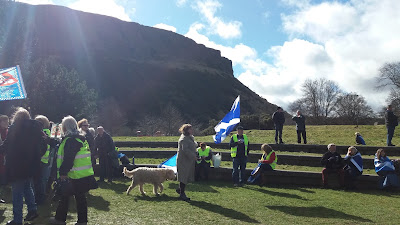


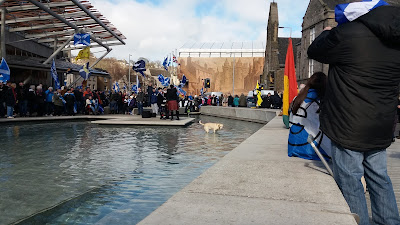


One of the joys of an event like that is 'celebrity-watching'. I found myself standing right next to the legendary Scottish Resistance just before my speech, but possibly the most surreal spectacle was Michael Gray taking part in the Yes Bikers ride-past on a distinctly analogue bike, and grinning with sheer delight as if he'd just found out Santa exists after all. One or two people on social media criticised pro-indy MSPs for not turning up, but that's a bit unfair - I'm 99% sure I spotted Ash Denham, and there may have been others as well.
The schedule of the day was ingeniously crafted to provide lots of highly visual showstopping moments. It must have looked fabulous on television. In China, I mean - from what I can gather, the only TV cameras on the spot were from a Chinese channel. Ah well, maybe there are some soft No voters on holiday in Shanghai at the moment.
Like almost everyone, I took a few photos while I was there. Here's a selection...


Friday, March 23, 2018
SNP p-p-p-pick up a Penicuik in crucial by-election GAIN
I'm not sure if I've been the only person at the 'Hands Off Our Parliament' event today who spent half the time frantically searching his phone for the word 'Penicuik', but the news was good in the end. The SNP have gained the seat previously held by Labour, and this is the first actual SNP gain in a local by-election since the Westminster general election last June. Before you get too excited, it's one of those anomalies thrown up by the voting system, where Labour were defending the seat in spite of the fact that the SNP won the popular vote in the ward last time around. As you can see below, there was no big change in either the SNP or Labour vote. But it's still a significant blow for Labour, who have been overtaken by the SNP as the largest single party on Midlothian council. (Labour will presumably cling onto power with the help of their ever-faithful Tory allies.)
Penicuik by-election result (first preferences):
SNP 35.0% (-0.2)
Conservatives 30.2% (+4.0)
Labour 27.6% (+2.0)
Greens 7.2% (+1.6)
The SNP had to wait until the Green and Labour votes were redistributed before being formally declared the winners, but from the moment it became clear the Tories were in second place on first preferences, it was pretty obvious what the final result would be. Ironically, I saw a chap on Twitter claim that this result proves that only the Tories can beat the SNP, but if anything the opposite is true - if Labour had been second on first preferences, they probably would have taken a truck-load of transfers from the Tories, and might just have pipped the SNP on the final count. But the Tories are never likely to get enough Labour transfers to come from behind in a straight SNP v Tory run-off.
Thursday, March 22, 2018
If you want to get a Section 30 order, you first have to be serious about holding a referendum without one
My interest was caught by Peter A Bell's blogpost the other day about Green MSP Ross Greer's comments on Indyref 2, and not for the first time I find myself half-agreeing with Peter and half-disagreeing. I certainly agree that Greer, in arguing that a Section 30 order is essential before a referendum can go ahead, is a siren voice who could potentially lead us onto the rocks - not ideologically or philosophically, but simply in strategic terms. Greer suggests that we should forget all about holding a referendum without Westminster's consent and instead concentrate on "creating the political leverage to get the Section 30 order we need" - but the obvious point he's overlooked is that embarking on a process that could lead to a non-Westminster-approved referendum is in itself the sort of leverage that could actually produce a Section 30 order. It's arguably very unlikely that anything else would even be capable of creating sufficient leverage (with the possible exception of an early general election in which the SNP make net gains - but of course the triggering of an early election is not in the gift of anyone on the pro-indy side). There's no point in calling for the creation of leverage if in the same breath you're arguing that we should throw the best chance of leverage we have into the bin.
Greer says: "The idea of us being in a situation where we had to attempt independence with the absolute resistance of the UK government, I don’t think, would make independence actually possible." Does he not understand that this stance, if maintained, would give the UK government a very simple method by which they can make independence "impossible"? All they'd have to do is just keep saying "no" to a referendum. Job done. Scotland would have no leverage at all.
Think back to the first indyref. Why did the UK government grant a Section 30 order for that one? They didn't do it out of the goodness of their hearts, that's for sure. They did it because the SNP initially took the view that a Section 30 order wasn't needed and were talking seriously about going ahead without one. That was dangerous for the UK government, who risked losing any say over the format of the vote (for example whether there would be a Devo Max option), and also risked being faced with a dilemma over whether to take legal action to stop the referendum - which might or might not have succeeded, but would have been politically damaging either way. A credible threat of an "unapproved" referendum would generate a similar set of risks for London now.
In many ways, the strategic logic is similar to that of the Continuity Bill. The Scottish Government would much prefer a deal with London to protect devolution, but paradoxically by preparing the ground for exploiting a no-deal scenario, you make a deal far more likely to happen. But of course there's always just a chance that London will still prove intransigent, in which case you have to fall back on the Continuity Bill - in that sense it's an each-way bet. Perhaps that's what scares people about using the same tactic to extract a Section 30 order - if it didn't work, we'd actually have to press ahead with an "unapproved" referendum. But would that really be so awful? If a referendum bill was passed without a Section 30 order and the Supreme Court subsequently upheld it, it would become the law of the land and the "fears" of a unionist boycott would probably recede. If the Supreme Court didn't uphold it, the vote wouldn't happen anyway, but at least we'd then have political and legal clarity which would lead us inexorably towards using a Holyrood election to seek an outright mandate for independence.
Greer raises a specific concern about unionist-controlled local authorities refusing to cooperate with a referendum held without a Section 30 order. I'm obviously not a legal expert, so I'm willing to be corrected on this, but it seems intuitively likely that there are ways to deal with that problem. It's surely of some significance that powers over local government are devolved to Scotland.
Incidentally, I'd also suggest it's rather important that Labour and the Liberal Democrats (with the eccentric exception of Mike Rumbles) have created a precedent by voting in favour of the Continuity Bill, in spite of the Presiding Officer's opinion that it exceeds the parliament's powers. That will make it harder for either party to credibly argue that the SNP are doing something terribly wrong by passing a referendum bill over which there is some legal doubt. I don't say that in any sort of triumphalist "gotcha" way - I think Labour and the Lib Dems have done absolutely the right thing over the Continuity Bill, and they may even have done it for the right reasons. But it's created new facts on the ground, just the same.
Where I part company with Peter A Bell is his belief that Greer's flawed thinking on strategy is symptomatic of a major difference in approach between the Greens and the SNP. In reality, Greer's views are shared by some senior people in the SNP, while some take the opposite view, and others are somewhere in between. I've no idea which camp Nicola Sturgeon is in, and unless Peter has some sort of inside knowledge, I think he's in danger of projecting his own beliefs onto her. This isn't first and foremost an SNP v Green problem - there's an internal SNP debate on strategy that needs to be won.
* * *
If you're an SNP supporter in the Penicuik ward, don't forget to vote in the local by-election today. The SNP won the popular vote in the ward last year, but this is exactly the sort of place where Labour have prospered in recent months, so it could be a tight contest and every vote is important. (The Tories are in with a serious chance as well.)
Monday, March 19, 2018
Senior BBC journalists are completely losing the plot in their posture towards Alex Salmond
If you haven't seen/heard Alex Salmond's exchange with the BBC's John Sweeney yesterday, it's worth following this link and having a listen, because it's one of the most extraordinary things I've ever heard. What Sweeney's almost comically hostile attitude reminded me of was the guidelines for BBC presenters in the 1980s and early 90s when dealing with Sinn Féin spokespeople. Although interviews with Sinn Féin were permitted, they weren't to be regarded as anything remotely like normal interviews with normal politicians, where at least part of the purpose is to allow the interviewee to get his or her point across. Instead, presenters were expected to do anything and everything necessary to destroy the credibility of the interviewee, and to constantly remind viewers that Sinn Féin were not a legitimate political party with a legitimate viewpoint, but rather a public relations front for filthy terrorists and murderers.
Incredible though it may seem, that was almost exactly the posture Sweeney adopted towards Salmond yesterday. He literally treated Salmond, a former First Minister of Scotland and a current Privy Counsellor, as the equivalent of a terrorist spokesperson. Sweeney was theoretically in the position of interviewee, but from the moment he opened his mouth, his single-minded objective was to deny the legitimacy of Salmond as an interviewer on the basis that Salmond is a paid Putin stooge, to deny the legitimacy of any questions Salmond asked on the basis that they were coming out of the mouth of a paid Putin stooge, and even to deny the legitimacy of the subject that he had been invited on the programme to speak about because it had been selected by a paid Putin stooge. It was clear that he had decided in advance that he would regard his participation in the interview as a failure unless he effectively pulled off a full-blown coup against the interviewer and managed to spend the whole ten minutes putting Salmond on the ropes about a completely different subject, ie. Salmond supposedly being a paid Putin stooge.
At several points, Sweeney attempted to contrast the different practices of the BBC and Russian-owned RT, on which Salmond's weekly TV show runs. But let me just ask the obvious question: can anyone imagine a BBC interviewer putting up with the behaviour that Sweeney exhibited yesterday? Off the top of my head, I cannot recall a single example of a guest on the BBC being allowed to spend an entire interview ignoring the actual subject of the interview and instead making a prolonged personal attack on the interviewer. The closest I can think of is Jo Swinson asking an awkward question about John Humphrys' views on his female colleagues, but that was much briefer and much more courteous, and she only got away with it because of truly exceptional circumstances. Normally the outside interests of the interviewer are completely off limits. Sweeney also suggested that RT does not allow criticism, whereas people are permitted to criticise the BBC on the BBC, but is it actually true that there's any real distinction there? I've seen limited criticisms of RT expressed on RT, and yes, I've also seen limited criticisms of the BBC expressed on the BBC. In both cases, the broadcaster itself is the gatekeeper of the extent and type of criticism that is aired, by virtue of being able to select which people are or are not invited to speak. Former BBC Scotland presenter Derek Bateman has often noted that he hasn't been invited to take part in any BBC programmes as a pundit or commentator since he started making constructive criticisms of the corporation on his blog. Paul Kavanagh, a fierce critic of the BBC, has similarly observed that he is never invited onto BBC programmes, in spite of the fact that as a regular columnist on The National he is on a list of people recommended to the BBC on an ongoing basis as possible pro-independence guests. By contrast, a small number of 'safer' pro-independence guests such as Angela Haggerty (broadly a defender of the BBC) appear extremely frequently.
What Sweeney did yesterday was eerily reminiscent of Nick Robinson's outburst against Salmond on social media a few months ago, which leaves us with the distinct impression of a BBC that now views itself as being in a state of open warfare with the former leader of the UK's third largest political party, and doesn't see any problem with that. I have to say I'm struggling to imagine the BBC losing the plot quite so comprehensively with the former leader of any of the main London-based parties, which raises some troubling questions about underlying attitudes within the BBC towards the Scottish independence movement. Is the ludicrously contrived link between Salmond and the Russian menace being used as a conveniently deniable outlet for the contempt some senior BBC journalists and presenters have always felt towards the SNP in general? If so, how can the BBC be trusted to cover Scottish politics and the independence issue impartially?
Incidentally, what yesterday's interview was actually supposed to be about was Newsnight's bizarre decision to use a backdrop featuring a doctored image of Jeremy Corbyn in front of the Kremlin as part of a Bolshevik-style poster. Salmond did a heroic job of dragging Sweeney kicking and screaming back to that topic, which produced this remarkable moment about three minutes in -
Alex Salmond: The mainstream press are accusing Jeremy Corbyn of being a Kremlin stooge. So why should you picture him against the Kremlin?
John Sweeney: Because somebody has poisoned two British citizens, or rather one British citizen and his daughter, and you cannot buy this nerve agent in a shop.
What? I mean, what?! How does that reply make any logical sense unless the BBC are insinuating that Corbyn was somehow involved in the poisoning himself? I asked that question on Twitter last night, and Sweeney (who must have been searching for his own name, because I didn't tag him in the tweet) offered this retort -
"James! The exchange was more nuanced than that. I pointed out @AlexSalmond takes money from the Kremlin’s chums and that too many Putin critics get shot. After a bit he cut me off."
Words fail me. If anyone can detect even an ounce of "nuance" in Sweeney's unhinged, paranoid rant about a veteran Scottish politician supposedly being a puppet of the Russian state, you're doing better than me.
Incredible though it may seem, that was almost exactly the posture Sweeney adopted towards Salmond yesterday. He literally treated Salmond, a former First Minister of Scotland and a current Privy Counsellor, as the equivalent of a terrorist spokesperson. Sweeney was theoretically in the position of interviewee, but from the moment he opened his mouth, his single-minded objective was to deny the legitimacy of Salmond as an interviewer on the basis that Salmond is a paid Putin stooge, to deny the legitimacy of any questions Salmond asked on the basis that they were coming out of the mouth of a paid Putin stooge, and even to deny the legitimacy of the subject that he had been invited on the programme to speak about because it had been selected by a paid Putin stooge. It was clear that he had decided in advance that he would regard his participation in the interview as a failure unless he effectively pulled off a full-blown coup against the interviewer and managed to spend the whole ten minutes putting Salmond on the ropes about a completely different subject, ie. Salmond supposedly being a paid Putin stooge.
At several points, Sweeney attempted to contrast the different practices of the BBC and Russian-owned RT, on which Salmond's weekly TV show runs. But let me just ask the obvious question: can anyone imagine a BBC interviewer putting up with the behaviour that Sweeney exhibited yesterday? Off the top of my head, I cannot recall a single example of a guest on the BBC being allowed to spend an entire interview ignoring the actual subject of the interview and instead making a prolonged personal attack on the interviewer. The closest I can think of is Jo Swinson asking an awkward question about John Humphrys' views on his female colleagues, but that was much briefer and much more courteous, and she only got away with it because of truly exceptional circumstances. Normally the outside interests of the interviewer are completely off limits. Sweeney also suggested that RT does not allow criticism, whereas people are permitted to criticise the BBC on the BBC, but is it actually true that there's any real distinction there? I've seen limited criticisms of RT expressed on RT, and yes, I've also seen limited criticisms of the BBC expressed on the BBC. In both cases, the broadcaster itself is the gatekeeper of the extent and type of criticism that is aired, by virtue of being able to select which people are or are not invited to speak. Former BBC Scotland presenter Derek Bateman has often noted that he hasn't been invited to take part in any BBC programmes as a pundit or commentator since he started making constructive criticisms of the corporation on his blog. Paul Kavanagh, a fierce critic of the BBC, has similarly observed that he is never invited onto BBC programmes, in spite of the fact that as a regular columnist on The National he is on a list of people recommended to the BBC on an ongoing basis as possible pro-independence guests. By contrast, a small number of 'safer' pro-independence guests such as Angela Haggerty (broadly a defender of the BBC) appear extremely frequently.
What Sweeney did yesterday was eerily reminiscent of Nick Robinson's outburst against Salmond on social media a few months ago, which leaves us with the distinct impression of a BBC that now views itself as being in a state of open warfare with the former leader of the UK's third largest political party, and doesn't see any problem with that. I have to say I'm struggling to imagine the BBC losing the plot quite so comprehensively with the former leader of any of the main London-based parties, which raises some troubling questions about underlying attitudes within the BBC towards the Scottish independence movement. Is the ludicrously contrived link between Salmond and the Russian menace being used as a conveniently deniable outlet for the contempt some senior BBC journalists and presenters have always felt towards the SNP in general? If so, how can the BBC be trusted to cover Scottish politics and the independence issue impartially?
Incidentally, what yesterday's interview was actually supposed to be about was Newsnight's bizarre decision to use a backdrop featuring a doctored image of Jeremy Corbyn in front of the Kremlin as part of a Bolshevik-style poster. Salmond did a heroic job of dragging Sweeney kicking and screaming back to that topic, which produced this remarkable moment about three minutes in -
Alex Salmond: The mainstream press are accusing Jeremy Corbyn of being a Kremlin stooge. So why should you picture him against the Kremlin?
John Sweeney: Because somebody has poisoned two British citizens, or rather one British citizen and his daughter, and you cannot buy this nerve agent in a shop.
What? I mean, what?! How does that reply make any logical sense unless the BBC are insinuating that Corbyn was somehow involved in the poisoning himself? I asked that question on Twitter last night, and Sweeney (who must have been searching for his own name, because I didn't tag him in the tweet) offered this retort -
"James! The exchange was more nuanced than that. I pointed out @AlexSalmond takes money from the Kremlin’s chums and that too many Putin critics get shot. After a bit he cut me off."
Words fail me. If anyone can detect even an ounce of "nuance" in Sweeney's unhinged, paranoid rant about a veteran Scottish politician supposedly being a puppet of the Russian state, you're doing better than me.
Subscribe to:
Posts (Atom)