Tuesday, February 7, 2017
Homage to Catalonia
Just a quick note to let you know that I have a new article at the TalkRadio website about the appalling events in Catalonia, where the former Prime Minister Artur Mas has been put on trial simply for organising a vote on independence that he had been given an overwhelming mandate for. I also touch on the vitally important democratic principle that is at stake for all of us "separatists" everywhere. You can read the article HERE.


Monday, February 6, 2017
Scotland will become independent, says 61% of public in explosive Panelbase poll
Panelbase have updated their datasets, thus solving the mystery of yesterday's tweet from Jason Allardyce suggesting that the public believe Scottish independence to be "inevitable". That turns out to be a reference to the re-asking of a question that has been posed before (and with unchanged wording, thus making a direct comparison with the previous poll possible).
38% (+3) believe Scotland is likely to become independent within 5-10 years
16% (-2) believe Scotland is likely to become independent, but not for at least 10-15 years
7% (-1) believe Scotland is likely to become independent, but not for at least 20-30 years
27% (+1) do not believe Scotland is likely to become independent in the next few decades
13% (n/c) don't know
That means a total of 61% expect independence within the next few decades. A clear majority (54%) selected one of the first two options, which in spite of the imprecise wording appears to imply that they expect independence within two decades at the absolute most. And that's with the don't knows taken into account - if they're stripped out, more than 43% of the sample expect independence within just five or ten years.
As you'd imagine, Yes voters from the first indyref are most bullish about the likelihood of independence, but the total number of No voters who anticipate independence at some point over the next few decades (40%) is almost equal to the number of No voters who don't think it will happen at all (43%). And intriguingly enough, as many as 49% of English-born voters expect independence, and only 36% don't. However, the subsample of English voters is relatively small, so those figures should be treated with caution.
The other important piece of news from the updated datasets is the complete figures for Westminster voting intention, including the smaller parties...
SNP 47% (n/c)
Conservatives 27% (+3)
Labour 15% (-1)
Liberal Democrats 4% (-1)
Greens 3% (n/c)
UKIP 3% (-1)
Adding up the raw numbers gives the two main pro-independence parties an outright majority of the vote - just. The SNP and Greens have approximately 50.3% between them. Part of the explanation is that No voters from 2014 are significantly more likely than Yes voters to say they have less than an 80% chance of turning out for an election, or that they don't know which party they would vote for, and as a result end up being removed from the sample. Nevertheless, a majority for the pro-independence parties is highly encouraging as we ponder the possibility (I've no idea of how strong a possibility it is) of a snap Holyrood election to win an outright mandate for independence if the Westminster Tories are stupid enough to attempt to block a referendum.
* * *
If you enjoy my writing, you can follow me on Twitter here, like the Facebook page here, or make a donation here.
38% (+3) believe Scotland is likely to become independent within 5-10 years
16% (-2) believe Scotland is likely to become independent, but not for at least 10-15 years
7% (-1) believe Scotland is likely to become independent, but not for at least 20-30 years
27% (+1) do not believe Scotland is likely to become independent in the next few decades
13% (n/c) don't know
That means a total of 61% expect independence within the next few decades. A clear majority (54%) selected one of the first two options, which in spite of the imprecise wording appears to imply that they expect independence within two decades at the absolute most. And that's with the don't knows taken into account - if they're stripped out, more than 43% of the sample expect independence within just five or ten years.
As you'd imagine, Yes voters from the first indyref are most bullish about the likelihood of independence, but the total number of No voters who anticipate independence at some point over the next few decades (40%) is almost equal to the number of No voters who don't think it will happen at all (43%). And intriguingly enough, as many as 49% of English-born voters expect independence, and only 36% don't. However, the subsample of English voters is relatively small, so those figures should be treated with caution.
The other important piece of news from the updated datasets is the complete figures for Westminster voting intention, including the smaller parties...
SNP 47% (n/c)
Conservatives 27% (+3)
Labour 15% (-1)
Liberal Democrats 4% (-1)
Greens 3% (n/c)
UKIP 3% (-1)
Adding up the raw numbers gives the two main pro-independence parties an outright majority of the vote - just. The SNP and Greens have approximately 50.3% between them. Part of the explanation is that No voters from 2014 are significantly more likely than Yes voters to say they have less than an 80% chance of turning out for an election, or that they don't know which party they would vote for, and as a result end up being removed from the sample. Nevertheless, a majority for the pro-independence parties is highly encouraging as we ponder the possibility (I've no idea of how strong a possibility it is) of a snap Holyrood election to win an outright mandate for independence if the Westminster Tories are stupid enough to attempt to block a referendum.
* * *
If you enjoy my writing, you can follow me on Twitter here, like the Facebook page here, or make a donation here.
Sunday, February 5, 2017
Congratulations to the Scottish Tories on entering the Guinness Book of Records for the most lies told about a single opinion poll
A week on, further details have been released from the Panelbase poll for the Sunday Times - thus allowing the Tories to triple the number of brazen and genuinely enormous lies that they've told about the findings. Here is a full list of the whoppers so far...
1) Ruth Davidson claimed that the poll shows support for an independence referendum has fallen to 27%. In fact, it shows that 49.4% of respondents want an indyref within the next two years. The claim of a decline in support is also misleading because the question asked was different from previous Panelbase polls.
2) Davidson claimed today that the poll found an increase in support for the Tories in Westminster voting intention after the Scottish budget. In fact, the fieldwork was entirely carried out before the budget.
3) The Tories claimed today that the poll shows a 6% increase in support for themselves, and a 3% drop in support for the SNP. In fact, it only shows a 3% increase for the Tories, and no drop at all for the SNP, who remain on 47%.
To be fair, there's a potentially innocent explanation for Whopper 3, because Panelbase had to issue a correction in September after inaccurate figures from their last poll got into circulation. John Curtice's What Scotland Thinks website still lists those wrong numbers, which do indeed give the bogus impression that the new poll shows a 6% boost for the Tories and a 3% drop for the SNP. For clarity, here are the correct figures -
SNP 47% (n/c)
Conservatives 27% (+3)
Labour 15% (-1)
Liberal Democrats 4% (-1)
Conservatives 27% (+3)
Labour 15% (-1)
Liberal Democrats 4% (-1)
The movement towards the Tories could just be margin of error noise, but if it's real, it does look very much like the new support is coming from other unionist parties, rather than from disgruntled SNP voters (as Davidson would have you believe).
As far as I can see, Labour's 15% support is a new all-time low for the party in Westminster voting intentions - although that can possibly be explained by the extreme scarcity of Scotland-only Westminster polls since a big chunk of Labour's core support drifted off to the Tories.
Jason Allardyce revealed on Twitter that the poll also shows that a majority of respondents believe independence is inevitable. The Tories may find it harder to bluff their way out of that one. Presumably there are more details in the Sunday Times, but I don't pay the Murdoch Levy, so I'll have to wait for the Panelbase datasets to appear (hopefully tomorrow).
* * *
UPDATE : Having recalled the incorrect reporting of the previous Panelbase poll in September, I did some double-checking and discovered that What Scotland Thinks also still lists the incorrect figures from that poll on the independence question. John Curtice seems to have relied on his own site's archive rather than the Panelbase datasets when he did his write-up last week, because he overlooked the error and incorrectly stated that support for independence had dropped by 2% (from 48% to 46%) whereas in fact it had only dropped by a statistically insignificant 1% (from 47% to 46%). There do seem to be a whole string of errors on What Scotland Thinks related to Panelbase polls - not just the numbers, but also inaccurate reporting of question wording which leads to misleading comparisons between apples and oranges. I don't think there's any malicious intent at all behind the mistakes, but given how much trust is placed in that site by the mainstream media and political parties, it's becoming a bit of a problem. Hopefully someone will go through the archive with care and make corrections where needed, because it's clear that Curtice and co are beginning to confuse the hell out of themselves, never mind the rest of us.
* * *
Daisley FINALLY admits that STV didn't "silence" him - so why is he still playing the martyr?
Stephen Daisley's former bosses at STV must have felt entirely vindicated yesterday after his decision to join the Daily Mail and write a belligerent piece that basically branded the SNP as the equivalent of a neo-Nazi party (he genuinely seems unable to spot any kind of distinction between the left-wing civic nationalism of the SNP and the far-right ethnic nationalism of the likes of Steve Bannon). By doing so, he helpfully underscored why his previous joint position as STV's "digital politics and comment editor" and provocative right-wing columnist on the STV website was so utterly untenable. Regardless of the technicalities of whether Ofcom rules extend to websites, a politically neutral broadcaster simply can't have an "editor" who is so unremittingly hostile to one particular mainstream political party - unless, of course, he buries his own personal views for the duration of holding the position, in the same way that is required of the likes of Bernard Ponsonby and Brian Taylor. Daisley was scarcely doing that. The Nat-bashing rant in the Mail article was simply the full-fat version of what we had been seeing in his STV columns over a long period.
"I was summoned to a meeting with STV’s head of digital and head of news and told my role was being changed. I could edit STV’s politics page or I could write but I could no longer do both."
In other words, Daisley was asked to make a perfectly reasonable choice. He could carry on as STV's digital politics editor and do it in the impartial way that would be expected of anyone else in such a position - or he could carry on writing his columns giving his own personal views. For reasons that mysteriously aren't specified, Daisley chose to give up his columns. So it turns out that all the stuff from Nick Cohen and chums about how Daisley was "silenced" is a load of guff - he was perfectly at liberty, if he so chose, to continue using the highly privileged platform he'd been given (one that for a long time was literally not afforded to anyone else at all) to express his political opinions on a high-profile and trusted website. Instead, he walked away.
A few cynics may be wondering what this whole drama has really been about, and whether Daisley seized upon an opportunity to pose as a unionist martyr in the interests of his own career. Seems to be paying off for him - I would imagine that his Mail column will be rather better remunerated than the STV gig.
Amid all the Salmond-is-Mussolini ravings, you'd have been forgiven for overlooking by far the most important revelation in the article -
"I was summoned to a meeting with STV’s head of digital and head of news and told my role was being changed. I could edit STV’s politics page or I could write but I could no longer do both."
In other words, Daisley was asked to make a perfectly reasonable choice. He could carry on as STV's digital politics editor and do it in the impartial way that would be expected of anyone else in such a position - or he could carry on writing his columns giving his own personal views. For reasons that mysteriously aren't specified, Daisley chose to give up his columns. So it turns out that all the stuff from Nick Cohen and chums about how Daisley was "silenced" is a load of guff - he was perfectly at liberty, if he so chose, to continue using the highly privileged platform he'd been given (one that for a long time was literally not afforded to anyone else at all) to express his political opinions on a high-profile and trusted website. Instead, he walked away.
A few cynics may be wondering what this whole drama has really been about, and whether Daisley seized upon an opportunity to pose as a unionist martyr in the interests of his own career. Seems to be paying off for him - I would imagine that his Mail column will be rather better remunerated than the STV gig.
Thursday, February 2, 2017
A reminder of the Scottish Government's four main options if the London Tories are stupid enough to attempt to block an independence referendum
Michael Fallon, who was probably just shooting his mouth off without his masters' knowledge, has walked back his "forget it" comment about Indyref 2 at a rate of knots. But this may be a useful moment to remind ourselves that, whatever they may choose to believe, the UK government are not actually in a position to use Spanish-style autocratic powers to close down the issue of independence. If by any chance they do try to block a binding independence referendum, the SNP would have four clear options, none of which London would realistically be able to interfere with.
1) A consultative referendum could be called. This might end up in the courts, but Professor Robert Black believes such a vote would be legal as long as the question is chosen with care (ie. 'Should Scotland be an independent country?' wouldn't be an option).
2) A snap Holyrood election could be called, and could function as a de facto consultative referendum, with the pro-independence parties making clear in their manifestos that they would regard a parliamentary majority as an outright mandate for independence, without any further need for a referendum. (Technically Nicola Sturgeon doesn't have the power to call an early election, but under the rules it would be easy enough to bring one about.)
3) As the Tories are raising hair-splitting objections to the quality of the mandate for a second indyref, the SNP could call their bluff by using a snap election to obtain a mandate for a specific pledge to hold a referendum in 2018. "What's your excuse now?" they could then ask.
4) The SNP could withdraw from Westminster. The almost total absence of Scottish representatives from the UK's only national democratic institution would not be sustainable in the long-run, and would bring matters to a head sooner or later. This is probably the least likely of the four options, because it would carry the significant risk of the SNP being regarded as having let their own constituents down. But it's a perfectly viable (and legal) option if all else fails.
This is the moment when someone pipes up and says "you're forgetting option 5 - UDI". But let's be serious - in the modern world, you can't declare independence without a specific mandate.
* * *
If you enjoy my writing, you can follow me on Twitter here, like the Facebook page here, or make a donation here.
Tory cabinet minister boasts that democracy in Scotland is dead with the chilling threat : "Forget it, Jocks"
The UK Defence Secretary Michael Fallon has given an interview in the Herald in which he explains that the respect agenda between the UK government and Scotland must "work two ways". Here is a quick cut-out-and-keep guide to Mr Fallon's startling notion of each side's required contribution to this vital process of mutual respect...
The UK government's contribution to the respect agenda :
1) When Scotland narrowly votes against independence because the UK government told the public that was the only way to keep Scotland in the EU, the UK government then attempts to take Scotland out of the EU just three years later.
2) When Scotland votes by an overwhelming margin to stay within the EU, the UK government announces that the result doesn't matter.
3) When the Scottish government presents compromise proposals to ensure that Scotland at least remains in the single market after Brexit, the UK government rejects them out of hand before any negotiations have taken place.
4) When the Scottish people give an overwhelming mandate to a party with an explicit manifesto commitment reserving the right to hold an independence referendum if Scotland is dragged out of the EU against its will, the UK government uses the contemptuous words "Forget it" to announce that the mandate will be totally ignored.
5) When an election result leaves the Scottish Parliament with a pro-referendum majority, the UK government redefines the concept of democracy (but only as it applies to Scotland, naturally), and announces that it doesn't matter who won the election - the test is instead whether the winning party lost a few seats. If this intriguing principle were to be applied more broadly, it would of course mean that Mrs Thatcher "lost" the 1987 election, that John Major "lost" the 1992 election, and that the European Commission would have been entirely within its rights to overturn every majority decision of the British Parliament between 1987 and 1997. Basically the Fallon Doctrine is : if you don't give your governing party even more seats than last time, you're automatically voting for colonialism.
Scotland's contribution to the respect agenda :
1) Accepting all of the above without complaint.
2) That's it.
* * *
I don't know about you, but after Fallon's mad imperialist intervention I'd be only too delighted to see Nicola Sturgeon end the phony war within the next few weeks by declaring her intention to hold a referendum in 2018, and holding a vote in the Scottish Parliament to demonstrate that the referendum has majority support among this country's elected representatives. If the UK government then repeats Fallon's boast that Scottish democracy has been abolished, I'd then be only too delighted to see tens of thousands of people peacefully taking to the streets week after week after week to assert that London's rule in our country will be illegitimate until our right to exercise self-determination at a time of our own choosing is fully respected. Oh, and let's make sure we keep the options of calling a consultative referendum without Westminster permission, and of a snap Holyrood election that will double as an independence referendum, firmly on the table. If the London establishment truly believe this is a fight they can win, I have just three words for them : Bring It On.
By the way, the Herald article completely misrepresents Panelbase's polling yet again. It claims that support for holding Indyref 2 "by spring 2019" has "fallen significantly" from 43% to 27%. That's absolute garbage - support for holding a referendum within a maximum of two years (ie. by early 2019) actually stands at 49.4% in the latest Panelbase poll. The 27% figure is for the option of "in the next year or two", and is not directly comparable to the 43% figure in an earlier poll which was for a different option of "in the next two or three years". The date of spring 2019 was never specified in any of Panelbase's questions.
* * *
If you enjoy my writing, you can follow me on Twitter here, like the Facebook page here, or make a donation here.
* * *
If you enjoy my writing, you can follow me on Twitter here, like the Facebook page here, or make a donation here.
Wednesday, February 1, 2017
A final response to Kevin Williamson
So two things happened yesterday as a result of Kevin Williamson's extraordinary rant about so-called 'tactical voting' on Sunday. Firstly, a few people on Twitter commented that there needed to be some sort of 'truce' on the issue with a second indyref potentially on the horizon, and secondly, Williamson just carried on ranting at people, including myself. Having reflected on this quite a bit, what I've decided to do is respond to his latest diatribe (because unsurprisingly he tried to shift the goalposts yet again), and then I'm going to 'mute' both him and another individual on Twitter, and do my utmost never to engage with them on social media again, or at least not this side of Indyref 2. I'm going to do that for my own sanity as much as anything else, because it's basically quite a nasty trolling effort that a number of us have found ourselves on the wrong end of, and the fact that the people responsible for it are leading lights within the pro-indy new media doesn't alter our need to take the basic steps to protect ourselves and to make sure that our quality of life isn't adversely affected by what they're doing. (And, yes, from my own perspective it really is getting to that stage.)
If we strip away all the content-free scorn and mockery from Kevin (his main tactic yesterday was to brush off each and every reasonable point with the bizarre catch-all retort "Dream on, chum, this is Scotland"), the only substantive point he seemed to be making was that it didn't matter that John Curtice has concluded that tactical voting cost the SNP their overall majority, because even if the SNP had reached the magic figure of 65, they would somehow have been magically forced by the unionist parties into putting up one of their own number as Presiding Officer, and would thus have lost the majority straight away and been left in a 64-64 deadlock with the opposition parties. Moreover, he argued that unless we could definitively prove that he was wrong about that, it meant that he wasn't wrong. This in turn meant that he was justified in saying on Sunday that tactical voting did not harm the SNP or cost them their overall majority, and that he was therefore owed an apology for the characterisation of that claim as a Trump-style "alternative fact".
There's just one little tiny snag here - none of this bears any resemblance whatever to the claim Kevin actually made on Sunday, or to what I characterised as an "alternative fact". What he actually claimed was that tactical voting had rescued the pro-independence majority, and that without it we would not currently have the parliamentary arithmetic to call a second independence referendum. Here's a reminder of his exact words -
"Vindication! If it wasn't for us lot who called #2ndVoteGreen wouldn't be a maj for #indyref2. Thanks + apologies due to Greens, Bella, et al."
"if it wasn't for us indy supporters who split our votes there'd be NO majority for Indyref2"
"Luckily enough people ignored you otherwise there'd be NO majority for indyref2"
There was no room for ambiguity in those statements. He was not making a restrained and limited argument that tactical voting did not technically cost the SNP their overall majority. He was very specifically asserting that tactical voting was responsible for securing a pro-independence majority. That was a downright lie. I called it out as a lie, and I make no apology whatever for calling it out as a lie. If John Curtice was quoted/paraphrased accurately by the Sunday Herald, his conclusion was that there would have been a 67-62 pro-independence majority if tactical voting had not occurred. Self-evidently, the choice of Presiding Officer would have made no difference to that arithmetic - even if the PO had come from either the SNP or the Greens, there would still have been a 66-62 pro-indy majority.
It's supremely ironic that having been so outraged by the entirely justified "alternative fact" characterisation, Kevin's next step was straight out of the Trump playbook. Instead of admitting that his claim was inaccurate (or coming up with new evidence to establish that it was correct after all), he pretended that he hadn't made the claim in the first place, and that he had actually said something entirely different. Apparently he hopes that no-one is going to notice or double-check. Yes, folks, we are well and truly into "alternative facts" territory here, and we might as well call a spade a spade.
However, let's humour Kevin just for a moment and play along with the charade that he only made the more modest claim that he is now pretending to have made. Is it true that 65 seats wouldn't 'really' have been an SNP majority, and that the SNP would have been forced to put someone forward as Presiding Officer? In a word, no. In that circumstance, the party leadership would have been absolutely determined to ensure that the PO came from the opposition benches, thus preserving their slim majority. Although they wouldn't have been able to literally prevent an SNP MSP from being nominated for the position, it's highly unlikely that would have happened (any ambitious MSP with a credible chance would likely have been offered a government job anyway), but even if it had happened, there would have been no difficulty at all in preventing that person from being elected.
That means Kevin's entire case hinges on the assumption that every single one of the 64 opposition MSPs would have declined to put themselves forward for the job. Frankly, that beggars belief. The opposition benches are full to bursting with ambitious people whose party leaderships wouldn't have been able to buy them off with government positions, or even with the realistic hope of government positions in the medium-to-long term. Of course someone would have come forward. If they hadn't, the result would have been a re-run of the election, and there's no question at all as to who would have received the blame for that. Having held the position of Presiding Officer for two of the previous four parliaments, the onus was scarcely on the SNP to step up to the plate again (and especially not after the open discontent on the Labour benches about not being given their "turn" in 2011 when Tricia Marwick was elected).
It's also worth making the point that even if Kevin is right that the SNP would have acted irrationally by electing one of their own number as Presiding Officer, it would still be categorically untrue for him to claim that the SNP were "not harmed" by tactical voting. Without it, they would not have been reduced to a minority government (64-64 is deadlock rather than a minority), and there would have been a pro-independence Presiding Officer. In two very concrete ways, then, Kevin's wildly implausible scenario would still have left the SNP in a better position than they currently find themselves as a result of the tactical voting debacle.
* * *
OK. What you've just read was my very last response to Kevin or to anyone else from Bella on this subject. If they try to rewrite history yet again (and on past form it seems highly likely they will), I'll just refer people back to this blogpost or to my previous one. I'm now going to mute Kevin on Twitter, and as an extra precaution I'm also going to mute CommonSpace editor Angela Haggerty, who randomly piled in on Kevin's behalf with a taunting tweet yesterday. Given the thuggish nature of Kevin's language on Sunday (which I can only presume she saw), it's pretty extraordinary that she would nail her colours so firmly to the mast in that way, and it once again undermines her innocent claims that CommonSpace always takes a position of studied neutrality on these disputes. This of course follows on from an unpleasant incident a few weeks ago when Angela spontaneously intervened in another dispute to brand myself and Andrew Morton "weird auld guys". Enough is enough as far as I'm concerned. I'd have been more than happy to debate with her seriously and constructively on tactical voting, radical feminism, or any other subject she wants. But she clearly considers it beneath her dignity to respectfully discuss anything with the likes of me, and has instead put Scot Goes Pop in the "Wings box" which is the equivalent of dirt to be crushed beneath her shoe.
That's fine. Kevin and Angela evidently feel there is no pro-indy alternative media worth a damn beyond the "important" and "vital" confines of Bella and CommonSpace, but a good number of us beg to differ. We've got our own path to follow, and if others have decided not to show basic respect towards us or solidarity with us, that's regrettable, but it's not something we can control. Hopefully muting them will at least allow for a degree of peaceful co-existence, which seems to be the most that can be hoped for at this stage.
If we strip away all the content-free scorn and mockery from Kevin (his main tactic yesterday was to brush off each and every reasonable point with the bizarre catch-all retort "Dream on, chum, this is Scotland"), the only substantive point he seemed to be making was that it didn't matter that John Curtice has concluded that tactical voting cost the SNP their overall majority, because even if the SNP had reached the magic figure of 65, they would somehow have been magically forced by the unionist parties into putting up one of their own number as Presiding Officer, and would thus have lost the majority straight away and been left in a 64-64 deadlock with the opposition parties. Moreover, he argued that unless we could definitively prove that he was wrong about that, it meant that he wasn't wrong. This in turn meant that he was justified in saying on Sunday that tactical voting did not harm the SNP or cost them their overall majority, and that he was therefore owed an apology for the characterisation of that claim as a Trump-style "alternative fact".
There's just one little tiny snag here - none of this bears any resemblance whatever to the claim Kevin actually made on Sunday, or to what I characterised as an "alternative fact". What he actually claimed was that tactical voting had rescued the pro-independence majority, and that without it we would not currently have the parliamentary arithmetic to call a second independence referendum. Here's a reminder of his exact words -
"Vindication! If it wasn't for us lot who called #2ndVoteGreen wouldn't be a maj for #indyref2. Thanks + apologies due to Greens, Bella, et al."
"if it wasn't for us indy supporters who split our votes there'd be NO majority for Indyref2"
"Luckily enough people ignored you otherwise there'd be NO majority for indyref2"
There was no room for ambiguity in those statements. He was not making a restrained and limited argument that tactical voting did not technically cost the SNP their overall majority. He was very specifically asserting that tactical voting was responsible for securing a pro-independence majority. That was a downright lie. I called it out as a lie, and I make no apology whatever for calling it out as a lie. If John Curtice was quoted/paraphrased accurately by the Sunday Herald, his conclusion was that there would have been a 67-62 pro-independence majority if tactical voting had not occurred. Self-evidently, the choice of Presiding Officer would have made no difference to that arithmetic - even if the PO had come from either the SNP or the Greens, there would still have been a 66-62 pro-indy majority.
It's supremely ironic that having been so outraged by the entirely justified "alternative fact" characterisation, Kevin's next step was straight out of the Trump playbook. Instead of admitting that his claim was inaccurate (or coming up with new evidence to establish that it was correct after all), he pretended that he hadn't made the claim in the first place, and that he had actually said something entirely different. Apparently he hopes that no-one is going to notice or double-check. Yes, folks, we are well and truly into "alternative facts" territory here, and we might as well call a spade a spade.
However, let's humour Kevin just for a moment and play along with the charade that he only made the more modest claim that he is now pretending to have made. Is it true that 65 seats wouldn't 'really' have been an SNP majority, and that the SNP would have been forced to put someone forward as Presiding Officer? In a word, no. In that circumstance, the party leadership would have been absolutely determined to ensure that the PO came from the opposition benches, thus preserving their slim majority. Although they wouldn't have been able to literally prevent an SNP MSP from being nominated for the position, it's highly unlikely that would have happened (any ambitious MSP with a credible chance would likely have been offered a government job anyway), but even if it had happened, there would have been no difficulty at all in preventing that person from being elected.
That means Kevin's entire case hinges on the assumption that every single one of the 64 opposition MSPs would have declined to put themselves forward for the job. Frankly, that beggars belief. The opposition benches are full to bursting with ambitious people whose party leaderships wouldn't have been able to buy them off with government positions, or even with the realistic hope of government positions in the medium-to-long term. Of course someone would have come forward. If they hadn't, the result would have been a re-run of the election, and there's no question at all as to who would have received the blame for that. Having held the position of Presiding Officer for two of the previous four parliaments, the onus was scarcely on the SNP to step up to the plate again (and especially not after the open discontent on the Labour benches about not being given their "turn" in 2011 when Tricia Marwick was elected).
It's also worth making the point that even if Kevin is right that the SNP would have acted irrationally by electing one of their own number as Presiding Officer, it would still be categorically untrue for him to claim that the SNP were "not harmed" by tactical voting. Without it, they would not have been reduced to a minority government (64-64 is deadlock rather than a minority), and there would have been a pro-independence Presiding Officer. In two very concrete ways, then, Kevin's wildly implausible scenario would still have left the SNP in a better position than they currently find themselves as a result of the tactical voting debacle.
* * *
OK. What you've just read was my very last response to Kevin or to anyone else from Bella on this subject. If they try to rewrite history yet again (and on past form it seems highly likely they will), I'll just refer people back to this blogpost or to my previous one. I'm now going to mute Kevin on Twitter, and as an extra precaution I'm also going to mute CommonSpace editor Angela Haggerty, who randomly piled in on Kevin's behalf with a taunting tweet yesterday. Given the thuggish nature of Kevin's language on Sunday (which I can only presume she saw), it's pretty extraordinary that she would nail her colours so firmly to the mast in that way, and it once again undermines her innocent claims that CommonSpace always takes a position of studied neutrality on these disputes. This of course follows on from an unpleasant incident a few weeks ago when Angela spontaneously intervened in another dispute to brand myself and Andrew Morton "weird auld guys". Enough is enough as far as I'm concerned. I'd have been more than happy to debate with her seriously and constructively on tactical voting, radical feminism, or any other subject she wants. But she clearly considers it beneath her dignity to respectfully discuss anything with the likes of me, and has instead put Scot Goes Pop in the "Wings box" which is the equivalent of dirt to be crushed beneath her shoe.
That's fine. Kevin and Angela evidently feel there is no pro-indy alternative media worth a damn beyond the "important" and "vital" confines of Bella and CommonSpace, but a good number of us beg to differ. We've got our own path to follow, and if others have decided not to show basic respect towards us or solidarity with us, that's regrettable, but it's not something we can control. Hopefully muting them will at least allow for a degree of peaceful co-existence, which seems to be the most that can be hoped for at this stage.
Tuesday, January 31, 2017
Drama as Panelbase release their datasets : it turns out half of the Scottish public want a second indyref within TWO years, not three
As I mentioned in the post about the new Panelbase poll, I was having to take all the information from John Curtice's What Scotland Thinks website, because Panelbase hadn't released their datasets yet. It turns out that there were a few inaccuracies on What Scotland Thinks. I would normally just update the original post, but I think the surgery required would be a bit too drastic in this case - it would even involve altering the title. Here's what you need to know...
* Panelbase significantly changed their wording from previous polls on the question relating to the timing of a second independence referendum. They no longer asked about whether there should be a referendum "in the next two or three years" (option 1) or "in about two or three years" (option 2), but instead changed that to "in the next year or two" (option 1) or "in about two years" (option 2). So the half of respondents who gave a pro-referendum answer were indicating that they wanted an indyref within a maximum of just TWO years, not three. The most important point here is that the change in wording means that the results are not directly comparable with the previous polls in the series. Much has been made in certain quarters about the supposed drop in support for an early referendum, but that's based on a misconceived comparison of apples and oranges - of course you're going to get a slightly smaller figure if you ask about a tighter timescale.
* What Scotland Thinks wrongly reported opposition to an early second indyref as standing at 50%. After rounding, the correct figure is 51%. The unrounded figures are 49.4% in favour of a referendum within two years, and 50.5% opposed to a referendum "in the next few years" (which is slightly contradictory wording, incidentally). That remains a statistical tie, in any case - meaning that you can't tell which side is really in the lead, due to the standard 3% margin of error.
* Panelbase haven't changed the wording of their headline independence question, but as a commenter pointed out on the earlier thread, that wording arguably leaves a little to be desired. It asks people about a scenario in which "the referendum" is held "again" tomorrow. That conditions people to think of Indyref 2 as a straight re-run of a vote that has already taken place, and possibly steers them back towards the way they voted in September 2014. It would be better to have a more neutral wording of "If a referendum on Scottish independence was held tomorrow, how would you vote in response to the question 'Should Scotland be an independent country?'". Perhaps that would make no difference in practice, but it would still be the right thing to do as a matter of principle. Put it this way : if you wanted to find out how people plan to vote in the next UK general election, you wouldn't ask them "if the 2015 general election was held again tomorrow, how would you vote?"
* * *
If you enjoy my writing, you can follow me on Twitter here, like the Facebook page here, or make a donation here.
* Panelbase significantly changed their wording from previous polls on the question relating to the timing of a second independence referendum. They no longer asked about whether there should be a referendum "in the next two or three years" (option 1) or "in about two or three years" (option 2), but instead changed that to "in the next year or two" (option 1) or "in about two years" (option 2). So the half of respondents who gave a pro-referendum answer were indicating that they wanted an indyref within a maximum of just TWO years, not three. The most important point here is that the change in wording means that the results are not directly comparable with the previous polls in the series. Much has been made in certain quarters about the supposed drop in support for an early referendum, but that's based on a misconceived comparison of apples and oranges - of course you're going to get a slightly smaller figure if you ask about a tighter timescale.
* What Scotland Thinks wrongly reported opposition to an early second indyref as standing at 50%. After rounding, the correct figure is 51%. The unrounded figures are 49.4% in favour of a referendum within two years, and 50.5% opposed to a referendum "in the next few years" (which is slightly contradictory wording, incidentally). That remains a statistical tie, in any case - meaning that you can't tell which side is really in the lead, due to the standard 3% margin of error.
* Panelbase haven't changed the wording of their headline independence question, but as a commenter pointed out on the earlier thread, that wording arguably leaves a little to be desired. It asks people about a scenario in which "the referendum" is held "again" tomorrow. That conditions people to think of Indyref 2 as a straight re-run of a vote that has already taken place, and possibly steers them back towards the way they voted in September 2014. It would be better to have a more neutral wording of "If a referendum on Scottish independence was held tomorrow, how would you vote in response to the question 'Should Scotland be an independent country?'". Perhaps that would make no difference in practice, but it would still be the right thing to do as a matter of principle. Put it this way : if you wanted to find out how people plan to vote in the next UK general election, you wouldn't ask them "if the 2015 general election was held again tomorrow, how would you vote?"
* * *
If you enjoy my writing, you can follow me on Twitter here, like the Facebook page here, or make a donation here.
Monday, January 30, 2017
Bella's Shame : The disturbing use of Trump-style "alternative facts" by the RISE/Green-supporting new media
From what I can gather, the Bella Caledonia editorial team still very much preach the gospel of "solidarity" between Yessers - which, as many of us have learnt the hard way, roughly translates as "when we criticise you, we're teachers, but when you criticise us, you're immature dividers". I was treated to another depressing (and frankly quite upsetting) example of that maxim last night. I had just settled down to enjoy a relaxing Sunday evening at Celtic Connections, when I made the schoolboy error of checking my phone. What you're about to see was what was waiting for me on Twitter from the deputy editor of Bella - a man who I can't recall even mentioning, let alone having had any contact with, for several months. I've got to tell you, Mr Williamson, that I'm not sensing much "solidarity", "respect" or "tolerance" in this little lot.


As regular readers know, I'm not someone who uses the word "lie" with abandon, but I have to say I don't see how I can avoid it in this particular case. (Although as we're now in the era of the "alternative fact", perhaps we do have a charitable euphemism that would fit.) Mr Williamson's basic claim - that there wouldn't now be a majority for an independence referendum if some SNP supporters hadn't "tactically" switched to the Greens on the list ballot - is not merely misleading, it's a downright lie. It's a claim that's not even supported by the Sunday Herald article he prays in aid, which in spite of being drenched in highly misleading spin, goes no further than to suggest that less tactical voting might have resulted in two more SNP seats, and four fewer Green seats. You won't need to consult an abacus to work out that this means that even the Sunday Herald are admitting there would have been a pro-independence majority with or without tactical voting. Perhaps more to the point, they're also tacitly admitting that the SNP would have retained their overall majority if tactical voting hadn't occurred - because, of course, two extra SNP seats would have been sufficient to take the party to the magic number of 65.
What is most disgraceful about Kevin's rant is not the outrageous and totally unfounded allegation that I was "abusive" towards tactical voting supporters. It's not the way he deliberately misrepresents my position on so-called tactical voting on the list, or even the way he deliberately misrepresents the Sunday Herald article. No, it's the way he tries to rewrite history about his own position during the election campaign - because back then he was never even talking about a situation in which it was assumed that the SNP might lose their majority, and tactical votes on the list might somehow help to salvage a joint SNP/Green majority. He was doing the polar opposite of that - he was saying that it was absolutely 100% certain that the SNP would win a majority on constituency seats alone, and he was pouring extreme mockery and scorn on anyone who dared to question that self-evidently ludicrous claim. (How he has the nerve to accuse his critics of "abuse" after his own antics during the campaign is, to say the least, somewhat hard to understand.) I think probably the simplest way of illustrating this point is to re-post an exchange I had with him in August 2015. I defy anyone to read the following and conclude that this is a guy who has a leg to stand on.
Kevin Williamson : ScotGoesPop all over place here. SNP at 62% now in Constit vote! 2nd Vote SNP will bolster Lab MSPs #ListVoteGreen
Me : "All over the place"? Do you mean I've contradicted myself? In what sense?
Kevin Williamson : You've consistently refused to acknowledge SNP are on course to win 65+ Constituency seats - enough to form Govt
Me : Exactly, I've consistently argued against that notion. How is that "all over the place"?
Kevin Williamson : because to argue against it is to deny the reality of consistently good opinion polls for SNP now at 62%
Me : Ah, now we're getting somewhere. The opinion polls are NOT showing the SNP consistently on 62%. Panelbase say 53%.
Kevin Williamson : almost every non partisan pundit forecasting SNP winning almost all of the Holyrood Constituency seats in 2016. Why not you?
Me : Not good enough, Kevin, justify that. Who are these pundits and when did they say it?
Kevin Williamson : I'm beginning to think you're either not paying attention to Scottish politics or in denial to make a party political point
Me : For clarity, have you ignored my question because you're unable to answer it, or for another reason?
Kevin Williamson : okay lets clarify things. How many Constituency seats do you think SNP are on course to win? Give us a ballpark figure?
Me : They are not "on course" for any particular figure. There is a 9% divergence between the pollsters, with NINE MONTHS to go!
Me : By the way, I'm still waiting to hear who these "non-partisan pundits" are.
Kevin Williamson : come on James! Is that the best analysis we're going to get from you on Scot Goes Pop? "Mibbes aye mibbes naw"
Me : This is pathetic, Kevin. Give me the names of the pundits you've cited, and direct me to what they've said.
Kevin Williamson : google the articles in wake of last couple of polls James. There are NONE suggesting SNP arent on course to sweep Constit seats.
Me : If it's that easy, you should be able to give me a couple of names so I know who you mean?
Kevin Williamson : An opinion poll analyst who refuses to project no. seats from opinion polls? Heard it all now. What you afraid of?
Me : Woah, woah, woah. What does "project" mean? You do know that opinion polls are snapshots not predictions? Perhaps you don't.
Kevin Williamson : You're just being pedantic. Every month Scot Goes Pop refuses to project no. of SNP seats its credibility will sink.
Me : If helping people understand the limitations of opinion polls will somehow harm my credibility, I'll have to live with that.
* * *
So let's sum up. Here we have a chap who screamed blue bloody murder at me because I refused - supposedly for reasons of blind partisanship - to forecast that the SNP would take circa 62% of the constituency vote (they actually took only 46.5%), and that they would win almost every single constituency seat (they actually failed to win FOURTEEN constituency seats). I don't think it's unreasonable or arrogant of me to point out that my determination to be more circumspect than he demanded was 100% vindicated in every respect. I couldn't predict the election result, and that was the whole point - nobody could, and he certainly couldn't. But having got everything so completely, hopelessly, cluelessly wrong, he now demands that I should apologise to him. If it wasn't so offensive, it would actually be very, very funny.
It's difficult to say too much about the John Curtice report that the Sunday Herald article refers to, because it apparently hasn't even been published yet. Most pertinently, it's unclear whether the report uses survey evidence to positively identify which votes were genuinely intended "tactically", or whether it just plays around with various electoral permutations and makes educated guesses about "tactical" intent. But even if we assume for the sake of argument (and I do stress that it's a highly questionable assumption) that the effect of tactical voting was exactly as Curtice is apparently saying it was (ie. a net loss of two SNP seats and a net gain of four Green seats), then what that would mean, without even a shadow of doubt, is that tactical voting comprehensively backfired as far as SNP supporters are concerned. Without it, there would have been a pro-independence majority and an outright SNP majority. As it is, there is a pro-independence majority, but no outright SNP majority. There is no planet on which that can be considered anything other than a worse outcome from an SNP supporter's point of view. A couple of extra pro-indy seats is not compensation for the loss of the SNP majority, because there is nothing we can do with 69 pro-indy seats that we couldn't have done with 67 - but as we've been reminded in recent days, there's a hell of a lot we could have done with 65 SNP seats that we can't do with only 63. Perhaps most importantly of all, retaining an outright SNP majority would have saved us from the gloating of the unionist media last May, which for a while threatened a decisive shift in the prevailing political "narrative". In a perverse way, we should count ourselves extremely lucky that the events of the EU referendum campaign promptly reversed the loss of momentum the independence movement had only just suffered as a result of the tactical voting debacle.
By the way, contrary to Kevin's desperate rewriting of history, I never, ever claimed that attempts at tactical voting would definitely have a negative effect. I always acknowledged the possibility that it could have a positive outcome - but I noted that if it did so, that would happen as a result of complete chance, and not as a result of sound strategy. The caution I gave to people was that what they thought was "tactical voting" was in fact "gambling voting" - you just couldn't tell whether you would get the result you intended, or whether it would blow up in your face. In this particular instance, the latter happened. And yet the siren voices who led SNP supporters onto the rocks are now claiming "vindication". It is quite simply extraordinary - but in the new Orwellian era of Trump, Spicer and Bannon, perhaps we shouldn't be shocked by anything.
You might be wondering whether the Sunday Herald are as guilty of misrepresentation as Kevin Williamson himself is. As I've already noted, their article is drenched in misleading spin, and frankly that's not at all surprising. They're obviously trying to cover their embarrassment over their moment of madness last spring when for one weekend only they were taken over lock, stock, and barrel by the Bella-sponsored "tactical voting" propaganda campaign, thus potentially contributing to the loss of the SNP majority. For the most part, though, the article does just about manage to stay on the right side of factual accuracy. Unfortunately, the one big exception is the totally inaccurate headline (the only thing that a lot of people will read), which falsely claims that "indy supporters who voted Green did not...harm SNP". That's directly contradicted by the text of the article itself. I won't use the word "lie" on this occasion, though - there may be a semi-innocent explanation, such as a sub-editor getting so carried away with the spin in the article that they honestly thought it said something that it didn't.
Final thought : While we're on the subject of undeserved apologies being demanded, it should be pointed out that I was actually promised an apology in advance by someone in the tactical voting lobby - but it never materialised. The CommonSpace columnist Jonathan Rimmer reacted with apparently genuine astonishment when I predicted (one of the few hard predictions that I did make) that Solidarity would outpoll RISE in Glasgow. He then spontaneously promised to apologise if I turned out to be right, which he was quite sure I wouldn't.

Actual Glasgow result : Solidarity - 3593 votes, RISE - 2454 votes. Admittedly a wee bit closer than I was expecting, but I did call it correctly.
In your own time, Jonathan.


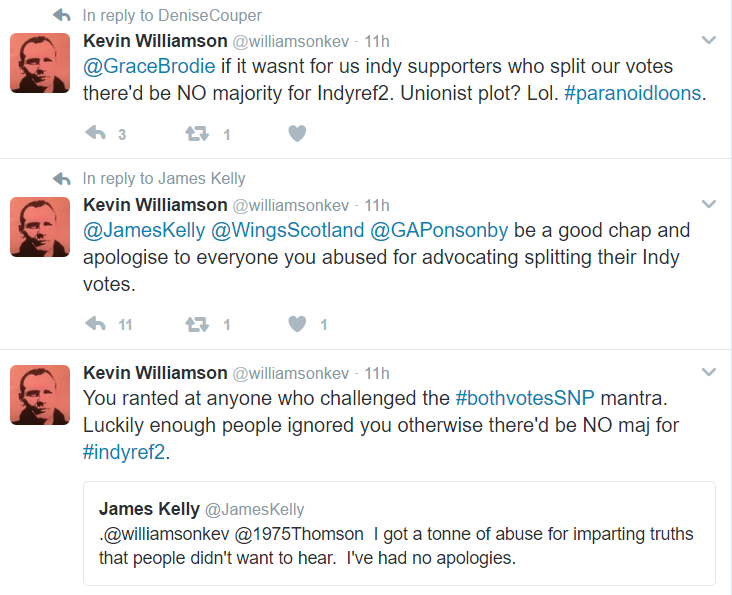


(Click to enlarge each screenshot.)
As regular readers know, I'm not someone who uses the word "lie" with abandon, but I have to say I don't see how I can avoid it in this particular case. (Although as we're now in the era of the "alternative fact", perhaps we do have a charitable euphemism that would fit.) Mr Williamson's basic claim - that there wouldn't now be a majority for an independence referendum if some SNP supporters hadn't "tactically" switched to the Greens on the list ballot - is not merely misleading, it's a downright lie. It's a claim that's not even supported by the Sunday Herald article he prays in aid, which in spite of being drenched in highly misleading spin, goes no further than to suggest that less tactical voting might have resulted in two more SNP seats, and four fewer Green seats. You won't need to consult an abacus to work out that this means that even the Sunday Herald are admitting there would have been a pro-independence majority with or without tactical voting. Perhaps more to the point, they're also tacitly admitting that the SNP would have retained their overall majority if tactical voting hadn't occurred - because, of course, two extra SNP seats would have been sufficient to take the party to the magic number of 65.
What is most disgraceful about Kevin's rant is not the outrageous and totally unfounded allegation that I was "abusive" towards tactical voting supporters. It's not the way he deliberately misrepresents my position on so-called tactical voting on the list, or even the way he deliberately misrepresents the Sunday Herald article. No, it's the way he tries to rewrite history about his own position during the election campaign - because back then he was never even talking about a situation in which it was assumed that the SNP might lose their majority, and tactical votes on the list might somehow help to salvage a joint SNP/Green majority. He was doing the polar opposite of that - he was saying that it was absolutely 100% certain that the SNP would win a majority on constituency seats alone, and he was pouring extreme mockery and scorn on anyone who dared to question that self-evidently ludicrous claim. (How he has the nerve to accuse his critics of "abuse" after his own antics during the campaign is, to say the least, somewhat hard to understand.) I think probably the simplest way of illustrating this point is to re-post an exchange I had with him in August 2015. I defy anyone to read the following and conclude that this is a guy who has a leg to stand on.
Kevin Williamson : ScotGoesPop all over place here. SNP at 62% now in Constit vote! 2nd Vote SNP will bolster Lab MSPs #ListVoteGreen
Me : "All over the place"? Do you mean I've contradicted myself? In what sense?
Kevin Williamson : You've consistently refused to acknowledge SNP are on course to win 65+ Constituency seats - enough to form Govt
Me : Exactly, I've consistently argued against that notion. How is that "all over the place"?
Kevin Williamson : because to argue against it is to deny the reality of consistently good opinion polls for SNP now at 62%
Me : Ah, now we're getting somewhere. The opinion polls are NOT showing the SNP consistently on 62%. Panelbase say 53%.
Kevin Williamson : almost every non partisan pundit forecasting SNP winning almost all of the Holyrood Constituency seats in 2016. Why not you?
Me : Not good enough, Kevin, justify that. Who are these pundits and when did they say it?
Kevin Williamson : I'm beginning to think you're either not paying attention to Scottish politics or in denial to make a party political point
Me : For clarity, have you ignored my question because you're unable to answer it, or for another reason?
Kevin Williamson : okay lets clarify things. How many Constituency seats do you think SNP are on course to win? Give us a ballpark figure?
Me : They are not "on course" for any particular figure. There is a 9% divergence between the pollsters, with NINE MONTHS to go!
Me : By the way, I'm still waiting to hear who these "non-partisan pundits" are.
Kevin Williamson : come on James! Is that the best analysis we're going to get from you on Scot Goes Pop? "Mibbes aye mibbes naw"
Me : This is pathetic, Kevin. Give me the names of the pundits you've cited, and direct me to what they've said.
Kevin Williamson : google the articles in wake of last couple of polls James. There are NONE suggesting SNP arent on course to sweep Constit seats.
Me : If it's that easy, you should be able to give me a couple of names so I know who you mean?
Kevin Williamson : An opinion poll analyst who refuses to project no. seats from opinion polls? Heard it all now. What you afraid of?
Me : Woah, woah, woah. What does "project" mean? You do know that opinion polls are snapshots not predictions? Perhaps you don't.
Kevin Williamson : You're just being pedantic. Every month Scot Goes Pop refuses to project no. of SNP seats its credibility will sink.
Me : If helping people understand the limitations of opinion polls will somehow harm my credibility, I'll have to live with that.
* * *
So let's sum up. Here we have a chap who screamed blue bloody murder at me because I refused - supposedly for reasons of blind partisanship - to forecast that the SNP would take circa 62% of the constituency vote (they actually took only 46.5%), and that they would win almost every single constituency seat (they actually failed to win FOURTEEN constituency seats). I don't think it's unreasonable or arrogant of me to point out that my determination to be more circumspect than he demanded was 100% vindicated in every respect. I couldn't predict the election result, and that was the whole point - nobody could, and he certainly couldn't. But having got everything so completely, hopelessly, cluelessly wrong, he now demands that I should apologise to him. If it wasn't so offensive, it would actually be very, very funny.
It's difficult to say too much about the John Curtice report that the Sunday Herald article refers to, because it apparently hasn't even been published yet. Most pertinently, it's unclear whether the report uses survey evidence to positively identify which votes were genuinely intended "tactically", or whether it just plays around with various electoral permutations and makes educated guesses about "tactical" intent. But even if we assume for the sake of argument (and I do stress that it's a highly questionable assumption) that the effect of tactical voting was exactly as Curtice is apparently saying it was (ie. a net loss of two SNP seats and a net gain of four Green seats), then what that would mean, without even a shadow of doubt, is that tactical voting comprehensively backfired as far as SNP supporters are concerned. Without it, there would have been a pro-independence majority and an outright SNP majority. As it is, there is a pro-independence majority, but no outright SNP majority. There is no planet on which that can be considered anything other than a worse outcome from an SNP supporter's point of view. A couple of extra pro-indy seats is not compensation for the loss of the SNP majority, because there is nothing we can do with 69 pro-indy seats that we couldn't have done with 67 - but as we've been reminded in recent days, there's a hell of a lot we could have done with 65 SNP seats that we can't do with only 63. Perhaps most importantly of all, retaining an outright SNP majority would have saved us from the gloating of the unionist media last May, which for a while threatened a decisive shift in the prevailing political "narrative". In a perverse way, we should count ourselves extremely lucky that the events of the EU referendum campaign promptly reversed the loss of momentum the independence movement had only just suffered as a result of the tactical voting debacle.
By the way, contrary to Kevin's desperate rewriting of history, I never, ever claimed that attempts at tactical voting would definitely have a negative effect. I always acknowledged the possibility that it could have a positive outcome - but I noted that if it did so, that would happen as a result of complete chance, and not as a result of sound strategy. The caution I gave to people was that what they thought was "tactical voting" was in fact "gambling voting" - you just couldn't tell whether you would get the result you intended, or whether it would blow up in your face. In this particular instance, the latter happened. And yet the siren voices who led SNP supporters onto the rocks are now claiming "vindication". It is quite simply extraordinary - but in the new Orwellian era of Trump, Spicer and Bannon, perhaps we shouldn't be shocked by anything.
You might be wondering whether the Sunday Herald are as guilty of misrepresentation as Kevin Williamson himself is. As I've already noted, their article is drenched in misleading spin, and frankly that's not at all surprising. They're obviously trying to cover their embarrassment over their moment of madness last spring when for one weekend only they were taken over lock, stock, and barrel by the Bella-sponsored "tactical voting" propaganda campaign, thus potentially contributing to the loss of the SNP majority. For the most part, though, the article does just about manage to stay on the right side of factual accuracy. Unfortunately, the one big exception is the totally inaccurate headline (the only thing that a lot of people will read), which falsely claims that "indy supporters who voted Green did not...harm SNP". That's directly contradicted by the text of the article itself. I won't use the word "lie" on this occasion, though - there may be a semi-innocent explanation, such as a sub-editor getting so carried away with the spin in the article that they honestly thought it said something that it didn't.
Final thought : While we're on the subject of undeserved apologies being demanded, it should be pointed out that I was actually promised an apology in advance by someone in the tactical voting lobby - but it never materialised. The CommonSpace columnist Jonathan Rimmer reacted with apparently genuine astonishment when I predicted (one of the few hard predictions that I did make) that Solidarity would outpoll RISE in Glasgow. He then spontaneously promised to apologise if I turned out to be right, which he was quite sure I wouldn't.

Actual Glasgow result : Solidarity - 3593 votes, RISE - 2454 votes. Admittedly a wee bit closer than I was expecting, but I did call it correctly.
In your own time, Jonathan.
Sunday, January 29, 2017
Landmark Panelbase poll finds 50% of public demand a second independence referendum within just THREE YEARS
You may remember that way back in the mists of the time (otherwise known as a couple of months ago), the unionist press were beside themselves with excitement about a YouGov poll that suggested for the first time that support for independence might have fallen fractionally below the 45% achieved in the September 2014 referendum. However, the actual drop in Yes support from the previous poll was small, and was potentially consistent with meaningless statistical 'noise' caused by normal sampling variation. So that meant we had to wait for more polls before we could judge whether the shift in opinion was real or illusory. Unfortunately, we've been stuck in polling Antarctica since then - all we've really had is a mildly encouraging BMG poll showing a very slight increase in support for Yes, but that wasn't reliable because BMG had radically (and rightly) changed their question since their previous poll. So today's Panelbase poll is the first solid piece of information since YouGov, but unfortunately it hasn't really cleared the mists much. It does show a trivial 1% decrease in Yes support since Panelbase last reported several months ago, but crucially, it differs from YouGov in continuing to show a Yes vote that is higher than in the 2014 referendum.
Should Scotland be an independent country?
Yes 46%
No 54%
No 54%
So the jury is still very much out - there's still no convincing evidence of a recent drop in support for independence. There are basically two plausible possibilities - either there has been a very small swing to No, or there has been no change at all.
In any case, given that we seem to be at least eighteen months away from a referendum, it's arguably not terribly important which side holds the lead at the moment - what matters is that we have an extremely close and competitive race that is there to be won. The more interesting question in the poll is perhaps the one on the principle of holding an early referendum...
Want a second independence referendum within two or three years?
Yes 50%
No 50%
No 50%
The 'Yes' figure is an aggregate of support for two very similar options - 27% of respondents want the referendum "in the next two or three years" as Brexit negotiations are still ongoing, while a further 23% of respondents want the referendum to be held "in about two or three years" after the negotiations have finished. The bottom line is that half the population want a referendum within a maximum of three years. You'll probably already have seen unionist politicians and journalists misrepresent the poll by concentrating solely on the 27% figure, and giving the impression that the other 73% don't want an early referendum. "Deliberately misleading" is the most charitable way of describing that, but it's basically an outright and extremely cynical falsehood.
Incidentally, the Panelbase datasets aren't out yet, so I've taken the above figures from the What Scotland Thinks website. I gather from observing a few exchanges on Twitter that there are slightly contradictory numbers doing the rounds - some people are saying that opposition to an early referendum stands at 51%, not 50%. Doesn't make a huge amount of difference one way or the other, though - at worst, we're talking about a 49/51 split, which is comfortably within the margin of error.
Panelbase also asked a few questions about attitudes to Europe. Support for Britain remaining within the European Union is near-enough identical to the result of the referendum in June, with 61% saying they would vote Remain in a repeat referendum, and 39% saying they would vote Leave. Those figures may not seem hugely surprising, but it's certainly important for the independence movement that there is no sign of Scotland reconciling itself to the UK-wide referendum result, which is something that potentially could have happened with the helpful 'encouragement' of the London-based broadcast media. Admittedly, another logical possibility was a widespread outbreak of buyers' remorse among the minority who voted Leave as the horrors of Brexit became ever-more apparent, and that doesn't seem to have happened either.
On the related but somewhat different question of whether an independent Scotland should apply to join the EU, the level of pro-European sentiment is much the same. I can't find the figures with neutrals excluded, but my rough calculation suggest they must be in the region of 61% to 39% in favour of EU membership. This handily gives the lie to David Mundell's very, very peculiar claim that Scottish voters only intended to vote in favour of Britain remaining within the EU, and didn't necessarily give a monkey's about whether Scotland did.
There is significant (albeit not overwhelming) concern about the impact of Brexit on the Scottish economy - 41% think the effect will be negative, and only 21% think it will be positive. The remainder either don't have an opinion or think the effect will be neutral.
There is a narrow plurality (40% to 37%) in favour of EU citizens having the automatic right to live and work in Scotland "after the UK leaves the EU". In spite of that being a positive result for the Yes/Remain movement, Professor John Curtice is reading exaggerated significance into the fact that the majority isn't much bigger. For my money, though, the question asked was far from ideal - many people will simply have been answering it on the logical basis of "free movement will obviously end in Scotland when it ends in Britain". It would have been better if respondents had been asked in a much clearer way about whether special arrangements should be made for Scotland to allow free movement to continue here, and only here, after Brexit.
Respondents were apparently extremely sceptical about whether the UK government will abide by its obligations under the Sewel Convention, which is supposed to prevent powers being stripped from the Scottish Parliament without its consent. A mere 29% expect Scotland to have more control over its own laws after Brexit, which in theory should happen automatically under the terms of the Scotland Act, as long as the Sewel Convention is adhered to. Recent statements from both Theresa May and David Davis suggest that the public's suspicions about their intentions may indeed be fully justified. (By the way, John Curtice seems to be missing the point on this subject - he interprets the poll as showing that the public do not share the SNP's concerns that Scotland will have less control over its own laws than it currently does as a result of Brexit. The actual concern is that the powers being repatriated from Brussels will be grabbed by Westminster, when in many cases they should go direct to Holyrood under the law as it stands.)
A final thought : incredibly, there are still unionist trolls on Twitter who are trying to paint Northumberland-based Panelbase as some kind of Scottish nationalist front organisation, and one that always produces much better results for Yes than any other firm. (The claim today being that if even Panelbase have Yes on "only" 46%, the situation must be grim indeed.) I think these people must be permanently stuck in a 2013 timewarp, because by the end of the 2014 referendum campaign Panelbase's figures were actually fairly typical for the polling industry as a whole, and unlike ICM and YouGov they didn't produce a late poll putting Yes in the lead.
On the related but somewhat different question of whether an independent Scotland should apply to join the EU, the level of pro-European sentiment is much the same. I can't find the figures with neutrals excluded, but my rough calculation suggest they must be in the region of 61% to 39% in favour of EU membership. This handily gives the lie to David Mundell's very, very peculiar claim that Scottish voters only intended to vote in favour of Britain remaining within the EU, and didn't necessarily give a monkey's about whether Scotland did.
There is significant (albeit not overwhelming) concern about the impact of Brexit on the Scottish economy - 41% think the effect will be negative, and only 21% think it will be positive. The remainder either don't have an opinion or think the effect will be neutral.
There is a narrow plurality (40% to 37%) in favour of EU citizens having the automatic right to live and work in Scotland "after the UK leaves the EU". In spite of that being a positive result for the Yes/Remain movement, Professor John Curtice is reading exaggerated significance into the fact that the majority isn't much bigger. For my money, though, the question asked was far from ideal - many people will simply have been answering it on the logical basis of "free movement will obviously end in Scotland when it ends in Britain". It would have been better if respondents had been asked in a much clearer way about whether special arrangements should be made for Scotland to allow free movement to continue here, and only here, after Brexit.
Respondents were apparently extremely sceptical about whether the UK government will abide by its obligations under the Sewel Convention, which is supposed to prevent powers being stripped from the Scottish Parliament without its consent. A mere 29% expect Scotland to have more control over its own laws after Brexit, which in theory should happen automatically under the terms of the Scotland Act, as long as the Sewel Convention is adhered to. Recent statements from both Theresa May and David Davis suggest that the public's suspicions about their intentions may indeed be fully justified. (By the way, John Curtice seems to be missing the point on this subject - he interprets the poll as showing that the public do not share the SNP's concerns that Scotland will have less control over its own laws than it currently does as a result of Brexit. The actual concern is that the powers being repatriated from Brussels will be grabbed by Westminster, when in many cases they should go direct to Holyrood under the law as it stands.)
A final thought : incredibly, there are still unionist trolls on Twitter who are trying to paint Northumberland-based Panelbase as some kind of Scottish nationalist front organisation, and one that always produces much better results for Yes than any other firm. (The claim today being that if even Panelbase have Yes on "only" 46%, the situation must be grim indeed.) I think these people must be permanently stuck in a 2013 timewarp, because by the end of the 2014 referendum campaign Panelbase's figures were actually fairly typical for the polling industry as a whole, and unlike ICM and YouGov they didn't produce a late poll putting Yes in the lead.
* * *
UPDATE (Tuesday morning) : As mentioned above, I wrote this post before Panelbase released their datasets, so I was having to rely on John Curtice's What Scotland Thinks website for information about the poll. Now that the datasets are out, it turns out that there were some inaccuracies on What Scotland Thinks. Most importantly, it turns out that half of the public want an indyref within just TWO years, not three. You can read an update HERE.
* * *
Subscribe to:
Posts (Atom)