
Monday, August 14, 2017
Pop Goes Global
Spotted this on Waverley Bridge when I was on my way to a Fringe show on Thursday night. I was going to sue, but then I remembered that imitation is the sincerest form of flattery. ("Imitation" is not a pun about the Jan Ravens half of the picture, although I've just realised that it could be.)


Tuesday, August 8, 2017
Greer makes a sectarian attack - will the self-appointed Civility Police intervene?

Above is the Green MSP Ross Greer, in a cosy chat with the notorious James McEnaney of RISE, using sectarian anti-Irish language to attack Jason Michael of Butterfly Rebellion (who is not Irish himself but lives in Dublin and has worked at the Glencree Centre for Peace and Reconciliation). This seems to be Greer's revenge for a number of strong (but entirely non-abusive) criticisms that Mr Michael has made of the radical left over the last couple of weeks. The implication seems to be that Mr Michael is some kind of unhinged militant nationalist.
Mr Greer of course penned a Sunday Herald column at the weekend, which was objectively damaging to the Yes movement in that it contained an ageist comment which deeply upset older Yes activists, and was gleefully seized upon by an array of unionist politicians, up to and including Ruth Davidson herself. In defence of Mr Greer, the editor of the Sunday Herald argued that "any damage done to the Yes movement is down to absurd conspiracy-theory trolls screaming traitor at folk who are the real stalwarts of Indy". Well, in the above screenshot, who exactly is it that best fits the description of a screaming, absurd conspiracy-theorist troll? Isn't it Mr Greer himself? It sure as hell isn't Mr Michael, who has been civil and measured throughout - as you can judge for yourself by reading an example of his writing HERE.
Having been on the opposite side of the debate to the likes of Mr Greer over the last couple of weeks, I can't have been alone in noticing how the radical left feel that their 'moral righteousness' gives them an exemption from the human decency that they demand of others. I've been on the receiving end of sweary personal abuse from them that is every bit as nasty as the stuff that is supposed to make Stuart Campbell untouchable (engaging with him in any way is now a worse crime than holocaust denial, apparently). In particular, I had an extraordinary conversation with someone a couple of nights ago in which she patiently explained to me why it was perfectly all right that she had repeatedly called me a "pr*ck" - her defence was basically that she thinks I am a "pr*ck". The Green party council candidate who I caught 'liking' a tweet describing me as a "f***ing fool" essentially shrugged his shoulders and said "so what?" (Can you imagine the outrage if an SNP candidate was caught 'liking' a tweet in which Stuart Campbell called someone a "f***ing fool"? Yeah, exactly.)
It's ironic that Mr Greer made a reference to the Irish revolutionary period, because it seems to me that it's the radical left who are actually caught up in the warped logic of revolutionary zeal. The designated 'enemies of the revolution' (ie. those who veer by even the tiniest fraction away from approved forms of discourse on identity politics) are effectively non-people, and anything at all can be done to them for the sake of the greater good. It's hard to see any other way in which leading figures on the radical left can dehumanise others and chuck around abuse while still honestly believing themselves to be champions of civility and decency in political debate.
Sunday, August 6, 2017
Westminster bubble yet to catch up with the Scottish Tories' slippage
James Forsyth had a very silly article in the Sun yesterday portraying Ruth Davidson as the kingmaker in any potential Tory leadership contest. No-one would deny that Davidson is currently enjoying a spell of considerable popularity among the Tory grass-roots (especially south of the border, where the myth of a "Scottish Tory victory" has taken root), but the bottom line is that everyone knows she's on the Europhile wing of the party, and that if she backs Amber Rudd for leader it'll be obvious she's doing it for Europhile reasons. Anti-European Tory members will listen carefully to what Davidson has to say, and then think "no, actually, we need a Brexiteer in there".
There are also a couple of side-remarks in Forsyth's article that had me scratching my head. He claims that Jeremy Corbyn would now be Prime Minister if it hadn't been for the Tories' mini-revival in Scotland. As I pointed out in the immediate aftermath of the election, that simply isn't true. We'd certainly be in a very different place if it hadn't been for the Scottish Tory gains, because the Tory-DUP deal wouldn't have been arithmetically viable, and as a result we'd be heading towards a second general election in the autumn. However, there would currently be a Tory caretaker administration, not a Labour one.
And Forsyth notes that Davidson doesn't want 10 Downing Street for herself, because her "immediate aim is to be First Minister of Scotland, not PM". OK, where to start with that one? First of all, it can't be that much of an "immediate" aim, because she had a chance to stand for First Minister only last year, and declined to do so. Incredibly, Willie Rennie stood but Davidson didn't. There isn't another Scottish Parliament election due until May 2021 - almost four years away. If she does have longer-term designs on a senior Cabinet position at Westminster, she may have to start planning her escape from Holyrood sooner than that. Her moment in the sun won't last forever.
But let's assume Davidson is still committed to Holyrood in 2021. How exactly does she become First Minister? There are only two realistic ways it could happen -
a) The Tories become the largest single party in the Scottish Parliament and form a minority government with the help of Labour and Lib Dem abstentions.
b) The Tories finish second in the election, but form a government after at least one other unionist party backs Davidson in the First Minister vote.
We can pretty much rule out option b) straight away. Yes, we all know Labour and the Tories are close allies in Scotland, but their cooperation has largely been of the deniable variety. The moment you have Jackie Bird telling Reporting Scotland viewers that Labour actively voted for a Tory government, it'll be game over for Labour. The problem may not be quite so stark for the Lib Dems, but I'm fairly confident they would also regard it as too much of a risk.
Which means the only way for Davidson to become FM is to 'win' the 2021 election - ie. for the Tories to become the largest single party. Well, right now we're in the afterglow of the Scottish Tories' best election result since 1983 - and the limited available polling evidence suggests they've slipped back to third place. How are things going to get any better than they are now? Tired Westminster governments generally lose support, not gain it. Perhaps Davidson's best hope would be for the Tory government to fall quickly, for Corbyn to become PM and then have time to fail...but there's no guarantee that turn of events wouldn't help the SNP more than the Tories.
Let's face it - Davidson is highly unlikely to ever become Scotland's political leader. Kenny "Devo or Death" Farquharson got carried away with the thrilling motion of his pom-poms a few weeks ago and announced that Kezia Dugdale is the next First Minister. He was getting way ahead of himself, but it's certainly fair to say that Dugdale as FM is now less implausible than Davidson as FM.
Saturday, August 5, 2017
SNP by-election fundraiser
Just thought I'd give a quick plug to a particularly important SNP campaign fundraiser. There's a local government by-election taking place in early September in the Cardonald ward - and it's one of those STV paradoxes where Labour are defending the seat even though the SNP won the popular vote in the ward in May. In theory it's a golden opportunity for the SNP to increase its representation on Glasgow City Council from 39 seats to 40, inching slightly closer to the magic number of 43 required for an absolute majority. Unfortunately, however, the SNP only won the ward by a roughly 43% to 38% margin in May, and there's almost certainly been a swing to Labour since then (even if there's ongoing uncertainty over exactly how big that swing has been). Labour probably ought to be regarded as the slight favourites for this contest, so the SNP's campaign on the ground will be all-important.
A relatively modest £1000 is being sought for the campaign - if you'd like to contribute, the fundraiser page can be found HERE.
There's also a by-election coming up in North Lanarkshire, which if anything is even more important, because it will decide whether the SNP remain the single largest party on the council. If anyone spots a crowdfunder for that one, let me know and I'll post the details.
Friday, August 4, 2017
Lament for the Colonel as Scottish Tories remain in third place in YouGov subsample
There's been such a drought of polling recently that I was beginning to think we weren't going to get anything more until the end of the English school holidays. However, a Britain-wide YouGov poll suddenly appeared today, suggesting that Labour's very narrow lead over the Tories has stabilised after falling from a peak of 8 points in early July. The Scottish subsample continues to show the now familiar tight three-way battle: Labour 33%, SNP 29%, Conservatives 28%, Liberal Democrats 7%, Greens 2%, UKIP 2%.
The most significant thing about those figures is that the Tories are in third place, which has consistently been the case in all four post-election YouGov subsamples. The lead has been switching back and forth between the SNP and Labour, so it's anyone's guess which of those two parties would be in first place if YouGov conducted a full-scale Scottish poll of Westminster voting intentions right now. An average of the four subsamples produces an exact dead heat: SNP 32.3%, Labour 32.3%, Conservatives 26.3%, Liberal Democrats 6.0%.
On a more positive note, the SNP have had the lead in the majority of subsamples conducted across all firms. There have been fourteen subsamples since the election, with the SNP ahead in eight, Labour in five, and the Tories in only one. The SNP have been in either first or second place in all fourteen subsamples, whereas both Labour and the Tories have been in third place in some - underscoring the general impression that the SNP are the party most likely to have a small overall lead.
The most significant thing about those figures is that the Tories are in third place, which has consistently been the case in all four post-election YouGov subsamples. The lead has been switching back and forth between the SNP and Labour, so it's anyone's guess which of those two parties would be in first place if YouGov conducted a full-scale Scottish poll of Westminster voting intentions right now. An average of the four subsamples produces an exact dead heat: SNP 32.3%, Labour 32.3%, Conservatives 26.3%, Liberal Democrats 6.0%.
On a more positive note, the SNP have had the lead in the majority of subsamples conducted across all firms. There have been fourteen subsamples since the election, with the SNP ahead in eight, Labour in five, and the Tories in only one. The SNP have been in either first or second place in all fourteen subsamples, whereas both Labour and the Tories have been in third place in some - underscoring the general impression that the SNP are the party most likely to have a small overall lead.
Fly on the Wings of love, fly baby fly
I was a bit wary when I started reading Robin McAlpine's reflections on the controversy of recent days, because I thought he might simplistically portray CommonSpace as the victim of the piece - an interpretation which I think is quite difficult to sustain, especially after the ugly descent into witch-hunt territory when the website's editor 'named and shamed' Mhairi Black MP for simply hitting the 'like' button on tweets that were supportive of Scotland's leading pro-independence blogger Stuart Campbell. However, I'm relieved to say there's much more to Robin's article than that, and indeed it's an all-too-rare example of a column published on CommonSpace coming to Stuart's defence and pointing out the lack of perspective of those who constantly demonise him ("vendetta masquerading as virtue").
Basically Robin calls for "kindness not cruelty" towards both Wings and CommonSpace, which is a refreshingly ecumenical attitude. But I think the deficiency of the article is that it doesn't really acknowledge that CommonSpace itself has failed that test in recent days, and therefore not all of the brickbats that have been thrown at the site are totally unreasonable. Robin says that he can find nothing malicious in Angela Haggerty's Sunday Herald column about Stuart, and in terms of what she said directly that's true enough - but there was some fairly unsubtle innuendo in there. She suggested that Stuart was making a mistake that was somehow equivalent to the one made by a well-known politician who was found guilty of perjury. It's not terribly surprising that some of Stuart's supporters were angry enough to start thinking in the heat of the moment about whether CommonSpace was the sort of site they wanted to continue supporting financially. Robin suggests there was a "campaign to de-fund" the site - based on what I saw that isn't really true. Some people spontaneously announced they would be cancelling their subscriptions and there appeared to be a copycat effect. The only hint I could see of a true 'campaign' was the Butterfly Rebellion explicitly urging people to unfollow the CommonSpace Twitter account en masse, which I thought was way over-the-top (and also very surprising, given that Butterfly Rebellion is an intelligent and quality website).
As far as Jordan Daly's infamous hatchet job on Wings is concerned, Robin's defence is that the column was not commissioned, but was submitted in the normal way and met the criteria for publication, and therefore there was no reason not to publish it. That's fine as far as it goes, but I think it's a bit naive to imagine that an all-out attack on an important part of the independence movement can just be treated in the same way as any other article without there being negative consequences. I think CommonSpace could have avoided much of what happened if they had taken the following steps -
1) The title of the column should have been softened. Over the years I've written dozens of articles for other websites, but I can count on the fingers of one hand the number of times my own suggested title has been used without any alteration. An editor (or editorial team) can reasonably be expected to take some responsibility for the title of a column, which in this case was needlessly provocative by calling on readers to send the most popular pro-independence site packing.
2) There should have been a very strong disclaimer on the webpage itself that the column reflected the views of the writer, and not the editorial stance of CommonSpace. There seems to be a feeling that this sort of thing should just be taken as read, but again, I think that's naive. CommonSpace is well-known to have a past history of publishing brutal attacks on Wings, and not much of a past history of publishing defences of Wings. Not long before Jordan Daly's column appeared, the editor had tweeted views on the Wings controversy that seemed very much in line with Mr Daly's own perspective - and of course her Sunday Herald column was published not long afterwards. If there appears to be no obvious distinction between a columnist's views and the editorial line, people are naturally going to conflate the two unless you very clearly and prominently explain what the difference actually is.
3) The column should have been accompanied with another column putting the opposite view. I have a feeling the justification for that not happening would be that "no column putting the opposite view was submitted", but if you want to be seen as being responsible and not causing unnecessary ruptures in the independence movement, I think you need to be more proactive than that. A pro-Wings response should simply have been commissioned - ideally from Stuart himself, but if he wasn't interested I'm sure there would have been any number of other people willing to do it instead.
* * *
On the subject of the abuse Stuart Campbell has to put up with on a daily basis, here's another invaluable contribution to the cause of civility and solidarity from "Richard Palmer" - the troll ringleader who briefly turned his fire on me last week. He's now calling himself "Elite Baklava". Is it just me, or is "we need to do something about w***s like Campbell" a bit of a sinister thing to say? What on earth would that "something" be?


As you can see, the tweet in which Richard calls me a "f***ing fool" received two 'likes' - and one of them was from "David Al", aka David Allison, who was the Green Party's official candidate in the Barrhead ward at the council elections just three months ago. Call me biased, but if it's now in fashion to have witch-hunts based on politicians' Twitter 'likes', that's where I'd be starting.
I've no idea whether the Richard gang have any direct involvement in the notorious A Thousand Flowers website, but the overlap in terms of politically correct zealotry and mindless personal abuse is pretty striking.
Basically Robin calls for "kindness not cruelty" towards both Wings and CommonSpace, which is a refreshingly ecumenical attitude. But I think the deficiency of the article is that it doesn't really acknowledge that CommonSpace itself has failed that test in recent days, and therefore not all of the brickbats that have been thrown at the site are totally unreasonable. Robin says that he can find nothing malicious in Angela Haggerty's Sunday Herald column about Stuart, and in terms of what she said directly that's true enough - but there was some fairly unsubtle innuendo in there. She suggested that Stuart was making a mistake that was somehow equivalent to the one made by a well-known politician who was found guilty of perjury. It's not terribly surprising that some of Stuart's supporters were angry enough to start thinking in the heat of the moment about whether CommonSpace was the sort of site they wanted to continue supporting financially. Robin suggests there was a "campaign to de-fund" the site - based on what I saw that isn't really true. Some people spontaneously announced they would be cancelling their subscriptions and there appeared to be a copycat effect. The only hint I could see of a true 'campaign' was the Butterfly Rebellion explicitly urging people to unfollow the CommonSpace Twitter account en masse, which I thought was way over-the-top (and also very surprising, given that Butterfly Rebellion is an intelligent and quality website).
As far as Jordan Daly's infamous hatchet job on Wings is concerned, Robin's defence is that the column was not commissioned, but was submitted in the normal way and met the criteria for publication, and therefore there was no reason not to publish it. That's fine as far as it goes, but I think it's a bit naive to imagine that an all-out attack on an important part of the independence movement can just be treated in the same way as any other article without there being negative consequences. I think CommonSpace could have avoided much of what happened if they had taken the following steps -
1) The title of the column should have been softened. Over the years I've written dozens of articles for other websites, but I can count on the fingers of one hand the number of times my own suggested title has been used without any alteration. An editor (or editorial team) can reasonably be expected to take some responsibility for the title of a column, which in this case was needlessly provocative by calling on readers to send the most popular pro-independence site packing.
2) There should have been a very strong disclaimer on the webpage itself that the column reflected the views of the writer, and not the editorial stance of CommonSpace. There seems to be a feeling that this sort of thing should just be taken as read, but again, I think that's naive. CommonSpace is well-known to have a past history of publishing brutal attacks on Wings, and not much of a past history of publishing defences of Wings. Not long before Jordan Daly's column appeared, the editor had tweeted views on the Wings controversy that seemed very much in line with Mr Daly's own perspective - and of course her Sunday Herald column was published not long afterwards. If there appears to be no obvious distinction between a columnist's views and the editorial line, people are naturally going to conflate the two unless you very clearly and prominently explain what the difference actually is.
3) The column should have been accompanied with another column putting the opposite view. I have a feeling the justification for that not happening would be that "no column putting the opposite view was submitted", but if you want to be seen as being responsible and not causing unnecessary ruptures in the independence movement, I think you need to be more proactive than that. A pro-Wings response should simply have been commissioned - ideally from Stuart himself, but if he wasn't interested I'm sure there would have been any number of other people willing to do it instead.
* * *
On the subject of the abuse Stuart Campbell has to put up with on a daily basis, here's another invaluable contribution to the cause of civility and solidarity from "Richard Palmer" - the troll ringleader who briefly turned his fire on me last week. He's now calling himself "Elite Baklava". Is it just me, or is "we need to do something about w***s like Campbell" a bit of a sinister thing to say? What on earth would that "something" be?


As you can see, the tweet in which Richard calls me a "f***ing fool" received two 'likes' - and one of them was from "David Al", aka David Allison, who was the Green Party's official candidate in the Barrhead ward at the council elections just three months ago. Call me biased, but if it's now in fashion to have witch-hunts based on politicians' Twitter 'likes', that's where I'd be starting.
I've no idea whether the Richard gang have any direct involvement in the notorious A Thousand Flowers website, but the overlap in terms of politically correct zealotry and mindless personal abuse is pretty striking.
Tuesday, August 1, 2017
But it is, perhaps, the end of the beginning...
I'm indebted to a certain controversial rapper, because if I hadn't randomly followed a link in one of his tweets, I would be unaware of the fact that Allan Moore has charged me with (almost) singlehandedly destroying the Yes movement. I fear Allan may be overestimating my importance just a tad, but it would definitely be worth it if it was true. Just think of my place in the history books - they'd say the survival of the glorious United Kingdom of Great Britain and Northern Ireland was all down to that Scot Goes Pop blogger bloke. I'd be the modern-day Churchill.
"We had seen this argument before, with the blogger James Kelly aggressively promoting the 'both votes SNP' argument during last year’s Holyrood elections."
Well, I don't know if that's news to you, but it's sure as hell news to me. In reality, I must have been one of the few people on either side of the debate who went out of my way to avoid using the 'both votes SNP' line, and continually said how unhelpful and inappropriate it was. My main preoccupation was with getting the message out that so-called 'tactical voting on the list' was not feasible, and that people should vote for their first-choice party on the list vote - the more important of the two ballots. In practice, that meant trying to persuade SNP supporters that they should stick with the SNP on the list - because it was SNP supporters who were being targeted by the tactical voting lobby. The SNP weren't going around telling Green supporters that they should 'tactically' abandon their own party on the list.
"As for the both votes strategy it was a success... except it wasn’t. As the SNP gathered their biggest votes ever for FPTP and beat Labour’s record for list votes their success in the FPTP seats worked against them in the list seats while the thing which lost them the cherished majority was, well SNP losses in North East Fife, Edinburgh Western and Edinburgh Central which did for them."
Simply not true. Holding on to those constituencies would have been a 'get out of jail free' card for the SNP, but their failure to do so is not the primary reason they lost their majority. They actually enjoyed a significant net gain in terms of constituency seats, in line with their increased constituency vote share. But their list vote dropped from 44% to 41.7%, and because the overall composition of parliament is essentially determined by the list vote, their overall number of seats naturally fell. If you lose support on the more important of the two ballots, more often than not you're going to lose seats. This isn't rocket science.
"[Cat] Boyd’s appearance provoked obviously a reaction from the one eyed Yessers and also an astonishing response from the aforementioned Mister Kelly of the Scotland Goes Pop blog. Astonishing, because the post to all intents and purposes lays out a manifesto for an ideologically pure pro-Independence drive for votes taking Independence and independence only as the basis for your vote. There is no concession to whether you agree with the SNP on, say, local authority funding, education, taxation or relations with the EU, you vote SNP for independence... or you are the enemy for voting for a ‘Yoon’ party."
First of all, I did not call Cat Boyd "the enemy", and I'm not in the habit of calling either individuals or political parties "Yoons". (Nor, incidentally, is this blog called "Scotland Goes Pop", so I'm beginning to wonder about Allan's attention to detail.) However, it's quite true that I believe (and I think this is a statement of the bleedin' obvious) that a vote for an anti-independence party like Labour is a vote against independence, and that a vote for an anti-indyref party like Labour is a vote against holding an indyref. By the same token, a vote for an anti-European party like UKIP is a vote against remaining in the EU, the single market and the customs union, and people would rightly laugh at you if you tried to pretend it was anything else.
Any party is likely to have policies you disagree with, and so you're inevitably going to end up 'voting for' things you don't actually believe in. For example, I'm not mad keen on the fact that my vote for the SNP was an endorsement of NATO membership. But that didn't stop me, because leaving NATO isn't a high priority for me. And that's the bottom line - voting "proudly" for an anti-independence party doesn't mean that you're no longer in favour of independence, but it does mean you're not that bothered about it in comparison to other things. That's a pretty incredible position for the co-founder of a party that portrayed itself in last year's Holyrood election as passionately pro-independence, and sought pro-independence "tactical" votes on that basis. (Indeed, the 'I' in the acronym "RISE" actually stands for independence.)
"Kelly’s plot was well and truly lost right at the start when he said that RISE were now vulnerable...the point missed by Kelly is that RISE were canvassing for votes from the Radical Independence wing of the Independence constituency, votes that would only go to the SNP tactically anyway."
As RISE received only 0.5% of the national list vote, it's quite difficult (and perhaps not particularly important) to work out who those people were. Nevertheless, there is absolutely no doubt whatsoever that RISE very much wanted SNP supporters to lend them their list votes on a "tactical" basis. A press release was put out to that effect. If the same pitch is made next time around, it'll be undermined by the lack of commitment to independence demonstrated by a leading figure like Cat Boyd. That's the point I was making.
"We had seen this argument before, with the blogger James Kelly aggressively promoting the 'both votes SNP' argument during last year’s Holyrood elections."
Well, I don't know if that's news to you, but it's sure as hell news to me. In reality, I must have been one of the few people on either side of the debate who went out of my way to avoid using the 'both votes SNP' line, and continually said how unhelpful and inappropriate it was. My main preoccupation was with getting the message out that so-called 'tactical voting on the list' was not feasible, and that people should vote for their first-choice party on the list vote - the more important of the two ballots. In practice, that meant trying to persuade SNP supporters that they should stick with the SNP on the list - because it was SNP supporters who were being targeted by the tactical voting lobby. The SNP weren't going around telling Green supporters that they should 'tactically' abandon their own party on the list.
"As for the both votes strategy it was a success... except it wasn’t. As the SNP gathered their biggest votes ever for FPTP and beat Labour’s record for list votes their success in the FPTP seats worked against them in the list seats while the thing which lost them the cherished majority was, well SNP losses in North East Fife, Edinburgh Western and Edinburgh Central which did for them."
Simply not true. Holding on to those constituencies would have been a 'get out of jail free' card for the SNP, but their failure to do so is not the primary reason they lost their majority. They actually enjoyed a significant net gain in terms of constituency seats, in line with their increased constituency vote share. But their list vote dropped from 44% to 41.7%, and because the overall composition of parliament is essentially determined by the list vote, their overall number of seats naturally fell. If you lose support on the more important of the two ballots, more often than not you're going to lose seats. This isn't rocket science.
"[Cat] Boyd’s appearance provoked obviously a reaction from the one eyed Yessers and also an astonishing response from the aforementioned Mister Kelly of the Scotland Goes Pop blog. Astonishing, because the post to all intents and purposes lays out a manifesto for an ideologically pure pro-Independence drive for votes taking Independence and independence only as the basis for your vote. There is no concession to whether you agree with the SNP on, say, local authority funding, education, taxation or relations with the EU, you vote SNP for independence... or you are the enemy for voting for a ‘Yoon’ party."
First of all, I did not call Cat Boyd "the enemy", and I'm not in the habit of calling either individuals or political parties "Yoons". (Nor, incidentally, is this blog called "Scotland Goes Pop", so I'm beginning to wonder about Allan's attention to detail.) However, it's quite true that I believe (and I think this is a statement of the bleedin' obvious) that a vote for an anti-independence party like Labour is a vote against independence, and that a vote for an anti-indyref party like Labour is a vote against holding an indyref. By the same token, a vote for an anti-European party like UKIP is a vote against remaining in the EU, the single market and the customs union, and people would rightly laugh at you if you tried to pretend it was anything else.
Any party is likely to have policies you disagree with, and so you're inevitably going to end up 'voting for' things you don't actually believe in. For example, I'm not mad keen on the fact that my vote for the SNP was an endorsement of NATO membership. But that didn't stop me, because leaving NATO isn't a high priority for me. And that's the bottom line - voting "proudly" for an anti-independence party doesn't mean that you're no longer in favour of independence, but it does mean you're not that bothered about it in comparison to other things. That's a pretty incredible position for the co-founder of a party that portrayed itself in last year's Holyrood election as passionately pro-independence, and sought pro-independence "tactical" votes on that basis. (Indeed, the 'I' in the acronym "RISE" actually stands for independence.)
"Kelly’s plot was well and truly lost right at the start when he said that RISE were now vulnerable...the point missed by Kelly is that RISE were canvassing for votes from the Radical Independence wing of the Independence constituency, votes that would only go to the SNP tactically anyway."
As RISE received only 0.5% of the national list vote, it's quite difficult (and perhaps not particularly important) to work out who those people were. Nevertheless, there is absolutely no doubt whatsoever that RISE very much wanted SNP supporters to lend them their list votes on a "tactical" basis. A press release was put out to that effect. If the same pitch is made next time around, it'll be undermined by the lack of commitment to independence demonstrated by a leading figure like Cat Boyd. That's the point I was making.
Sunday, July 30, 2017
The easily distracted
Angela Haggerty is well within her rights to use her Sunday Herald column to further exacerbate the feud between CommonSpace and Wings Over Scotland if that's what she wants, but in doing so she's made a number of dubious points - and one of them is downright reprehensible. At the start of the piece, she recalls the immense political and personal damage done to Tommy Sheridan as a result of his legal action against the News of the World. Later, she notes that Sheridan "took his ego with him" to court, and that Stuart Campbell of Wings is "displaying those same signs of hubris" in preparing a defamation action against Kezia Dugdale. This appears to be a weasel word-ish (ie. conveniently deniable) way of implying that Stuart is the sort of person who would either commit perjury, or commit a wrongdoing of equivalent gravity, to win his case. Angela has got no conceivable justification for that kind of nasty innuendo. Doubtless if Stuart suffers the embarrassment of losing his case, she'll claim that was the risk she was referring to, but there's a world of difference between losing a court case after pursuing it in good faith, and ending up in prison after being ruled to have misled the court.
Angela also draws a rather heroic comparison between the action against Ms Dugdale, and the one against Green MSP Andy Wightman, who she notes would be forced into bankruptcy if he loses, which would automatically cost him his seat in parliament. Again, this seems to be a way of implying that because one defamation case against a politician has troubling implications for democracy, the same must automatically be true of another defamation case against a politician. In reality, the differences between the two cases are not hard to spot. It seems unlikely that Kezia Dugdale would face ruin if she loses, given the more modest damages sought, and especially given that powerful and wealthy people presumably have her back. It's also not the case that Ms Dugdale is being hounded by a person or organisation that has unlimited access to the law due to their fabulous wealth. Indeed, one of the main criticisms of Stuart is that he isn't able to cover the costs himself and has had to run a fundraiser - something which anyone could theoretically do with the help of social media if they were persuasive enough. So which is it? Is it a good thing or a bad thing that the 'little guy' has the same access to the law as Andy Wightman's pursuers? The reason Stuart's fundraiser has succeeded is that the backers perceive Ms Dugdale as the establishment figure who thinks she can act with impunity - very much the reverse of the Wightman scenario.
Angela warns Stuart that his posting history will be dragged up in court - for example his controversial views on the Hillsborough tragedy, and his alleged "transphobia" in comments about Chelsea Manning. Well, that's as may be, but none of that will be directly relevant to the much narrower point being adjudicated upon. Stuart is specifically claiming that Ms Dugdale defamed him by calling him homophobic. Transphobia and homophobia are self-evidently not the same thing, and it's even harder to see how an opinion about the cause of a disaster in a football stadium twenty-eight years ago will constitute proof of prejudice against gay people. It's perfectly possible to think Stuart is offensive while still accepting he is not homophobic.
The conclusion of the article contains the standard warning that this whole thing is just oh so terribly damaging to the independence movement. Well, it's only a week ago that Angela said it was damaging to the independence movement that Cat Boyd was being criticised for pursuing her political objectives in her own chosen way (ie. by voting for an anti-indy party at the general election), so it seems pretty illogical that Angela now thinks savaging Stuart for doing his own thing is somehow helpful. She thinks the court case will be a "distraction" for the movement, and yet in the notorious attack piece she ran on CommonSpace the other day, Wings (an astonishingly popular website read by hundreds of thousands of people in Scotland) was sneeringly dismissed as "nothing more than a man with a blog...[with] a bit of a strange cult following".
How much of a "distraction" could anything done by such a 'fringe' figure ever be? Unless, of course, some people are determined to be "distracted" at great length in pursuance of their own agendas?
Friday, July 28, 2017
Why should a citizen exercising his legal rights cause a "schism"?
As a result of last night's bizarre episode, I was left with little option but to block another batch of 'trendy Yessers' on Twitter, so perhaps now I have even less to lose by saying what I think about the latest controversy related to Wings. I am, to put it mildly, a bit bemused by the suggestion that Stuart Campbell is causing a "schism" in the Yes movement simply by seeking legal redress. If a schism occurs over this (and I don't think it will), it'll happen because some people have lost their sense of perspective about Stuart to such an extent that they feel he shouldn't be able to exercise his basic legal rights. In the first instance, this is a private matter between Stuart and Kezia Dugdale as individuals. But, in order to bring a legal action against Ms Dugdale, Stuart requires funds. Some people have sufficient private means to go to court, but those that don't have to seek alternative methods. There is nothing illegitimate in the method Stuart has selected. On the face of it, it's very hard to see why anyone thinks they have a right to be angry about what he's done so far.
It seems to me the subtext of the complaints (and for the most part it is only a subtext) is that Stuart is 'obviously' guilty of homophobia, and that the court action is compounding it - in other words that taking Ms Dugdale to court is in itself a form of homophobia. That's getting into very dangerous territory, and it will come back to bite people if a judge decides that Stuart is not homophobic and was defamed. It may be a different story if the opposite verdict is reached, but that's a very big 'if', and at the moment too many people are putting the cart before the horse.
My own personal view is that what Stuart said about David Mundell was extremely hurtful but not homophobic. The comment would have been particularly wounding because it went to the heart of the experience of gay men in a society that doesn't accept them - ie. not being able to be true to themselves to such an extent that they might find a life partner of the opposite sex and start a family with them. It also arguably implied that any children that result from such a relationship 'shouldn't have happened', which is profoundly insulting for the individuals involved. But that's the point - it was insulting and hurtful for the individuals. To have crossed the boundary and actually become homophobic, I believe the comment would have had to say that society is/was right not to be accepting of gay relationships, and in fact it did the complete opposite.
The other justification for the "schism" argument is that Stuart is demanding support for his case as a "test of loyalty". As far as I can see, that's wholly untrue. He was irritated by attacks on him from the direction of CommonSpace, largely because he had strongly backed that website's editor in her dispute with the Sunday Herald and felt he deserved better as a result. But 'deserving better' does not necessarily mean active support - it could have just meant the absence of a rather gratuitous savaging. The idea that Stuart is trying to set himself up as some kind of overlord of the Yes movement is...well, it's a pretty obvious straw man.
More inspiring civility from our friends on the radical left...
It's genuinely quite disconcerting when half a dozen people you don't know from Adam suddenly launch a downright nasty, childish tag-team attack on you on Twitter for no apparent reason. These are people who clearly know all about me, hold very strong views about me, some of which appears to go all the way back to Christmas when I wrote a satirical poem that was a bit too close to the bone for some people on the radical left. And yet during all of those months of them nursing such a bitter personal grievance, I heard nothing from them, leaving me unaware of their existence. Then suddenly it all explodes in the space of a few minutes. Why?
Having thought about it, I've come to the strange conclusion that this was a pre-planned trolling operation. I think a few radical left activists got together after seeing me ask an inconvenient question, and decided it was my turn to get a playground monstering. In my view this sort of behaviour is totally unacceptable, but I'm not holding my breath for the self-appointed Civility Police on the radical left to actually condemn it - as they would do in an instant if it was coming in the opposite direction.


Utterly bizarre. If anyone has a clue who Richard and his chums are (there was also someone called Rachel McCormack), and what their agenda is, please do enlighten me.
UPDATE: I am reliably informed that Rachel McCormack is "a slightly contrarian, Scottish nationalist food and whisky writer" who has hated my guts for some time, even though she gets me mixed up with my Labour MSP namesake. You learn something new every night.
Having thought about it, I've come to the strange conclusion that this was a pre-planned trolling operation. I think a few radical left activists got together after seeing me ask an inconvenient question, and decided it was my turn to get a playground monstering. In my view this sort of behaviour is totally unacceptable, but I'm not holding my breath for the self-appointed Civility Police on the radical left to actually condemn it - as they would do in an instant if it was coming in the opposite direction.

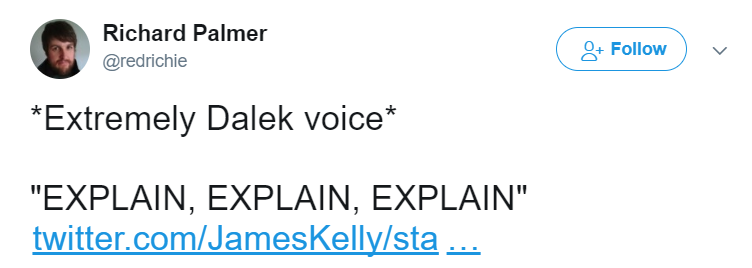


Utterly bizarre. If anyone has a clue who Richard and his chums are (there was also someone called Rachel McCormack), and what their agenda is, please do enlighten me.
UPDATE: I am reliably informed that Rachel McCormack is "a slightly contrarian, Scottish nationalist food and whisky writer" who has hated my guts for some time, even though she gets me mixed up with my Labour MSP namesake. You learn something new every night.
Subscribe to:
Posts (Atom)