Saturday, July 15, 2023

Do the SNP suddenly regard their Western Isles heartland as expendable? If so, why?

This is something I've been saying about the SNP for years, including prior to the spring of 2021 when I was still a member of the party.  I simply cannot understand how the SNP leadership can justify insisting on iron discipline among the rank-and-file membership, with a view to winning as many votes and seats as possible, and with the implication that a lost seat here or there could make all the difference to independence, when the leadership themselves are quite happy to needlessly chuck valuable seats away like confetti if the fancy takes them.  How many times has this happened now?  In the middle of the 2019 general election campaign, they hung Neale Hanvey out to dry over extremely tenuous and dubious allegations of antisemitism, which if I recall correctly were mainly about an article he tweeted or retweeted without checking carefully enough.  95 times out of 100, that ludicrous over-reaction from the SNP would have led to Labour winning the Kirkcaldy & Cowdenbeath constituency by default, but amazingly we got away with it on that occasion.  What should have happened, of course, is that Neale Hanvey should have put out an agreed apology for being a little bit careless with what he tweeted, but other than that the SNP should have stood by their man and stressed they were certain of his good faith.  What were they so afraid of?  OK, they might have faced spurious accusations of "institutionalised antisemitism" from the usual quarters, but that only becomes a problem if you make it one.  Very few votes are swung by that sort of thing if you simply face it down.

Then there was the Margaret Ferrier episode.  If the SNP had stood by her, it wouldn't necessarily have guaranteed that she'd have avoided being removed from her position, but she certainly would have had a much better chance.  As it is we have the grotesque spectacle of the SNP actively campaigning - they're literally one of two officially registered anti-Ferrier campaigners along with Labour - for a by-election to be held that they know is highly likely to lead to a pro-independence MP being replaced by a Labour MP.

And now they seem to be hellbent on also throwing away the Na h-Eileanan an Iar constituency, which they've held since 2005, long before their 2015 breakthrough, and which they previously held between 1970 and 1987.  Indeed, in the 1970 general election, it was the one and only constituency that they won anywhere in Scotland.  This is heartland territory that they suddenly seem to think is expendable for some reason.  It's all so pointless - why pick sides in a personal dispute between two MPs?  Angus MacNeil clearly felt that Brendan O'Hara had bullied him and that he was merely standing up for himself, so by suspending only Mr MacNeil for a week, the leadership were bound to look like they were enabling and endorsing bullying, and they could reasonably have expected Mr MacNeil to start considering his options as a result.  But even once he did that, he left himself a clear potential route back, which the leadership have now stupidly closed off by initiating proceedings likely to lead to his expulsion.  What does it matter if they think they're technically following the rule book?  There was a much stronger case, based on crystal-clear precedents, for suspending Nicola Sturgeon, Colin Beattie and Peter Murrell after the arrests, but they somehow managed to come up with excuses for giving those three people a free pass.

Make no mistake, Angus MacNeil may suffer as a result of this but the SNP will suffer even more - ultimately it's themselves they're punishing, not him.  He's made clear he will stand for re-election no matter what happens, which presumably means if he is expelled he will be standing either as an independent candidate or under the Alba banner.  Either of those scenarios would make the constituency practically unwinnable for the SNP.  Na h-Eileanan an Iar is one of the very, very few constituencies in Scotland (or anywhere in the UK for that matter) where people choose how to vote as much on the basis of the candidate as on the basis of the party.  After eighteen years in harness, Angus MacNeil is highly likely to have a sizeable personal vote which he will carry over either to Alba or to his independent campaign.  Precisely how sizeable is anyone's guess, but what will probably ensue is a two-horse race between Mr MacNeil and Labour, who are also fielding a very well-known (if rather controversial) candidate in the shape of Torcuil Crichton.  The absolute best-case scenario for the SNP might be to finish as runners-up to Labour, with Mr McNeil a strong third.  

Incidentally, if Mr McNeil is expelled, I very much hope he stands for Alba rather than as an independent.  Whatever he achieves as an independent candidate, no matter how remarkable, would be localised and strictly time-limited.  Whereas if he was to hold the seat as an official Alba candidate, that would have the potential to be a transformational moment for Scottish politics as a whole.

*  *  *

I launched the Scot Goes Pop fundraiser for 2023 a few weeks ago, and the running total has now passed £2000.  The target figure is £8500, however, so there's still quite some distance to travel.  If you'd like to help Scot Goes Pop continue by making a donation, please click HERE.  Many thanks to everyone who has donated so far.

Friday, July 14, 2023

Breaking: IPSO doubles down on its eccentric definition of 'press regulation' with its latest startling ruling that "yes, the Daily Express lied, but that's OK because The National hates Britain"

On 22nd May of this year, the Scottish Daily Express website published one of its regular wildly misleading articles about Scottish independence opinion polling, and it once again strayed into outright falsehood on one key point.  It claimed that "in fact, 'Yes' has only been higher than 46 per cent twice this year - both in polls carried on for the anti-Britain The National newspaper".  By definition that claim is a lie, because The National have only commissioned one poll this year - indeed, to the best of my knowledge that's the one and only poll they've ever commissioned in their whole nine-year existence.  Because the Express were referring to the numbers prior to Don't Knows being stripped out, the second poll they were referring to can only have been the Find Out Now poll I personally commissioned for Scot Goes Pop in March.  Before the exclusion of Don't Knows, that poll had Yes on 50% and No on 46%.  So the Express were falsely claiming that both polls with a high Yes vote had been commissioned by The National, when in fact only one of them had been.  The clear implication was that the results of the polls were somehow suspect or less credible due to both having been supposedly commissioned by exactly the same "anti-Britain" client.  Presumably we were supposed to believe The National had somehow been able to 'influence' or 'direct' the results of the polls, even though Find Out Now is affiliated to the British Polling Council and abides by that organisation's strict rules.

Having commissioned the March poll, I'm ideally placed to state beyond all doubt that The National had nothing whatever to do with it, not even informally.  I paid a significant sum of money for the poll from funds that had been contributed by generous Scot Goes Pop readers.  I spent probably around two weeks in quite complicated discussions with Find Out Now over the wordings of the supplementary questions in the poll, involving several phone calls, one video call, and goodness knows how much drafting and redrafting.  I didn't even inform The National of the poll's existence until after I received the results, which to my surprise included an outright Yes lead on the headline independence question.  For the record, I'm still on perfectly good terms with The National, but it won't surprise you to discover that they've contacted me far, far, far less often since I joined the Alba Party in 2021, and it's probably safe to assume there's a direct cause-and-effect explanation there.  When I realised the poll was newsworthy enough that The National might want to report it, I even had to check who the new editor was, and you might have seen my increasingly frantic attempts on Twitter to try to attract the attention of the paper's reporters, because I initially couldn't make any contact at all.  So any notion that I was somehow in cahoots with The National, or acting as their proxy, is utterly ludicrous.  

When the Express published their lie, I was still waiting to hear back from the "press regulator" IPSO - in reality a self-regulator set up as window dressing by the press themselves - about the final outcome of my earlier complaint against the same publication for a lie published in October 2022.  (That complaint was eventually upheld, but the only 'punishment' imposed on the Express, which I'm sure must have devastated them, was to be allowed to keep up their bogus 'correction' in which they reiterated the same lie in very slightly modified form.)  That was an incredibly gruelling process that took around seven or eight months, so I certainly wasn't going to jump into a fresh complaint lightly, but given that the Express's new lie directly related to me, it was difficult to just let it pass.  I talked it over with friends, including an Englishman who is a million miles removed from Scottish politics and was thus able to be totally objective, and they all agreed that what the Express had published passed the threshold of 'what really ought to be complained about', irrespective of the chances of success with IPSO.  There was an absolutely clear-cut factual inaccuracy, and it was being used to support an implication of poll-manipulation that would have carried significantly less credibility and plausibility if readers had known that the claim was false.  So with a certain degree of weariness I decided to take the plunge.

On this occasion, IPSO's 'bouncers' refused to let the complaint get past the first hurdle, ie. they dismissed it out of hand without passing it on to their Complaints Committee for a full-scale ruling.  As usual, however, their 'reasoning' - such as it was - will raise a few eyebrows.  They freely accepted that the Express had not told the truth to readers, because only one of the two polls being referred to had been commissioned by The National.  However, they felt that the only salient point was that the Express had identified The National as "anti-Britain", which they apparently regarded as both an accurate characterisation and one that is synonymous with "pro-independence".  Because the second poll had also been commissioned by a pro-independence client, ie. me, they felt it had essentially come from the same source as the first poll - yes, IPSO apparently regard every single pro-independence person, organisation and publication in Scotland as all being part of the same amorphous 'Blob', which acts with a single will.  They therefore believed the Express had not told a particularly important lie because it was such a close approximation to the truth.  That raises the obvious question of whether IPSO's worldview also includes the existence of an equivalent unionist 'Blob',  encompassing the likes of such disparate publications as the Daily Record and the Spectator, and regards them as all exactly the same entity. It seems rather unlikely somehow, doesn't it?

The reality is, though, that the Express did not identify The National as "pro-independence" but very specifically as "anti-Britain".  IPSO's suggestion that I was merely another part of The National's "Blob", and that by extension the source of the two polls was to all intents and purposes the same, could thus only make sense if they were inferring that I, too, was "anti-Britain".  When I prepared my initial complaint, I seriously considered taking issue with the claim that The National was anti-Britain, but I decided against it because I can't claim to have read more than a fraction of The National's output since 2014, and I thus can't exclude the possibility that it has occasionally included IRA-style or Gaddafi-style anti-British material - I very much doubt it but it's theoretically possible.  But I know for absolutely certain that neither I nor Scot Goes Pop are "anti-Britain", so I certainly wasn't going to stand for that sort of baseless implied allegation from a so-called "press regulator".  I was allowed an appeal to the Complaints Committee against the decision of the "bouncers" (the appeals process is just for show, of course, appeals are rarely if ever successful), and this is what I said - 

"Yes, I would like to request that your decision is reviewed by the Complaints Committee, for the following two reasons -

1) You have arbitrarily disregarded the meaning of the statement that the Express actually made, ie. that they were implying that the results of the two polls were somehow suspect or less reliable due to having been commissioned by *exactly the same client*.  If they had intended to make the implication that you attribute to them, ie. that polls can still be regarded as suspect if they are commissioned by more than one client, as long as those clients all happen to share the same view on independence, they would have done so.  But they did not - they clearly and falsely stated that only one client was involved.  This makes a crucial difference, because if they had made the statement you attribute to them, rather than the one they actually did make, it would have carried significantly less credibility.  Readers might find it plausible that a single client could somehow have found a way of 'influencing' the results of a poll conducted by a reputable polling firm, but the more clients are supposed to have pulled off this feat, the less plausible it becomes that it could really have happened.  Your suggestion that the false claim in the article that both polls were commissioned by the same client is somehow an 'insignificant inaccuracy' is thus without any foundation.

2) You hinge your decision entirely on a false conflation between the terms "pro-independence" and "anti-Britain" - in other words, because you apparently agree with the Express that The National can be accurately described as "anti-Britain", and because you have found that my blog is described as "pro-independence", and because you apparently think the terms "anti-Britain" and "pro-independence" are identical in meaning, you therefore think it doesn't really matter that the Express falsely attributed one of the two polls to The National rather than to me.  This amounts to an implied allegation (and to be clear, this is an implied allegation made by you on behalf of IPSO, and not by the Express) that I and the blog I write are "anti-Britain".  That is a baseless smear against me, and is bordering on defamatory in much the same way as any allegation that an opponent of independence is "anti-Scotland" (such extreme allegations are rarely made these days, and when they are, they are invariably denounced by all sides).   I do not wish Scotland to cease to be a British nation.  I am not opposed to British culture, or British values, or the British way of life. I do not wish Scotland to withdraw from the British-Irish Council.  I do not wish Scotland to withdraw from the Common Travel Area of the British Isles.  I wish the three countries that share the island of Great Britain to enter into a more mature and mutually beneficial pan-British relationship based on interdependence, respect, full self-government, and a continued British social union. That does not make me "anti-British" any more than a supporter of continued Norwegian independence is "anti-Scandinavian".  Ask yourself this - would you even dream of calling a supporter of Norwegian independence "anti-Scandinavian"?  Of course you wouldn't.  Then ask yourself *why* you wouldn't.  Because you intuitively know it is absurd, and self-evidently the polar opposite of the truth.  Norway is a Scandinavian nation, and believing in Norway makes a person *pro-Scandinavian*, not anti-Scandinavian.  Exactly the same principle applies to Scotland.  The term "Britain" is not synonymous with "whatever territory happens to be politically ruled by London at any given moment".  It's instead the name of the island shared equally by the nations of Scotland, Wales and England, and that will always be shared equally by them, irrespective of the political arrangements of the day.

I am not personally aware of any evidence that The National is, as the Express allege, an "anti-Britain" newspaper, and therefore that wording in the article probably constitutes an inaccuracy in its own right.  What I can tell you for absolutely certain, however, is that neither I nor my blog are "anti-Britain", and as the logic of your decision rests wholly on your erroneous belief that I am, your decision is thus fatally flawed and must be revisited.

I would be grateful if you'd let me know that this email requesting a review of your decision has been safely received within the seven-day period that you specified."

Inevitably, after a long wait of many weeks, I received a curt email from IPSO informing me that my appeal had been dismissed.  The only reason offered was that the Committee "noted" the explanation of IPSO's bouncers that they had never referred to Scot Goes Pop as "anti-Britain" but only as "pro-independence".  Hmmm.  Just one snag, guys - the Express DID refer to The National as "anti-Britain" but did NOT refer to The National as "pro-independence", so if you're now accepting those two concepts are not the same, you've just destroyed the whole basis for your argument that I and The National can be treated as part of the same "Blob" and that the false claim of the Express can thus be regarded as close enough to the truth as to be acceptable.  You've presented me with what is actually a watertight reason for allowing the complaint to proceed but are pretending that it's somehow a reasonable excuse for dismissing the complaint out of hand.

During the previous complaints process about the October article, I suggested that IPSO's reasoning may have included a degree of sophistry.  But on this occasion, there's no doubt whatever that they've resorted to wholesale sophistry - ie. they've come up with a jumble of words that they know damn well doesn't amount to a valid or logical reason for rejecting the complaint, but they hoped that if they said it briefly enough and put a full stop at the end of it, it would be accepted as something that looks a bit like an explanation, and nobody would burst out laughing.  I'm afraid it didn't quite have the desired effect.

Once again, I'd suggest there's a question here for the controversial journalist David Leask, who is forever telling us that the mainstream / legacy media is morally superior to filthy blogs such as this one, because newspapers have regular Corrections & Clarifications columns, and because they are "regulated by IPSO", who will step in if inaccuracies are not promptly corrected.  Well, here we have a clear-cut case where IPSO accept an inaccuracy was published, but have refused to instruct the Express to delete or correct it.  They passed their ruling to the Express, thus flagging up the inaccuracy to the publication, who also decided not to correct or delete it, and who will presumably now leave it up in perpetuity because it's been given the green light as an "acceptably small lie" under IPSO's eccentric interpretation of the Editors' Code.  So tell us, David: how does a "press regulator" confer moral superiority upon mainstream journalism if it refuses to regulate?  How do Corrections & Clarifications columns help when publications are free to arbitrarily pick and choose which lies to correct, and which lies to leave up forever?  Answers on a postcard, folks...

I'm somewhat relieved to say that for the first time in nine months, I now have no outstanding business with Britain's sham "press regulator".  With a bit of luck I can now take a breather, although if the Express tell more lies about independence polling (which frankly is almost inevitable), I'll let you know and hopefully a plucky Scot Goes Pop reader will be willing to do what is necessary.

PS.  Would IPSO have ever tried to argue that "anti-Scotland" and "unionist" have identical meanings?  Ah hae ma doots...

PPS.  I wonder how The National, who themselves are "IPSO-regulated", feel about IPSO apparently taking it as read that the Express' characterisation of them as "anti-Britain" is factually accurate and thus in compliance with the accuracy clause of the Code?  

*  *  *

I launched the Scot Goes Pop fundraiser for 2023 a few weeks ago, and the running total has now passed £2000.  The target figure is £8500, however, so there's still quite some distance to travel.  If you'd like to help Scot Goes Pop continue by making a donation, please click HERE.  Many thanks to everyone who has donated so far.

Thursday, July 13, 2023

List of things that are perhaps slightly odd about the alleged "Scottish poll from YouGov" that was published a few days ago

I increasingly feel that there's something not quite as it seems about the YouGov poll that unionists got so excited about a few days ago (even though it appeared to only show a statistically insignificant one-point drop in independence support once Don't Knows were excluded).  Here's a list of things that are unusual about it -

1) There was quite a significant gap between fieldwork and publication, to such an extent that the fieldwork was less recent than a Redfield & Wilton independence poll (showing Yes support increasing to 48%) that had been published earlier.

2) The data tables have still not been published, nor does there appear to be a write-up of the results on the YouGov website.  YouGov tend to be a lot quicker than that, especially with their own self-funded polls. 

3) There was no sign of Westminster or Holyrood voting intentions results in the reporting of the poll, even though it's almost inconceivable those questions wouldn't have been asked in a poll which had independence numbers and approval ratings for both Humza Yousaf and Rishi Sunak.

4) Everything above points to YouGov having been commissioned by a client who made a deliberate choice to delay publication and then withhold (or further delay) certain results.  And yet no client appears to be mentioned in the reporting of the poll - the Independent instead uses the peculiar formulation "a YouGov study, shared exclusively with the PA News Agency".  But shared by who?  The person or organisation behind this poll is apparently being a bit bashful.  Why?

5) Potentially most significant of all is that the poll is still not listed on John Curtice's What Scotland Thinks site.  OK, it's the middle of July, so maybe the person who normally does it is not around at the moment - but remember Professor Curtice heads the British Polling Council, so he usually knows pretty much everything straight away.  Has this poll not made his way to him yet, or does he still have doubts about its provenance?

I'm not quite sure where all of this leads, but one possibility is that this was not strictly speaking a YouGov poll at all - sometimes YouGov are commissioned to collect the raw data, and another firm takes it from there and makes decisions about (for example) how to weight the numbers.  If so, we may have been a bit misled, because the results shouldn't be regarded as comparable with previous YouGov polls.

Incidentally, there's a new GB-wide poll from YouGov today, which is interesting on a couple of points - 

Labour 43% (-4)
Conservatives 25% (+3)
Liberal Democrats 11% (+2)
Reform UK 8% (-1)
Greens 7% (-)
SNP 4% (+1)

Scottish subsample: SNP 39%, Labour 32%, Conservatives 12%, Greens 6%, Liberal Democrats 6%, Reform UK 2%

That breaks a sequence of three consecutive Scottish subsamples from YouGov that had Labour ahead of the SNP, and thus makes it seem a bit less inevitable that the SNP will be slipping to second place in any full-scale Scottish poll from YouGov.  And at Britain-wide level, there's a sharp swing back from Labour to Tory, which implies that the recent increase in the Labour lead (caused by the Partygate fallout among other things) may have been very short-lived.

*  *  *

I launched the Scot Goes Pop fundraiser for 2023 a few weeks ago, and the running total has now passed £2000.  The target figure is £8500, however, so there's still quite some distance to travel.  If you'd like to help Scot Goes Pop continue by making a donation, please click HERE.  Many thanks to everyone who has donated so far.
Wednesday, July 12, 2023

The independence movement needs its own all-out "Manhattan Project" to engage with Yes supporters who are switching to Labour and bring them - or enough of them - back into the fold in time for the general election next year


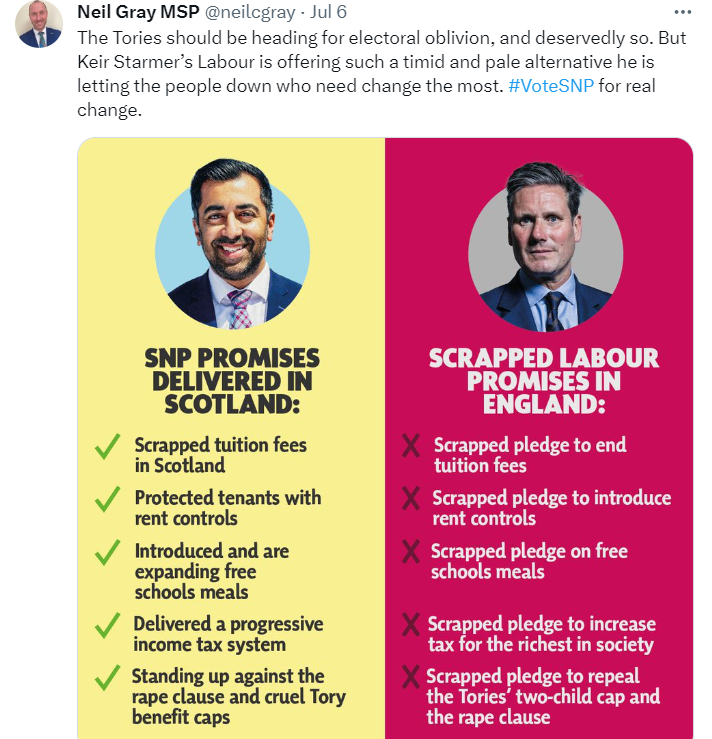
Neil Gray was one of Humza Yousaf's keenest supporters during the leadership race, which presumably meant he strongly shared the view that the SNP should "move down a gear" on independence and scrap Nicola Sturgeon's plan for a de facto referendum.  I've no idea whether he now accepts the logic for the partial U-turn that Yousaf has done since then by devising the so-called "Schrodinger's De Facto", but nevertheless the above screenshot is the perfect illustration of why it would be so foolish for the SNP to sideline independence and try to take on Labour purely on bread and butter matters, which has apparently been the cherished dream for so many Humza-supporting parliamentarians.

What is the messaging here? Labour isn't offering real change on five key policy areas where the SNP have delivered in Scotland, so...vote SNP so that an SNP government can be elected at Westminster to do more of this stuff?  Nope, that doesn't make sense, everyone knows the SNP can't form a government at Westminster and aren't interested in joining a coalition government.  (I distinctly remember having my head practically bitten off at a public event in the Traverse Theatre on the day of the 2015 general election for suggesting that the SNP might or should enter into a formalised deal for governing with Ed Miliband.)  Vote SNP in 2026 because the SNP can form a government at Holyrood and do good things?  Well, fine, but that doesn't answer the question of why anyone should vote SNP for Westminster in 2024.  Vote SNP and we might be able to have a positive influence on government policy from the outside?  Hmmm.  Maybe, but even leaving aside the fact that the SNP holding the balance of power is a long shot (perhaps 1 in 20 at best), you'd need a minority Labour government to take office to have any influence at all, in which case what the hell is the point of the binary-choice SNP v Labour messaging?  It just doesn't make any sense at all, and voters will know that.  They'll say that "it doesn't matter if SNP policies are superior to Labour policies, because at the end of the day Labour can form a government and you can't."  They might also point out that it's a bit daft to put photos of Humza Yousaf and Keir Starmer at the top of an SNP-Labour comparison graphic, given that Yousaf appears to be even less popular with the public than Starmer.

The SNP need an inspirational pitch that can compete with the clarity of Labour's "vote Labour on Thursday, and the Tories will be out of office on Friday".  Fortunately, there is such a pitch available and it goes like this: "Labour offer no change at all.  The real change Scotland needs is independence.  Vote SNP on Thursday to give us a mandate for an independent Scotland, so that on Friday we can start negotiating an independence settlement with the UK Government, and then get on with the job of transforming Scotland with the powers of independence."  Then you can get a hearing for all your wonderful policies on bread and butter matters (assuming they are wonderful policies), because you're putting them strictly in the context of what you would do in an independent Scotland, thus allowing voters to see a credible chain of events meaning that a vote for the SNP in a Westminster election would (or at least could) lead to the desired policies being enacted.

Since 2014, the independence movement has a proud history of finding DIY solutions when the SNP leadership have proved deficient, and I've been increasingly wondering in recent weeks if there is a role for us here.  Being part of the pro-independence alternative media often feels like preaching solely to the converted, which is why I've felt that the most constructive thing I can do for now is try to show to the many SNP members who read this blog that there is strong polling evidence that their party would be doing better if they replaced Humza Yousaf as leader.  It's probably literally true that changing leader would have ten times the positive effect that chapping on a million doors would have.

But we're also in a wholly unfamiliar situation, because the main reason the SNP are on a trajectory that could lead to defeat at the hands of Labour is that independence supporters, and specifically independence supporters who haven't changed their minds about independence, are drifting off to Starmer's party.  Is it just possible that the pro-indy alternative media would have a chance of reaching some of those people and thus having a positive effect?  We never had a hope in hell of persuading die-hard unionists to vote for pro-independence parties, because a) such people don't read our websites, and b) to the limited extent they do read our websites it's mainly to have a good laugh at us.  But independence supporters who used to vote SNP and have only very recently switched to Labour are a very different kettle of fish.  They might well give us a hearing and we might well be able to find arguments that would convince them.  

I doubt if the regular readership of Scot Goes Pop contains many casual independence supporters who are now planning to vote Labour.  But those people may be part of Facebook groups with the more hard-core independence campaigners, or have such campaigners among their friends list on social media.  I've been wondering more and more if I could play a small part by writing a series of articles setting out in concrete terms how Labour are not offering much change from the Tory status quo, how Keir Starmer is patently an untrustworthy and dishonourable man given that he has backtracked on all of the key pledges he made when standing for leader, and how independence rather than Labour offers the only real change.  I would then have to ask readers to share the articles with the Labour-curious independence supporters in their lives, otherwise they would never reach the target audience.  I'm not sure whether it would be best to host those articles on a fresh website to avoid the in-group nature of this blog detracting from the message.

So that's what I'm mulling over for my own part, but what we really need is an all-out, movement-wide effort to engage with switchers to Labour from our own side, to win them back, and to defeat Labour in the general election.  Call it the Yes movement's equivalent of the Manhattan Project - not in the sense of a project trying to blow up Japan or wider human civilisation, but a full-blooded, totally committed push towards a specific objective within a limited period of time.  We probably have around a year or fifteen months until the election, so that's how long we've got to turn things around.  We have the means to do it, but we need to find the will.  I said the other week that one of the semi-iron laws in politics is that divided parties don't win elections - well, another one is that parties or movements that have lost the will to win tend to lose.  Right now, the signs are not good, judging by self-indulgences such as the SNP choosing Yousaf for factional reasons when they knew damn well he was far more unpopular with the public than Kate Forbes, or a minority of supporters of smaller pro-indy parties apparently telling themselves they'll somehow have achieved something important if they 'target' particularly poor SNP MPs and get them replaced by unionist MPs.

Labour can still be defeated in Scotland next year - but only if we find the will.

*  *  *

I launched the Scot Goes Pop fundraiser for 2023 a few weeks ago, and the running total has now passed £2000.  The target figure is £8500, however, so there's still quite some distance to travel.  If you'd like to help Scot Goes Pop continue by making a donation, please click HERE.  Many thanks to everyone who has donated so far.

Monday, July 10, 2023

YouGov poll shows familiar pattern: support for independence holds up within the normal range, but Humza Yousaf's personal approval rating drops further to a deeply worrying *minus 27*

There's a limit to what I can tell you about the new Scottish poll from YouGov, who are always pretty quick to get up the data tables from their GB-wide polls, but as far as I can see haven't done so with this poll yet. Some unionist Twitter accounts are reporting the independence results with Don't Knows excluded as Yes 45% (-2), No 55% (+2), which makes no sense because the previous YouGov poll had Yes on 46% and No on 54%.  So if the headline numbers are comfirmed, it's actually a statistically insignificant one point change, and very much within YouGov's normal range, who are now pretty much the most No-friendly active pollster.  That would be bang in line with other polling firms reporting that Yes support is holding up normally in spite of the SNP's travails. However, I'm not even going to take it as read that the 45-55 split is accurate until we hear that from YouGov - this could turn out to be yet another bogus back-of-the-envelope amateur recalculation.

Labour propagandist Blair McDougall, who famously finished third in East Renfrewshire in 2017 after telling Tory voters they had to vote for him because it was a "two horse race" between himself and the SNP, is today saying that it's "still 45-55", as if polling has remained absolutely steady for the last nine years.  Embarrassingly for him, it turns out that YouGov's fieldwork is actually less recent than the Redfield & Wilton poll showing the gap had closed to Yes 48%, No 52%. In any case, the vast majority of polls in 2023 have shown Yes higher than 45%, and of course no fewer than five of those polls have shown an outright Yes lead.

I'm also concerned to see the STV news website reporting the Yes vote in the poll as being the support for "separation", which is pejorative language that an Ofcom-regulated broadcaster should not be using. They would never dream of describing the No vote as being for "London rule" or "colonialism", so there's no reason for them to apply different rules for the Yes vote.  It would be interesting to know whether they lifted the word direct from a press release, or whether the apparent political bias is in-house.

One thing that doesn't seem to be in dispute about the poll is that Humza Yousaf's net personal approval rating now stands at minus 27, which is a further slight worsening from the minus 25 recorded in April when his leadership was in its infancy.  The number of Don't Knows has dropped significantly since then, which suggests that as more people have seen him and made up their minds about him, they've come to the same negative conclusion as the people who already had a view about him before he became leader.  There's no point in anyone sticking their heads in the sand about this - the severe personal unpopularity of Yousaf represents a crisis for the SNP that must be resolved before the general election.

So far there's no sign of Holyrood and Westminster voting intention numbers, but I'd be very surprised if the poll didn't ask those questions.  I wouldn't be totally startled to see the SNP slip into second place - at the very least it's going to be tight.

*  *  *

I launched the Scot Goes Pop fundraiser for 2023 a few weeks ago, and the running total has now passed £2000.  The target figure is £8500, however, so there's still quite some distance to travel.  If you'd like to help Scot Goes Pop continue by making a donation, please click HERE.  Many thanks to everyone who has donated so far.

Sunday, July 9, 2023

The East Kilbride by-election result is a reminder that any Scottish Tory recovery would be more of a problem for Labour than for anyone else

Judging from the way people were talking about the by-election result in East Kilbride West (not to be confused with West Kilbride East), I thought I was going to be telling you about a calamity of biblical proportions, but actually the result is not quite as bad as it sounded.  It's true that the SNP have dropped from first place to third in the popular vote, but in last year's election the ward was what would be described in first-past-the-post terms as a tight three-way marginal, with the third-placed Tories only trailing the SNP by around eleven percentage points.  So it wasn't necessarily going to take huge swings to change the placings, and the SNP's eight-point drop is certainly not out of line with what the opinion polls would have led us to expect.

East Kilbride West by-election result on first preferences (6th July 2023)

Labour 40.3% (+13.7)
Conservatives 26.3% (+6.3)
SNP 22.6% (-8.3)
Greens 3.8% (n/a)
Independent 2.9% (n/a)
Liberal Democrats 2.4% (+0.3)
Scottish Family Party 1.2% (-0.4)

Nevertheless, on a uniform swing Labour would be ahead nationally by several points based on these changes.  The SNP's national vote tends not to be quite as high in local elections as in Westminster or Holyrood elections, so a Labour lead in local elections wouldn't necessarily translate into a Labour lead in other arenas - but nevertheless I think we have to face the possibility that Labour may already have a slight national advantage over the SNP on Westminster voting intentions.  All of the last three Scottish subsamples from YouGov showed a Labour lead, the most recent Panelbase poll showed a dead heat, and the new Survation and Redfield & Wilton polls show a tiny SNP lead that is well within the standard margin of error.

I remain optimistic that the SNP will ultimately eke out some sort of "win" at the 2026 Holyrood election (although not necessarily one that maintains the overall pro-independence majority in the parliament).  That's because it's very possible that two big changes will have occurred by then - Labour may have entered government in London and then moved into a spell of richly-deserved mid-term unpopularity, and Humza Yousaf may have been replaced as SNP leader by someone who is more popular with the voters.  But as far as next year's Westminster election is concerned, if the SNP want to avert defeat they really need to start from the assumption that they'd be coming from behind to do it - which means "continuity won't cut it", as the saying goes.  They've made a step in the right direction by sort of half-reviving the popular de facto referendum plan, which was always a prerequisite if the independence supporters who have drifted off to Labour were ever going to be tempted back.  But as I keep on saying, the SNP are going to have to address the leadership problem too, and do it before the election.  Either Humza will have to go, or a Unity Cabinet with a much more collective form of leadership will have to be appointed, to demonstrate to the public that the SNP have turned the page on a Sturgeon era that is now associated (rightly or wrongly) with sleaze.  Such a step would also inevitably improve the average quality of the ministerial team and thus help to offset Yousaf's personal unpopularity.

It's worth making the point that although it's not surprising that the SNP vote fell enough in East Kilbride West to slip behind the Tories, what is surprising is that the Tories gained as much as six percentage points themselves.  Remember that since this ward was last contested in May 2022, the Trussmageddon has occurred and the Tories haven't fully recovered from that sequence of events in the polls.  So in local by-elections you'd expect their vote to be slipping back or remaining steady.  If we do see some sort of Scottish Tory recovery going forward, that's very likely to indirectly benefit the SNP in a first-past-the-post general election, because returning Tory voters are far more likely to be coming from Labour than from the SNP.  We've been assuming that a Scottish Tory renaissance would only ever occur on the coat-tails of an English Tory rebound, but of course there's a precedent in 2017 for the Scottish Tories surging while the English Tories fell back (admittedly partly due to the Ruth Davidson Factor, which is now very much a thing of the past).

*  *  *

I launched the Scot Goes Pop fundraiser for 2023 a few weeks ago, and the running total has now passed £2000.  The target figure is £8500, however, so there's still quite some distance to travel.  If you'd like to help Scot Goes Pop continue by making a donation, please click HERE.  Many thanks to everyone who has donated so far.

Friday, July 7, 2023

A few months ago, the press regulator IPSO also upheld a complaint against the Sun on Sunday for lying about the results of a Scottish independence poll

You might remember that a few weeks ago, the "press regulator" IPSO (in reality a self-regulator set up by the press themselves in an attempt to head off calls for proper statutory regulation) upheld my complaint against the Scottish Daily Express for lying about the results of a Scottish independence poll.  However, they perversely allowed the Express to publish a bogus "correction" containing a slightly modified version of the same lie.  I had battled unsuccessfully for months to persuade IPSO to instruct the Express to publish a genuine correction, and the subtext of the responses I received was basically: "But can't you see that the severity of the lie has been reduced a bit?  What more do you expect from us?  Golden elephants?"  Instead of calling themselves a press regulator, IPSO should perhaps be billed as a "Lie Severity Reduction Body (but only if we happen to be in the mood, you understand)".

The reason I had to lodge that complaint myself was that a few weeks earlier I had suggested that Scot Goes Pop readers might want to complain about the Sun on Sunday's lies about another independence poll.  Several readers took up that suggestion, and I think the stress of the complaints process meant that they understandably didn't want to rush into a second complaint when I made a similar suggestion about the Express!  Because the complaints about the Sun on Sunday and the Express were running on a similar timetable, I had intended to write a single blogpost covering the outcome of both complaints - but in the end, the story of my own complaint against the Express was so complex and lengthy that I didn't have space for both.  So here, belatedly, is the story of what happened with the Sun on Sunday complaint.

The lie published by the Sun on Sunday was that support for independence had "plummeted" as a result of the Queen's death.  The drop in support quoted to justify the word "plummet" was seven percentage points from 49% in an earlier Panelbase poll to 42% in a newer Deltapoll survey.  That was a wholly bogus claim, because the two numbers weren't comparable - the 49% from Panelbase was after Don't Knows were excluded, and the 42% from Deltapoll was before Don't Knows were excluded.  A like-for-like comparison between the two polls showed only a statistically insignificant two-point drop, far lower than the Sun on Sunday were suggesting, and not enough to credibly support the word "plummet".  (Of course technically the publication shouldn't even have been making a comparison with a Panelbase poll which used a completely different methodology from the Deltapoll survey - the only meaningful comparison would have been with a previous poll from Deltapoll.)

Now, you might think this is an open and shut case of IPSO's code being breached on the "accuracy" clause.  But I was genuinely unsure whether the complaints would even get over the first hurdle, because IPSO have a track record of heroically "interpreting" their code in such a way as to allow newspapers to say whatever the hell they like about poll results, no matter how misleading.  There was an earlier incident in which a Scot Goes Pop reader had complained about the Daily Record falsely claiming that a poll had shown a drop in support for independence.  To make that claim, the Record were basing their comparison on an earlier poll that they had cherry-picked to suit themselves - it wasn't the most recent poll from the same firm, and it wasn't the most recent poll from any other firm either.  But IPSO's "bouncers" refused to allow the complaint to proceed, on the grounds that the Record were entitled to make a comparison between any two polls they liked.  Just think about the implications of that logic for a moment.  Suppose there was a poll which showed Yes support dropping like a stone from 48% to 39%.  What IPSO are saying, what IPSO are literally saying, is that it would be perfectly OK - and not a breach of the accuracy clause of the code - for The National to report that as a big surge in independence support because there was a previous poll in 2013 showing Yes on 34%.  That's the absurdity of what passes for "press regulation" in the UK.

So I was half-expecting IPSO to dismiss the complaints about the Sun on Sunday on the grounds that newspapers are perfectly entitled, if they wish, to make a bogus comparison between figures including Don't Knows and figures excluding Don't Knows.  But amazingly, it turned out that the Sun on Sunday's lie was a step too far even for IPSO, and the complaints were allowed to proceed.  Because there were multiple complainants, IPSO invoked a procedure whereby one person is selected as the 'lead complainant' and effectively makes decisions on behalf of all complainants from that point on.  It's far from clear how that person is selected.  Is it a random choice?  Is it whoever happened to complain first?  In this case, Stephen Duncan - who occasionally posts here as "Duncanio" - was chosen, which was a good outcome from our point of view because he proved to be a determined complainant who argued his points extremely intelligently.

The Sun on Sunday's initial response to the complaint was to delete the online version of the article and to offer to publish a correction of sorts.  This made it highly likely that the complaint would at least be nominally upheld if Stephen pursued it to the end of the process - but in the Kafkaesque world of IPSO complaints, the whole aim of the Sun on Sunday's concession was to ensure that the complaint was *not* upheld, because if Stephen was coaxed into saying he agreed that the complaint had been resolved to his satisfaction, IPSO would then mark the complaint as closed and effectively treat it as if it had never existed.  There would be no public record of an upheld complaint, or that the Sun on Sunday had been found to be lying.

Fortunately, Stephen didn't play along with that game, and pressed on with his complaint on the basis that the proposed correction was inadequate.  He felt it should have contained an apology, that its offered location was not prominent enough, that it should have made explicitly clear that the comparison was bogus because of the different treatment of Don't Knows, and that it should have made clear that the polls were also not comparable because one of them included 16 and 17 year olds in the sample, and the other did not.  Personally, I also felt that the proposed correction was inaccurate because it claimed that in reality there was a drop in Yes support of between two and four percentage points "depending on assumed variables in the polling".  In fact, the true figure is incalculable because no-one knows what the effect of one of the variables was, ie. the decision of Deltapoll not to interview 16 and 17 year olds.

In a distinct echo of my own complaint against the Express, IPSO's Complaints Committee upheld Stephen's complaint (or "partially upheld" it) but refused to impose any sanction on the publication beyond what had already been done and/or offered.  The need for the correction to refer to the point about 16 and 17 year olds was dismissed with two of the most jaw-dropping sentences you'll ever have the misfortune to read.  Effectively they agreed in every particular with Stephen's line of argument, but then rather optimistically tried to weaponise it against him - 

"It was therefore unclear as to the precise impact that this particular age group, which had been allowed to vote in the Scottish Independence in 2014, had upon the poll’s findings and by extension the accuracy of its comparison to the second poll. Taken in this context, and where readers would understand that a comparison between two different polls, undertaken by two separate organisations, at separate times, under different conditions and employing different methodologies, would have their own limitations, the Committee did not consider that this rendered the article inaccurate or misleading."

The whole point, of course, is that the vast majority of readers would NOT have understood - or not without having it explained to them - that the two polls were conducted by two separate organisations using different methodologies, or the serious implications of that fact.  They would have wrongly assumed that they were being presented with a like-for-like comparison and that the drop in the Yes support being reported was meaningful and accurately measured.  That's precisely WHY the Sun on Sunday's article was so seriously in breach of IPSO's own code (which forbids "misleading" claims as well as outright inaccurate ones), and that's why any Complaints Committee acting in good faith would have instructed the publication to amend their proposed correction accordingly.

You can read the IPSO ruling in its full dismalness HERE.

So we've now had two (or at least two) complaints upheld by IPSO in recent months about newspapers telling lies on Scottish independence polling.  Those might only seem like partial successes, given that IPSO allowed the papers in question to get away with murder in their published corrections (and in one case the Express were even allowed to tell a further lie in their "correction"), but the important point is that those upheld complaints are now a matter of public record.  They demonstrate that it's not some kind of tinfoil hat conspiracy theory to point out that the mainstream media are lying to the public on this topic for partisan reasons.  And if upheld complaints against certain publications become an established pattern, that can begin to seriously detract from the credibility of those publications' reporting.  To give an example, it's well-known that there have been a disproportionately high number of complaints upheld by IPSO against the Jewish Chronicle, and that has undoubtedly led to people taking the Jewish Chronicle's output less seriously.

So I would certainly urge Scot Goes Pop readers to continue complaining to IPSO about the misreporting of independence polls, especially if they spot a lie that is blatant enough that they think there's a chance a complaint will get past IPSO's "bouncers".  I can attest to the fact that seeing a complaint through to its final - and almost inevitably unsatisfactory - conclusion can be very stressful, but it may well pay useful dividends in the long run.

*  *  *

I launched the Scot Goes Pop fundraiser for 2023 a few weeks ago, and the running total has now passed £2000.  The target figure is £8500, however, so there's still quite some distance to travel.  If you'd like to help Scot Goes Pop continue by making a donation, please click HERE.  Many thanks to everyone who has donated so far.

Wednesday, July 5, 2023

Westminster REELS IN SHOCK as support for independence SURGES in new BOMBSHELL Redfield & Wilton poll - but Humza Yousaf's personal popularity slumps again, and the SNP are clinging on to a barely-there lead

Should Scotland be an independent country?  (Redfield & Wilton Strategies, 1st-2nd July 2023)

Yes 48% (+3)
No 52% (-3)

To some extent that's a reversion to the mean, because the 45% in the previous poll for Yes was unusually low, but a three-point jump does give me the opportunity to use the word "surges" in the headline in almost a non-ironic way.  The evidence that independence support is holding up irrespective of what happens to the SNP is now overwhelming - no matter how far the SNP slip, the Yes vote seems to remain in the familiar range, and that's a pattern across all polling firms.  Perhaps even more importantly, this is the second Redfield & Wilton poll in a row to show that a plurality of voters (41% to 40% in this case) want an independence referendum to be held within the next twelve months, providing a timely reminder that the likes of Alex Massie have no factual basis for their repeated claims that Scotland does not want a referendum.

Voters are almost split down the middle on what they think the result of an early independence referendum would be - 38% think Yes would win, and 42% think No would win.  That's potentially significant, because people will be basing their expectations on the views of their friends and families.  There's clearly still a lot of enthusiasm for independence out there, and not just among the members of volunteer online polling panels.

And now to the bad news - away from the independence numbers, this poll makes grim reading for the SNP in general and Humza Yousaf in particular.  The leadership will doubtless point out that the SNP are in the lead on all three ballots (Westminster, Holyrood constituency and Holyrood list) but as in yesterday's Survation poll, that lead is now barely there in all three cases.

Scottish voting intentions for the next UK general election:

SNP 35% (-2)
Labour 32% (+4)
Conservatives 21% (+1)
Liberal Democrats 7% (-2)
Greens 2% (-1)
Reform UK 2% (-1)

Seats projection (with changes from 2019 election): SNP 24 (-24), Labour 22 (+21), Conservatives 8 (+2), Liberal Democrats 5 (+1)

Among the predicted carnage here, Alison Thewliss, Anne McLaughlin, Stewart McDonald, Patrick Grady, David Linden, Tommy Sheppard and Deidre Brock would all be losing their seats, and ironically a big part of the reason for that is the unpopularity of the man most of them pressurised SNP members to install as leader, even though Kate Forbes was clearly far more liked by the public.  Humza Yousaf's net personal rating has slipped back to -10 in this poll, putting him well behind Scottish Labour leader Anas Sarwar (+4) and also behind UK Labour leader Keir Starmer (-1). And although he's ahead of Scottish Tory leader Douglas Ross (-19), it's not exactly the gap of light-years you would customarily expect.

The leadership were clearly thinking on the right strategic lines when they reversed course to some extent by saying they will allow people to vote directly for independence at the general election.  With independence now so much more popular than the SNP (a gap that appears to be growing even further), it plainly makes sense to make a big offer to independence supporters who have drifted off to Labour, and who quite simply have little interest in the SNP unless independence is back on the table.  But it does look like the leadership problem is going to have to be addressed too if the SNP are to have any chance of averting electoral disaster next year.  Either Yousaf will have to go, or he'll have to belatedly swallow his pride and bring Kate Forbes, Ash Regan, and one or two key Forbes supporters into senior positions in a Unity Cabinet with essentially a collective leadership.

One glimmer of light for the SNP is that the net rating for the whole party is -2, which is only very slightly behind Labour's +1.  So there isn't necessarily a mountain to climb if only the leadership problem can be sorted out before the general election.

Scottish Parliament constituency ballot: 

SNP 33% (-3)
Labour 30% (+1)
Conservatives 21% (-)
Liberal Democrats 10% (+2)
Greens 2% (-)
Reform UK 2% (-)
Alba 1% (-)

Scottish Parliament regional list ballot: 

SNP 28% (+3)
Labour 26% (-1)
Conservatives 19% (-)
Liberal Democrats 12% (+2)
Greens 8% (-5)
Reform UK 4% (+2)
Alba 2% (-)

Seats projection (with changes from 2021 election): SNP 40 (-24), Labour 38 (+16), Conservatives 26 (-5), Liberal Democrats 15 (+11), Greens 10 (+2)

Off the top of my head, I can't recall a worse projection than that for the SNP in well over a decade.  40 seats is seven lower than they had when they first took power under Alex Salmond by the slenderest of margins in 2007.  It's possible that they could repeat the trick given that on these numbers they would remain two seats ahead of Labour, but I'm not at all convinced.  The momentum against the SNP would be such that Labour might feel justified in using external support from the Tories to install a Labour-Lib Dem minority coalition government.  An additional problem here is the five-point slump for the Greens on the list vote - we'll have to wait to see whether that's a freak result or the start of a trend caused by the public losing patience with the key role played by Green ministers in some of the Scottish Government's most high-profile failures.  The SNP and Greens in combination are projected to have just 50 seats, far behind the combined total of 79 for unionist parties.

*  *  *

I launched the Scot Goes Pop fundraiser for 2023 a few weeks ago, and the running total has now passed £2000.  The target figure is £8500, however, so there's still quite some distance to travel.  If you'd like to help Scot Goes Pop continue by making a donation, please click HERE.  Many thanks to everyone who has donated so far.

New Survation poll shows independence support continuing to hold up impressively, while the SNP under Yousaf cling on to a precariously slender lead at both Westminster and Holyrood

So let's start with the customary good news - in common with all other recent polls, the new Survation poll shows support for independence holding up well, apparently unaffected by the trials and tribulations of the SNP.  There's a small decrease in the Yes vote from the previous Survation poll, but it's statistically insignificant.

Should Scotland be an independent country? (Survation, 23rd-28th June 2023)

Yes 47% (-1)
No 53% (+1)

As far as party political voting intentions are concerned, I'm not sure this poll really takes us forward on the questions we want answered.  After the recent Panelbase poll showing the SNP level-pegging with Labour on the Westminster ballot, Team Humza must have feared that the next poll would show an outright Labour lead.  That hasn't happened, but the snag is that Survation's results have recently been more favourable to the SNP than we've seen from other firms, and a 3-point SNP lead is in fact the worst result for the SNP in a Survation poll since Yousaf became leader.  So it's perfectly consistent with the trend shown by Panelbase, suggesting that the SNP vote has drifted further downwards over Yousaf's three months in charge.  That could conceivably mean that if other pollsters tested opinion right now, they'd find a small Labour lead or a dead heat.

Scottish voting intentions for the next UK general election:

SNP 37% (-1)
Labour 34% (+3)
Conservatives 17% (-1)
Liberal Democrats 9% (-)

Seats projection (with changes from 2019 election): SNP 26 (-22), Labour 22 (+21), Conservatives 6 (-), Liberal Democrats 5 (+1)

Of course there's the endless argument over whether the SNP are suffering because of Humza Yousaf's unpopularity with the public or because of the police investigation into people associated with the former Sturgeon leadership, but those two concepts are not hermetically sealed from each other.  Part of the problem Yousaf has with the public is that he is seen as Sturgeon's placeman, and so for as long as there is a cloud over her, it's a problem for him and for the SNP as a whole.  That problem can only be solved by fresh leadership, or by a unity team which puts an end to faction-only rule by Team Humza and brings Yousaf's rivals (who in many cases are also Sturgeon-sceptics) into senior positions, thus challenging the public perception that the current leadership is Continuity Sturgeon in all but name.

Scottish Parliament constituency ballot:

SNP 38% (-1)
Labour 33% (+3)
Conservatives 16% (-3)
Liberal Democrats 10% (+1)

Scottish Parliament regional list ballot:

SNP 30% (-2)
Labour 29% (+3)
Conservatives 17% (-2)
Greens 10% (-)
Liberal Democrats 9% (+2)
Reform UK 2% (-)
UKIP 1% (+1)

Seats projection (with changes from 2021 election): SNP 49 (-15), Labour 37 (+15), Conservatives 23 (-8), Greens 10 (+2), Liberal Democrats 10 (+6)

Once again, this poll shows the SNP practically being reduced to the same seat tally they had when they first took power by the skin of their teeth in 2007.  The pro-independence majority at Holyrood would be lost by some distance on these numbers - the SNP and Greens in combination would have 59 seats, and the unionist parties would have 70.

I must just note the weirdness and inconsistency of Survation's treatment of Alba.  In their previous poll in May, they included Alba as an option on both the Westminster and Holyrood list ballots, but this time Alba seem to have been totally excluded across the board - in spite of the fact that Alba took a decent 3% of the list vote in the previous poll, and also in spite of the fact that the obviously less popular UKIP are still being included as an option.  It literally makes no sense, except from a London-centric perspective in which Scotland-only parties are lazily assumed to be of less interest to poll respondents than UK-wide parties, however tiny.

I raised an eyebrow or two yesterday at the claim from one of Somerset's most-read Tory-voting bloggers that Mhairi Black was standing down because she knew she was going to get pumped at the general election, and because she also knew that if she switched to the Scottish Parliament, she would probably get in on the list.  The latter suggestion is curious due to Campbell's repeated vehement claims when he was floating the idea of a "Wings Party" that the SNP couldn't win list seats no matter how many list votes they took.  It's intriguing that he's now tacitly acknowledging that he led people up the garden path on that point.  And his other claim is innumerate, because Mhairi Black's seat is actually one of the 26 the SNP would hold on the above projections.  It would be a close-run thing, within a few percentage points, and any further worsening of the SNP's national position (which is entirely possible) could put the seat in the Labour column.  But the idea that the SNP aren't even in contention in the seat at this stage doesn't stand up to the remotest scrutiny.  The paradox of the claims that Black is deserting a sinking ship is that the SNP would have had a much better chance of holding her seat if she had been the candidate, because she presumably carries with her a small but important personal vote as an unusually well-known incumbent MP.

The criticism that I think can be fairly levelled at Black is over her claim that Westminster is a toxic work environment.  If you believe that, the logical response is to move the SNP decisively into the endgame for independence so that no-one in Scotland has to work in that environment ever again.  Instead, Black is planning a personal solution for herself only by (if the rumours are true) seeking to switch parliaments.  It seems she finds the ongoing prospect of Scotland's involvement in Westminster toxicity perfectly acceptable provided she isn't personally at the heart of it.

*  *  *

I launched the Scot Goes Pop fundraiser for 2023 a few weeks ago, and the running total has now passed £2000.  The target figure is £8500, however, so there's still quite some distance to travel.  If you'd like to help Scot Goes Pop continue by making a donation, please click HERE.  Many thanks to everyone who has donated so far.

Saturday, July 1, 2023

The incompatibility between NATO membership and signing the treaty banning nuclear weapons is actually a golden opportunity for the SNP to get themselves off the NATO hook

It's not often that one of the unionist usual suspects on Twitter makes me grudgingly say "good point", but that happened a week or two back when it was pointed out that Humza Yousaf was using coded language to shield anti-nuclear Yes supporters from the fact that the SNP government do not intend that an independent Scotland should sign the Treaty on the Prohibition of Nuclear Weapons.  He apparently said that Scotland would join NATO on the same basis that Finland recently joined - which is indirectly getting at the fact that Finland started opposing the treaty in line with NATO wishes, having previously abstained in the relevant UN votes.  

It was also suggested (and I don't know whether this is true or not) that Alyn Smith attacked the treaty more directly, saying "a piece of paper isnae going to keep us safe".  If so, and just as an aside, could I appeal to all politicians and political activists to stop abusing our wonderfully expressive Scots language by only switching to it when they want to make a particularly stupid point that they know they can't justify through rational argument.  It's like: "How do we bypass the voters' adult intelligence to win us a hearing on this one?  I know, let's switch to Scots, and then they'll all revert to childhood."

My own view is that the existence of the relatively new treaty is a golden opportunity for the SNP to get out of the mess of trying to oppose nuclear weapons and support NATO membership simultaneously, which is practically a contradiction in terms given that NATO largely exists to extend the so-called American nuclear "deterrent" to European countries who join up.  The SNP was traditionally anti-NATO to maintain consistency with the anti-nuclear policy, but got cold feet in the run-up to the 2014 referendum due to polls showing overwhelming support for NATO membership.  But here's the thing - polls also now show substantial support for the nuclear ban treaty.  I asked that question myself in one of the polls I commissioned for Scot Goes Pop - 

Scot Goes Pop / Panelbase poll, 21st-26th April 2021:

Nuclear weapons were banned by an international treaty that came into force in January this year.  However, the nine countries that are currently believed to possess nuclear weapons, including the UK, have so far refused to sign the treaty. Do you think the UK should join the treaty and dismantle its nuclear weapons?  

Yes: 47%
No: 33%

With Don't Knows removed -

Yes 59%
No 41%

If the public start to understand that there's an either/or choice here, and that they can't have both the things they want (ie. NATO membership and signing the treaty) they might start to be a bit more forgiving towards a political party or government that rejects NATO membership for the specific reason that it wants to join the treaty.  It would be interesting to see a poll in which a straight choice is presented to respondents to see what they regard as more important.  If I ever commission another poll in the future, I might ask that question (assuming no-one does it before me).

*  *  *

I launched the Scot Goes Pop fundraiser for 2023 a few weeks ago, and the running total has now passed £1800.  The target figure is £8500, however, so there's still quite some distance to travel.  If you'd like to help Scot Goes Pop continue by making a donation, please click HERE.  Many thanks to everyone who has donated so far.